Trochanteric and subtrochanteric hip fracture: AO 31A, stability, nail or sliding hip screw
On this page
MIROTECA medical team · Reviewed 23 Nov 2026 · 5 min read
Up to 60% of hip fractures in older adults. It is well-vascularised cancellous bone: a mechanical rather than biological problem, so union rarely fails. 60% are unstable1.
20.5 mmlateral wall: below it is incompetent (AO 31A2)3
Must know
What matters most for treatment and prognosis is intracapsular versus extracapsular1.
Unstable: reverse oblique, transtrochanteric, a large posteromedial fragment with a broken calcar and subtrochanteric extension. A small lesser trochanter fragment does not make it unstable1.
If the lateral wall is broken (intertrochanteric, reverse oblique), avoid the sliding hip screw: it fails often1.
Head screw centre-centre on both views and less than 25 mm from the apex1.
There is no evidence supporting preoperative skin traction1.
Anatomy and classification
They involve the trochanteric mass: intertrochanteric or subtrochanteric (between the lesser trochanter and where the shaft becomes cylindrical). They are stable or unstable depending on whether medial and posterior cortical contact remains after reduction1.
Boyd-Griffin: I undisplaced and stable (21%); II stable with little comminution (31%); III large comminuted posteromedial area (28%); IV intertrochanteric and subtrochanteric (15%)1.
For AO, the proximal segment (31) ends at the inferior border of the lesser trochanter; below it is the shaft (32)3.
Publicidad
Presentation
A fall from standing height in older adults; high energy in the young. A shortened, externally rotated leg, although not always. AP and lateral hip X-rays1.
Treatment
Closed reduction on a traction table and fixation with a sliding hip screw or an intramedullary nail. Principles do not change much with age1.
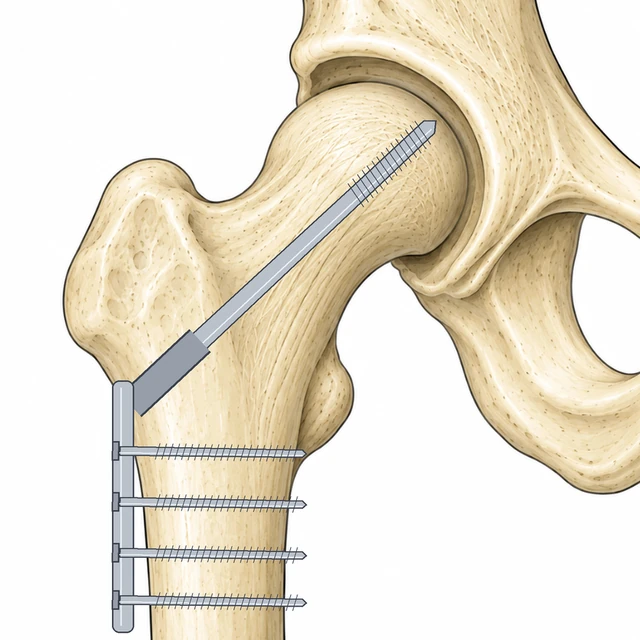
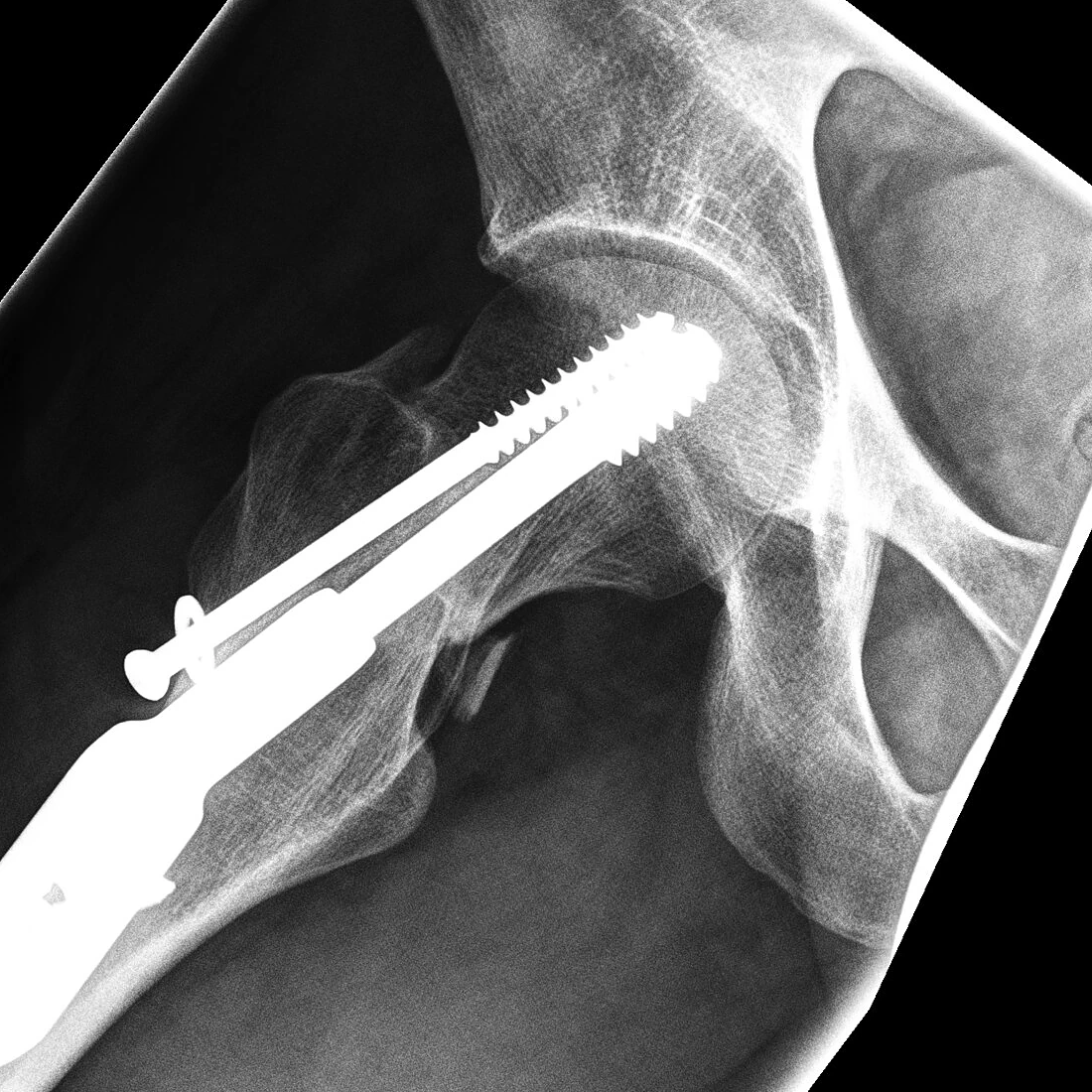
Drawing of a sliding hip screw and a real X-ray of one in place1.
Sliding hip screw (DHS)
Diagram (MIROTECA) and a real X-ray of each treatment; tap the X-ray to enlarge it. The X-ray shows the implant, not always the same fracture.
Complications
Fixation failure (cut-out)
Prevented by a centre-centre screw and tip-apex distance < 25 mm1.
Femoral fracture with the nail
With older Gamma nails there were more femoral fractures and reoperations than with the sliding hip screw4.
Mortality and dependence
As with any hip fracture in older adults: up to 30% mortality in the first year and half do not regain previous function1.
SECOT, NICE and Cochrane
Sources differ: SECOT generally recommends the intramedullary nail for its biomechanical advantages, leaving the sliding hip screw for stable or minimally displaced fractures1; NICE prefers the sliding hip screw for trochanteric fractures above the lesser trochanter (except reverse oblique) and the nail for subtrochanteric fractures2, in line with Cochrane4.
Key studies
Each card summarises the abstract of the study, with its link.
Cochrane: clavo frente a tornillo-placaSystematic review: 43 trials
Patients
Mainly older adults with trochanteric fractures
Result
The Gamma nail had more femoral fractures and reoperations than the sliding hip screw; no major differences in infection, mortality or medical complications. With newer nails (PFN), no differences.
What it means
Sliding hip screw for trochanteric fractures; nails may be better for subtrochanteric and unstable ones.