Odontoid fracture: Anderson-D'Alonzo, type II in older adults and treatment
On this page
MIROTECA medical team · Reviewed 23 Nov 2026 · 5 min read
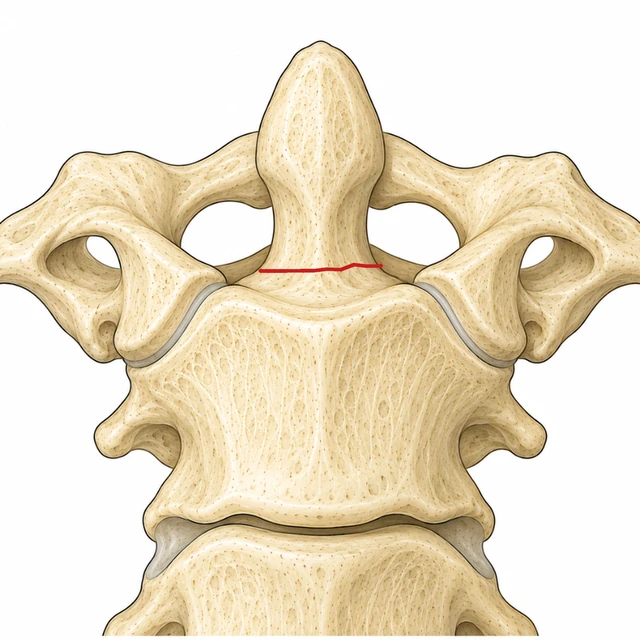
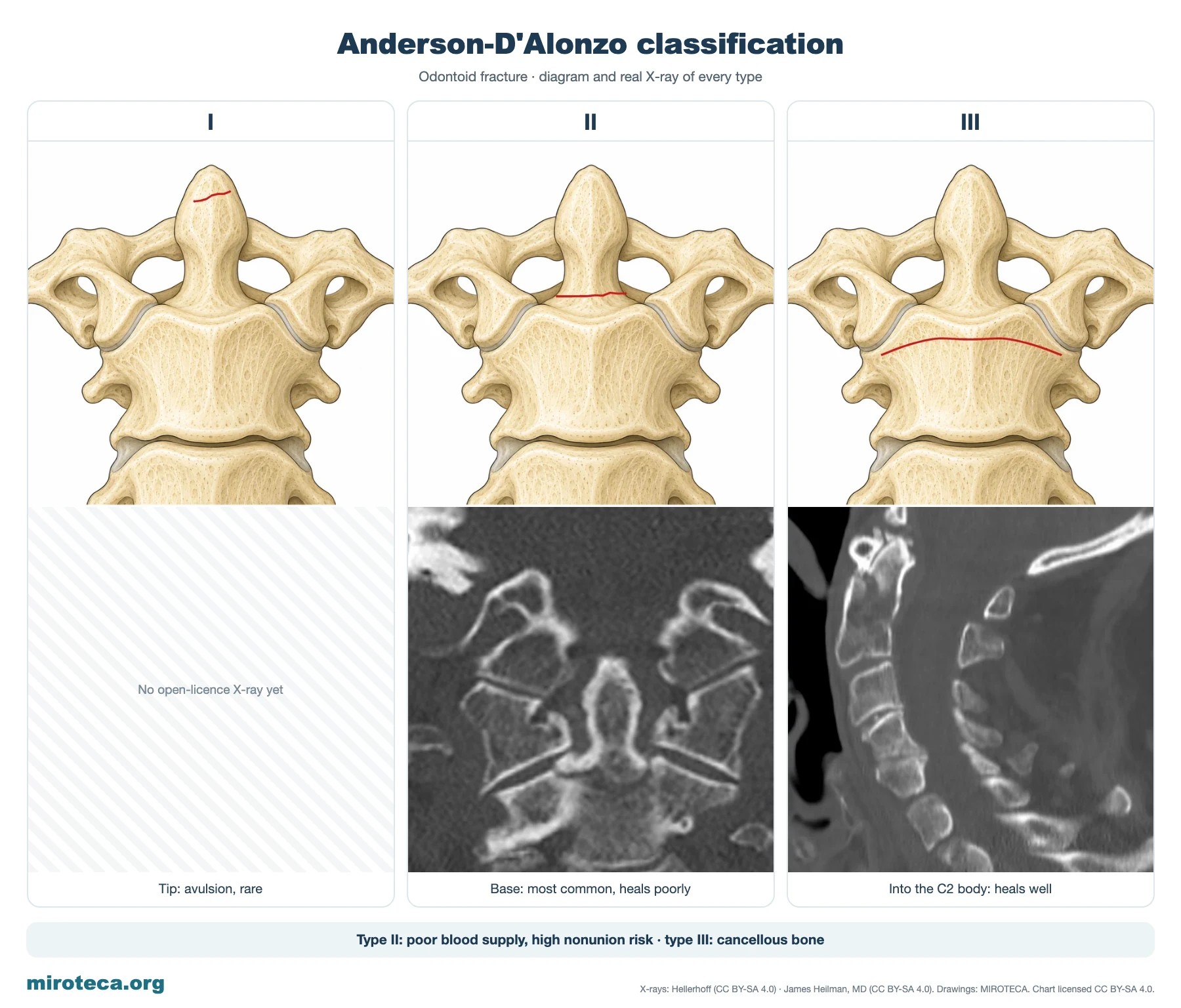
10-15% of cervical fractures. Type II, at the base of the dens, is the most common, unstable and has a high nonunion rate; in older adults C1-C2 fusion is favoured1.
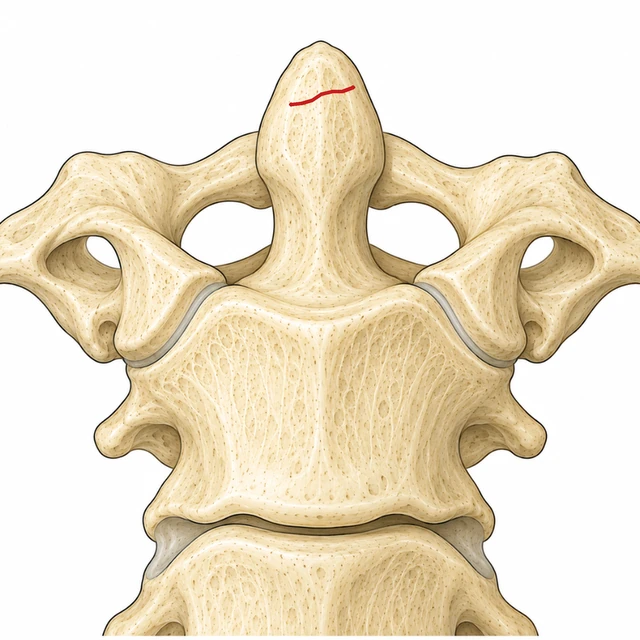
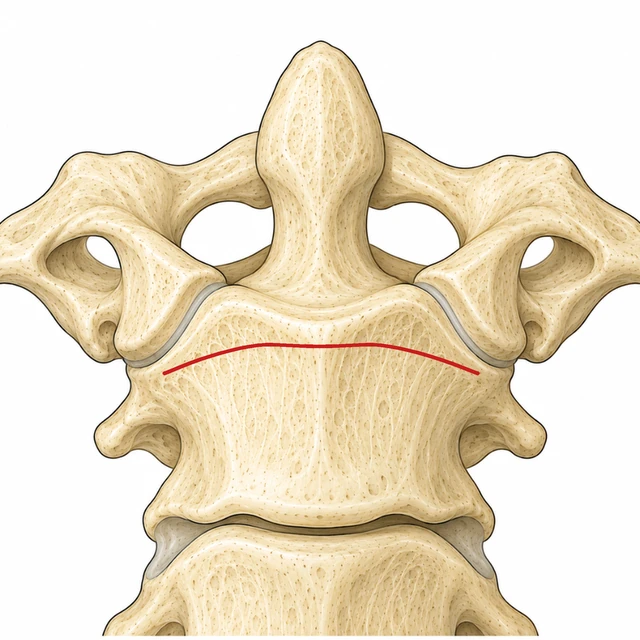
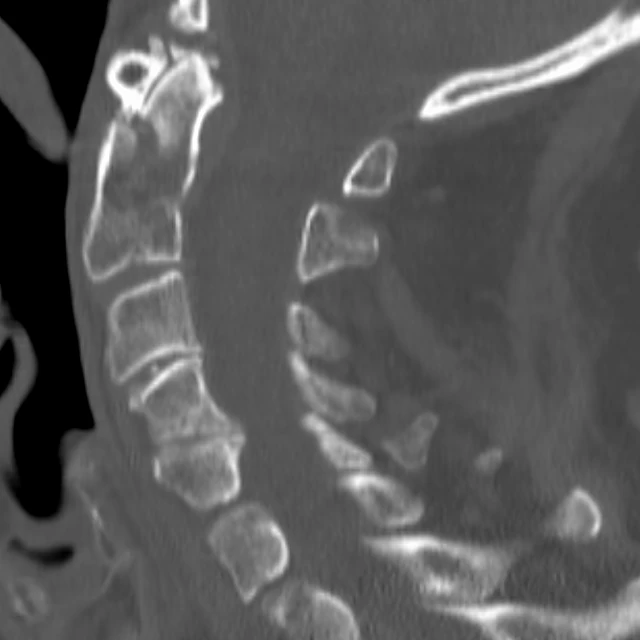
Type I: alar ligament avulsion, rare and stable. Type II: base of the dens, unstable. Type III: extends into the C2 body and heals well without surgery1.
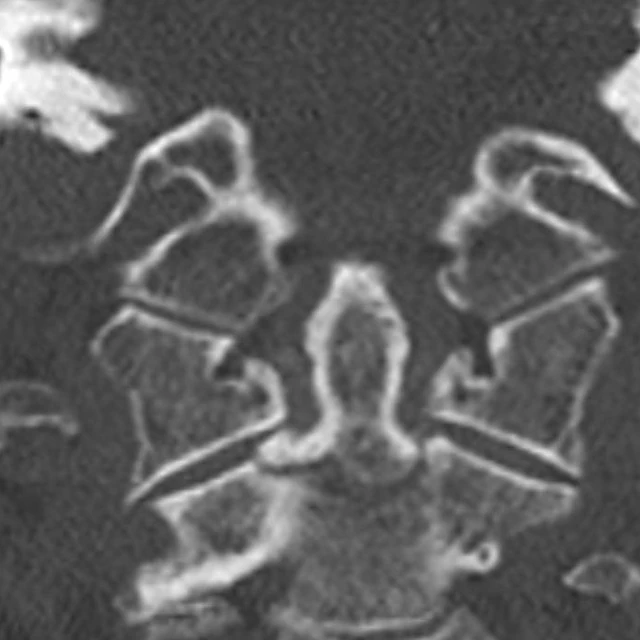
CT is the most useful test in the upper cervical spine; MRI assesses ligaments and retropharyngeal haematoma1.
Type II in older adults: SECOT prefers C1-C2 fusion; if not a candidate, a rigid orthosis or halo1.
Type II in young patients: undisplaced, halo for 6-12 weeks; displaced or comminuted, an odontoid screw or fusion1.
AANS/CNS advises considering surgery for type II from age 503.
Upper cervical spine
The atlas (C1) and axis (C2) form the upper craniocervical region: a lot of movement close to vital neural structures; road traffic accidents cause up to 45% of these fractures1. The transverse ligament is the key C1-C2 stabiliser: combined lateral mass overhang > 7 mm or an atlanto-dens interval > 5 mm in flexion suggests its rupture1.
X-rays from Wikimedia Commons and open-access articles (PubMed Central) under open licences, with author and licence on each; they are not owned by MIROTECA.
Spinal fractures have no code in the AO/OTA long-bone compendium: they are classified with the AO Spine systems.
Publicidad
Other C1 and C2 injuries
Jefferson (atlas burst): stable, rigid collar for 8-12 weeks; displaced > 7 mm, halo traction and halo vest; unstable or late, C1-C2 or occipitocervical fusion1.
Hangman's fracture (traumatic C2 spondylolisthesis, Levine-Edwards): I collar; II traction and halo; IIA halo without traction; III open reduction and fixation1.
Treatment
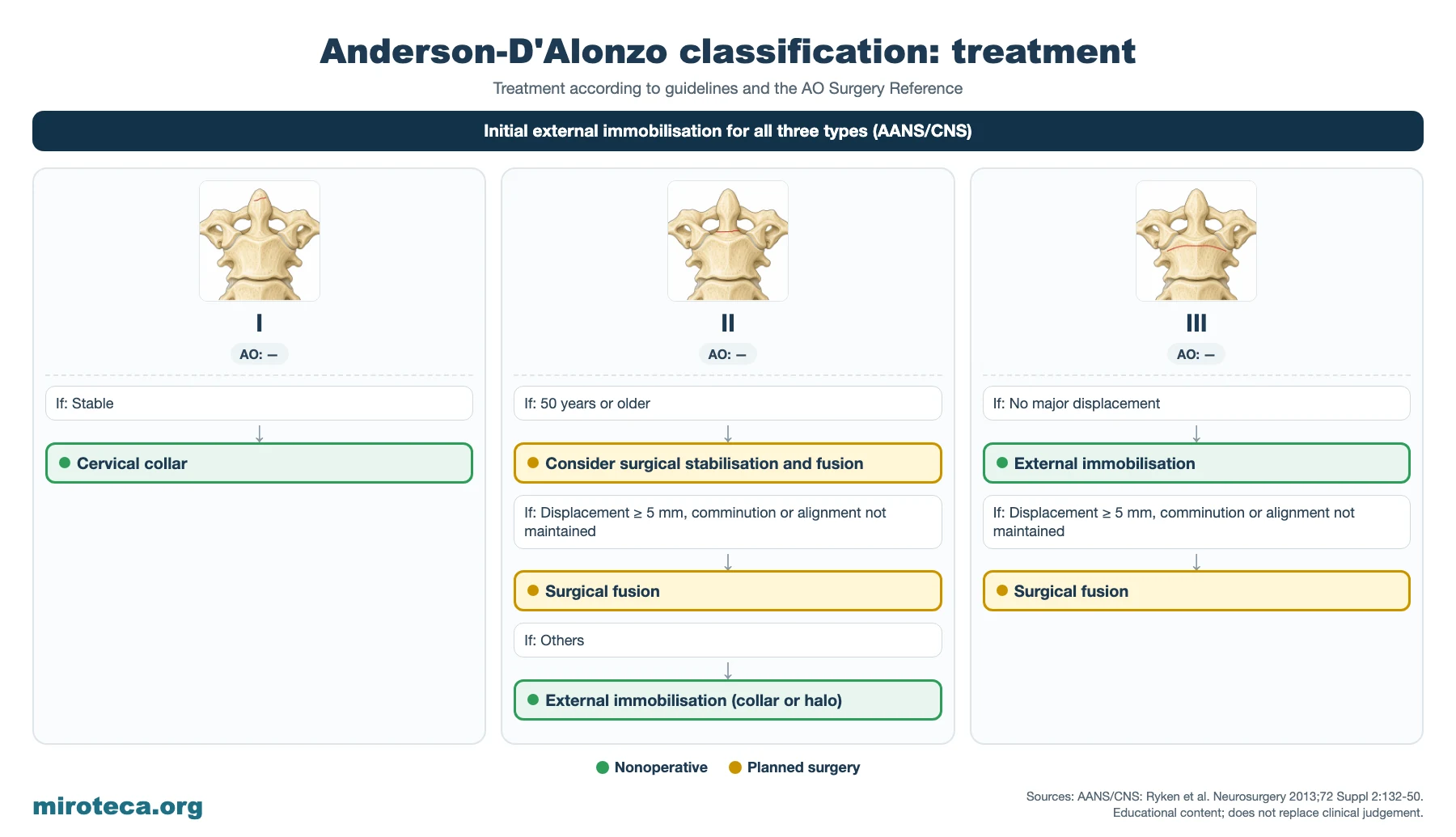
Simplified algorithm by type. Open it to see each type with its X-ray. Interactive version →
General principles
Type I: rigid collar.
Type II, older adult: C1-C2 fusion (if not a candidate, rigid orthosis or halo); young: halo for 6-12 weeks if undisplaced, odontoid screw or fusion if displaced.
Type III: orthosis or halo, healing well in 8-12 weeks; watch for translation or angulation1.
Complications
Nonunion
High in type II1; in older adults, 21% without surgery vs 5% with surgery2.
Mortality
18% at one year in older adults with type II in the AOSpine study2.
Key studies
Each card summarises the abstract of the study, with its link.
AOSpine: tipo II en mayores de 65Prospective multicentre cohort, non-randomised
Patients
159 patients aged 65 or over with type II fracture (101 operated, 58 not)
Result
At one year, better NDI and less pain with surgery; nonunion 5% vs 21%; similar complications; annual mortality 14% with surgery and 26% without (p = 0.059).
What it means
Consider surgical stabilisation in older adults fit for general anaesthesia.
An independent 82-year-old woman with a fracture at the base of the dens after a fall. Which type, and what does SECOT prefer if she is fit for surgery?
The base of the dens is type II; in older adults C1-C2 fusion is preferred.
Show the answer
Type II; C1-C2 fusion. The base of the dens is type II; in older adults C1-C2 fusion is preferred.
Which Anderson-D'Alonzo type heals well with an orthosis or halo?
Type III extends into the C2 body, with more cancellous surface.
Show the answer
Type III. Type III extends into the C2 body, with more cancellous surface.