Skip to content

Open fracture: Gustilo-Anderson, Tscherne, antibiotics, debridement and cover

On this page

MIROTECA medical team · Reviewed 23 Nov 2026 · 5 min read

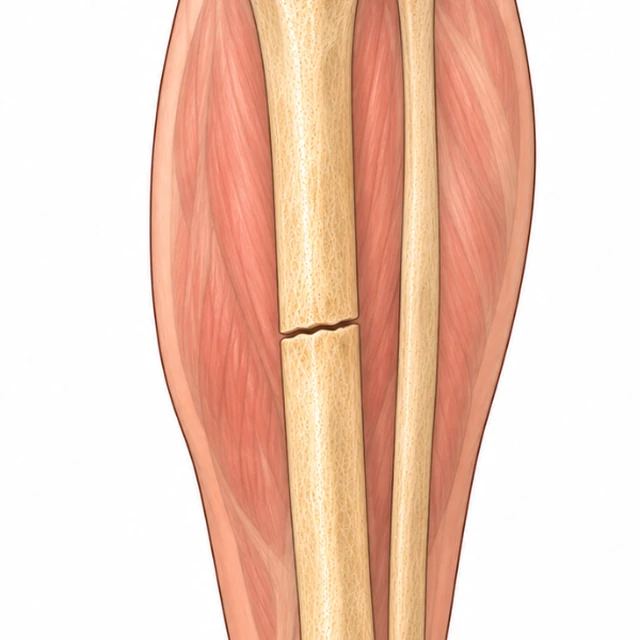
The fracture communicates with the outside. The risk is infection: IV antibiotics as soon as possible, tetanus prophylaxis, debridement, stabilisation and soft-tissue cover within 72 hours12.

Key points

1 hIV antibiotics, ideally1
≤ 72 hantibiotics and definitive cover1
NNT 13antibiotics prevent early infections4
42%amputations in type IIIC (1984 series)5

Must know

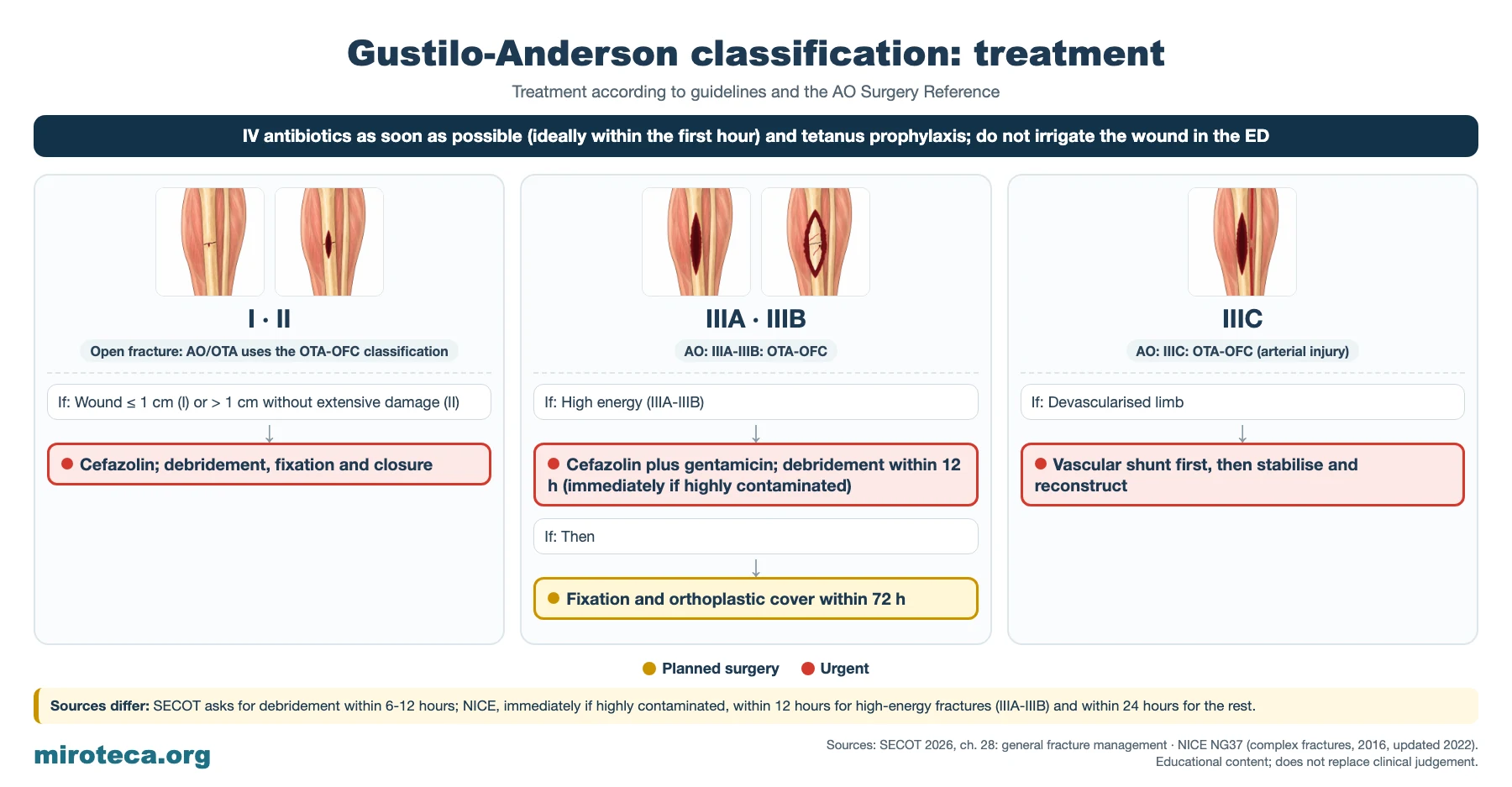
  • Antibiotics: types I-II, cefazolin 2 g every 8 h; type III, cefazolin plus single-dose gentamicin 5 mg/kg, adding metronidazole if anaerobes are a risk; until definitive closure or 72 h at most1.
  • Do not irrigate open fractures of long bones, hindfoot or midfoot in the ED or before theatre; saline-soaked dressing with an occlusive layer2.
  • Photograph the wound when first exposed and keep it in the record, so it is not uncovered repeatedly2.
  • Debridement, fixation and cover are done together by orthopaedic and plastic surgeons (orthoplastic approach)2.
  • Antibiotics reduce early infection: 13 patients need treating to prevent one infection4.

Gustilo-Anderson and Tscherne

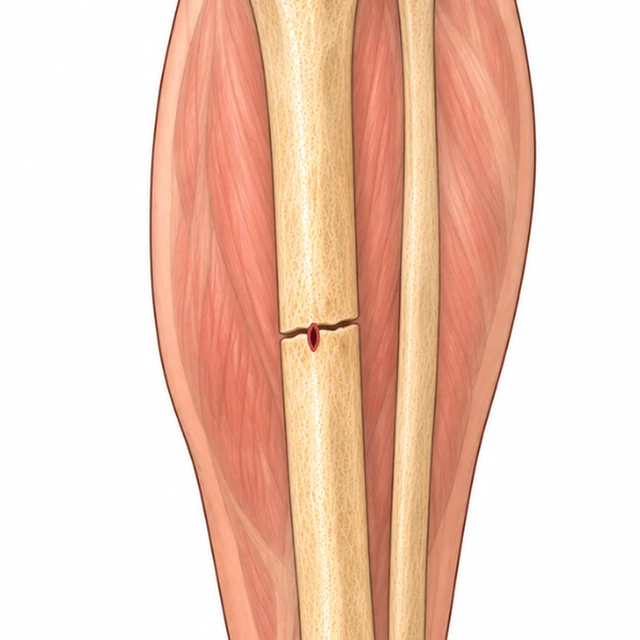
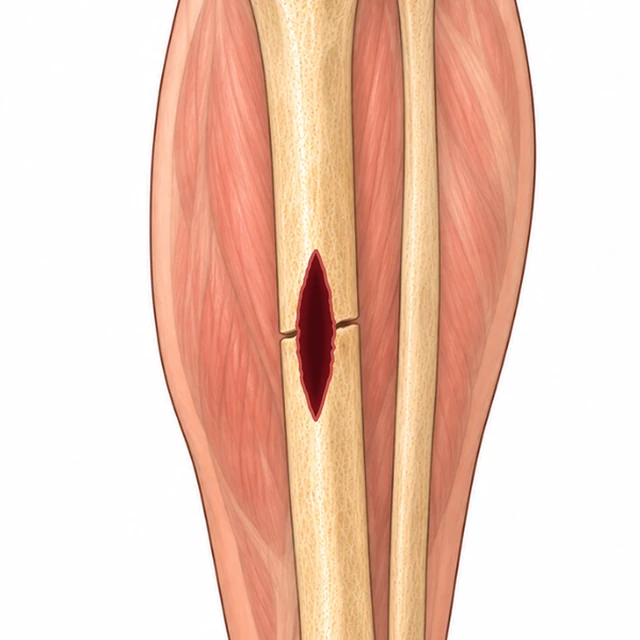
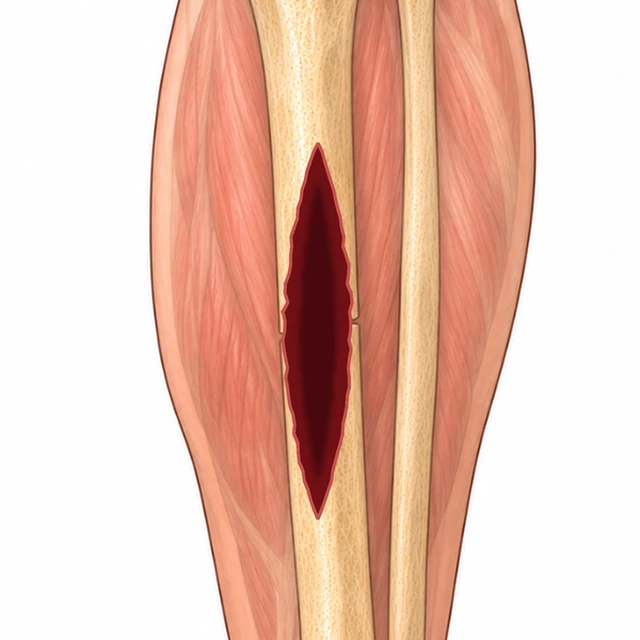
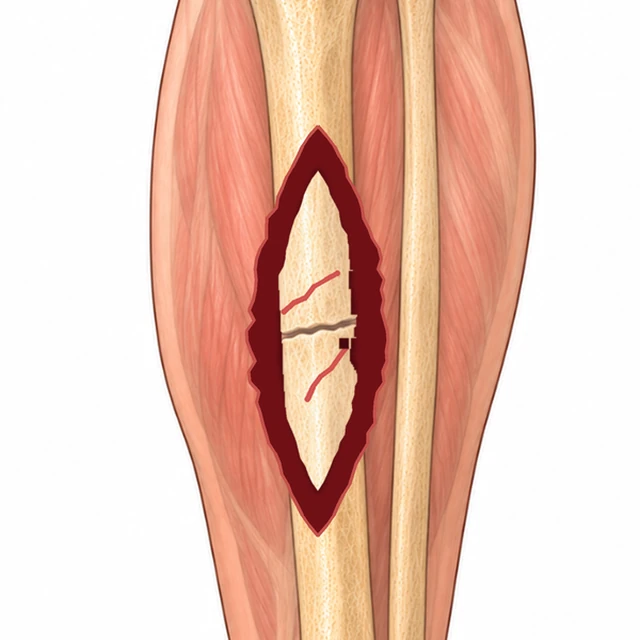
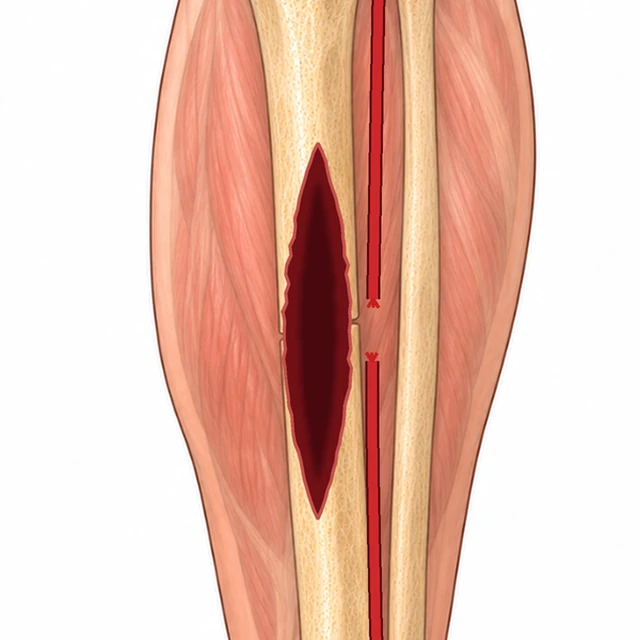
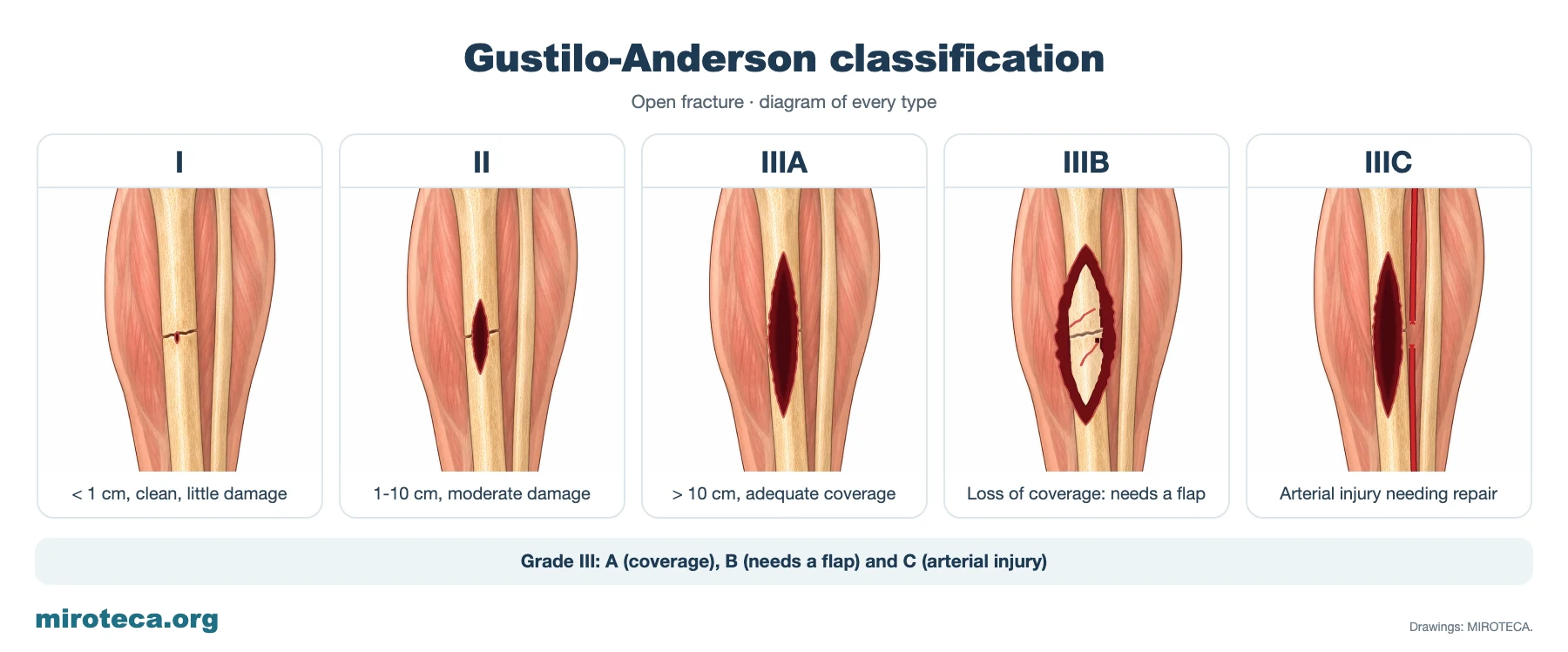
  • Gustilo I: wound < 1 cm, minimal contamination. II: > 1 cm without extensive damage. IIIA: severe damage with adequate cover. IIIB: loss of cover requiring plastic reconstruction. IIIC: vascular injury1.
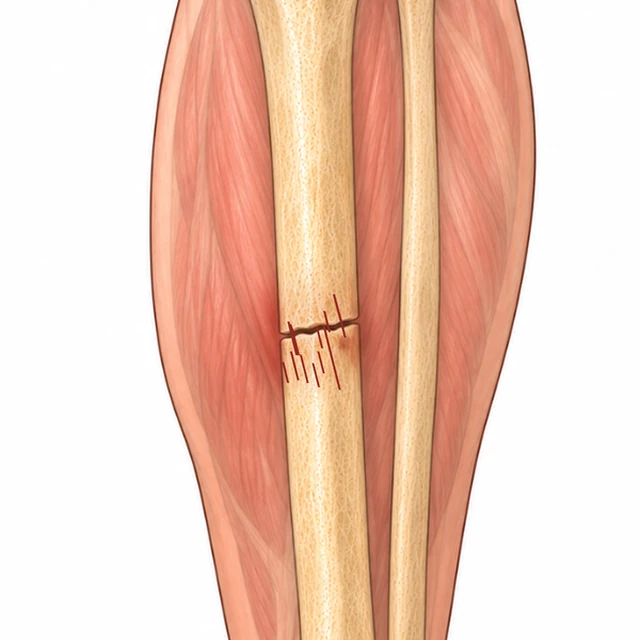
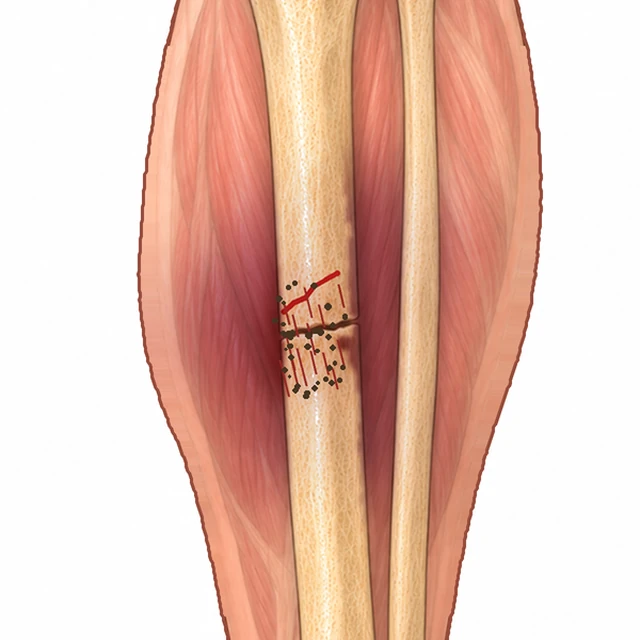
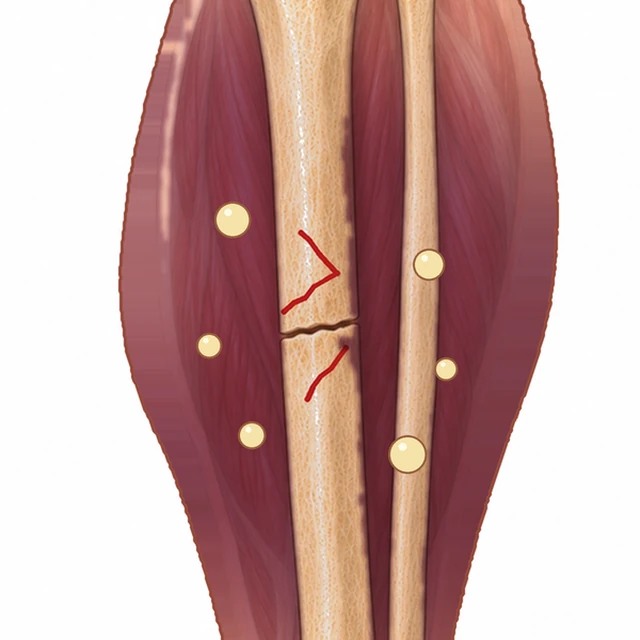
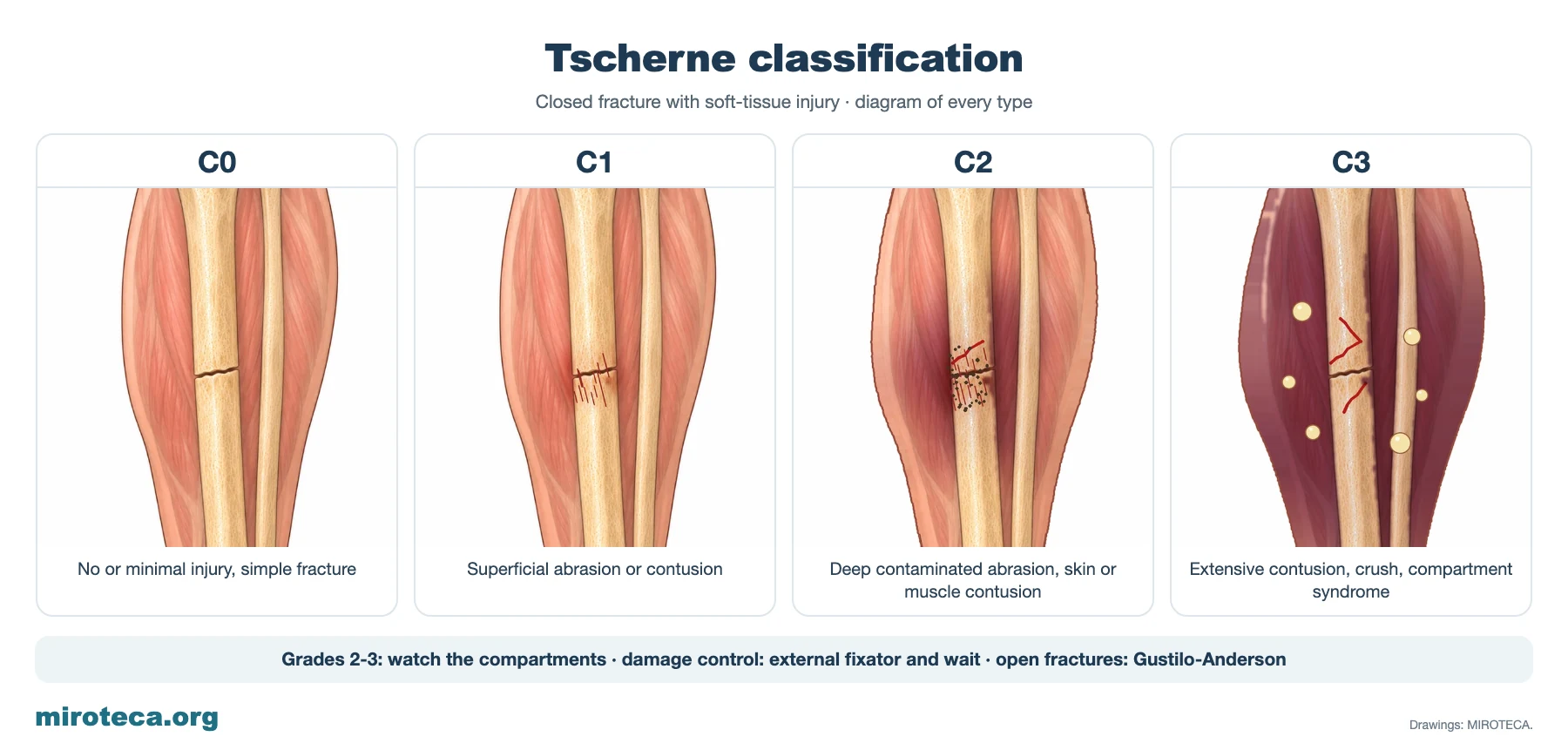
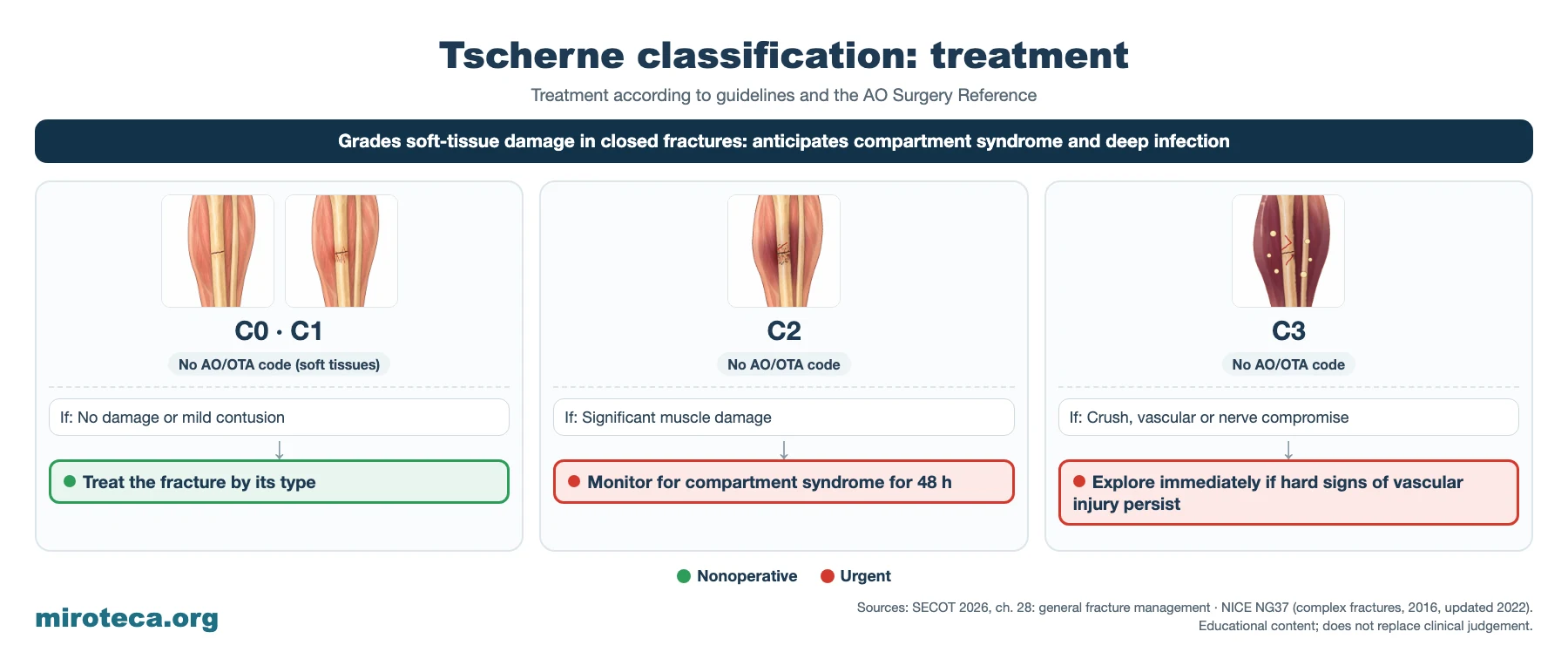
  • Tscherne (closed fractures): 0 no damage; I mild contusion; II significant muscle damage; III crush or vascular or nerve compromise1.

Classifications

Gustilo-Anderson classification

Full classification chart →

  • IGustilo-Anderson classification: I (< 1 cm, clean, little damage)< 1 cm, clean, little damage
  • IIGustilo-Anderson classification: II (1-10 cm, moderate damage)1-10 cm, moderate damage
  • IIIAGustilo-Anderson classification: IIIA (> 10 cm, adequate coverage)> 10 cm, adequate coverage
  • IIIBGustilo-Anderson classification: IIIB (loss of coverage: needs a flap)Loss of coverage: needs a flap
  • IIICGustilo-Anderson classification: IIIC (arterial injury needing repair)Arterial injury needing repair
Gustilo-Anderson classification: Full diagram of every typeFull diagram of every typeView, download and share (CC BY-SA) →Gustilo-Anderson classification: treatment chart according to guidelinesTreatment chart according to guidelinesAge and patient data → treatment, with AO codes and sources →

Tscherne classification

Full classification chart →

  • C0Tscherne classification: C0 (no or minimal injury, simple fracture)No or minimal injury, simple fracture
  • C1Tscherne classification: C1 (superficial abrasion or contusion)Superficial abrasion or contusion
  • C2Tscherne classification: C2 (deep contaminated abrasion, skin or muscle contusion)Deep contaminated abrasion, skin or muscle contusion
  • C3Tscherne classification: C3 (extensive contusion, crush, compartment syndrome)Extensive contusion, crush, compartment syndrome
Tscherne classification: Full diagram of every typeFull diagram of every typeView, download and share (CC BY-SA) →Tscherne classification: treatment chart according to guidelinesTreatment chart according to guidelinesAge and patient data → treatment, with AO codes and sources →

AO/OTA open fracture classification (OTA-OFC)3

PielSkin
1Edges that approximate
2Edges that do not approximate
3With extensive degloving
MúsculoMuscle
1No appreciable necrosis; function intact
2Localised loss, still functional
3Dead or non-functioning muscle, defect that does not approximate
ArteriaArtery
1No major vessel disruption
2Vessel injury without distal ischaemia
3Vessel injury with distal ischaemia
ContaminaciónContamination
1None or minimal
2Surface
3Embedded in bone or deep tissue, or high-risk setting
HuesoBone loss
1None
2Missing or devitalised fragments, with contact
3Segmental loss

OTA developed it to overcome the limitations of Gustilo-Anderson; it is scored at the first debridement3.

Publicidad

In the emergency department

  • Immediate IV antibiotics if not already given2.
  • Tetanus prophylaxis according to the patient's schedule1.
  • Saline dressing with an occlusive layer, no irrigation; photograph the wound2.
  • If hard signs of vascular injury persist after realigning the limb, immediate surgical exploration; do not delay revascularisation for angiography; in a devascularised limb, a vascular shunt before stabilisation2.
  • In tibial fractures, watch for compartment syndrome for 48 hours2.

Treatment

Open fracture: treatment algorithm
Simplified algorithm by type. Open it to see each type with its X-ray. Interactive version →

General principles

Debridement: SECOT asks for it within 6-12 hours1; NICE, immediately if highly contaminated, within 12 hours for high-energy fractures (likely IIIA or IIIB) and within 24 hours for the rest2.

Fixation and cover: temporary (external) or definitive fixation1; if possible, definitive fixation and cover at the time of debridement or, if not, within 72 hours; with internal fixation, cover at the same time2.

Complications

Infection and osteomyelitis

In the 1984 series, wound infection 4% in IIIA, 52% in IIIB and 42% in IIIC5.

Amputation

0% in IIIA, 16% in IIIB and 42% in IIIC in that series5.

Compartment syndrome

Monitor for 48 hours in tibial fractures2.

Delayed union and nonunion

12 of the 75 patients with type III fractures in the 1984 series5.

SECOT and NICE: timings

Sources differ: SECOT asks for debridement within 6-12 hours1; NICE sets times by contamination and energy (immediate, 12 or 24 hours)2. Both agree on early antibiotics and cover within 72 hours.

Key studies

Each card summarises the abstract of the study, with its link.

Gustilo-Anderson (1976)Retrospective and prospective analysis
Patients
1,025 open long-bone fractures
Result
With debridement, irrigation, cultures and antibiotics, infection fell to 2.5%; in type III it was 44% retrospectively and 9% prospectively. Proposes a cephalosporin for prophylaxis.
What it means
Origin of the classification and of routine antibiotics.

Limitation
Historical series.

J Bone Joint Surg Am 1976;58:453-8 · PubMed 773941

Subtipos IIIA-IIIC (1984)Single-centre series
Patients
87 type III open fractures
Result
Splits type III into IIIA, IIIB and IIIC by prognosis. 77% of infections were Gram-negative: recommends adding an aminoglycoside in type III.
What it means
Explains gentamicin in type III.
Limitation
Small, old series.

J Trauma 1984;24:742-6 · PubMed 6471139

Cochrane: antibióticoSystematic review: 7 studies, 913 participants
Patients
Open limb fractures
Result
Antibiotics reduced early infection (RR 0.41; NNT 13).
What it means
Further placebo trials are not justified in middle- and high-income countries.
Limitation
Insufficient data for other outcomes.

Cochrane Database Syst Rev 2004;CD003764 · PubMed 14974035

Exam-style questions

Open tibial fracture with exposed bone that will need a flap, no arterial injury. Which Gustilo type?

Show the answer

IIIB. IIIB: loss of cover requiring plastic reconstruction.

Which antibiotic is given for a type III open fracture per SECOT?

Show the answer

Cefazolin plus gentamicin. Type III: cefazolin plus gentamicin; metronidazole if anaerobes are a risk.

Practise classifying real X-rays →

See also

Sources

  1. SECOT. Spanish Orthopaedic Resident Manual 2026, chapter 28: general fracture management and complications.
  2. NICE NG37. Fractures (complex): assessment and management (2016, updated 2022).
  3. AO/OTA. 2018 compendium: open fracture classification (OTA-OFC).
  4. Gosselin RA et al. Cochrane Database Syst Rev 2004;CD003764.
  5. Gustilo RB et al. J Trauma 1984;24:742-6.
  6. Gustilo RB, Anderson JT. J Bone Joint Surg Am 1976;58:453-8.

MIROTECA medical team. Educational content; it does not replace clinical judgement.