
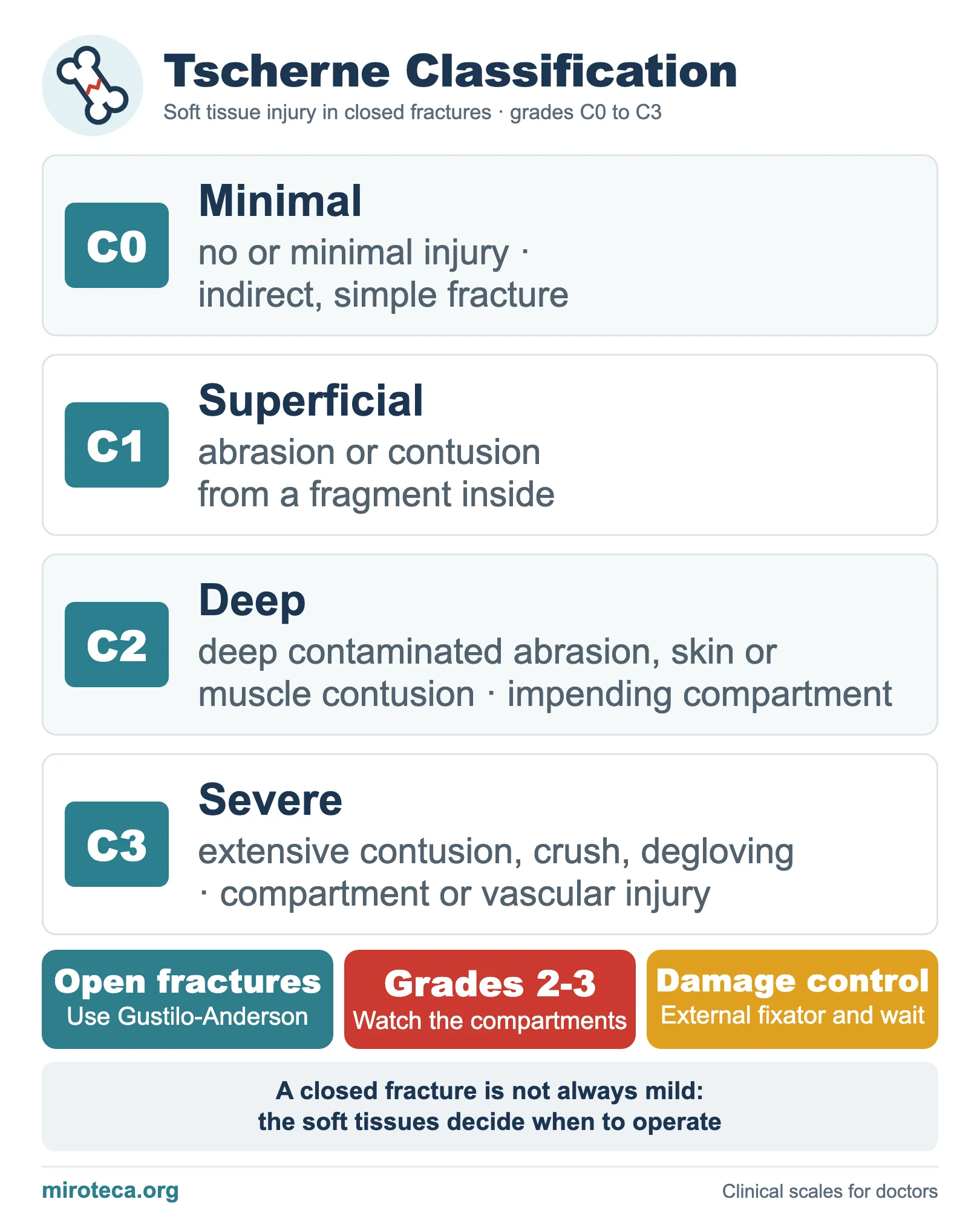
What the chart shows
The Tscherne classification (Tscherne and Oestern, 1982) grades the soft tissue damage around a fracture. It is used mainly for closed fractures, complementing Gustilo-Anderson, which is used for open fractures. Skin and muscle condition decides when and how to operate.
The detail that settles it
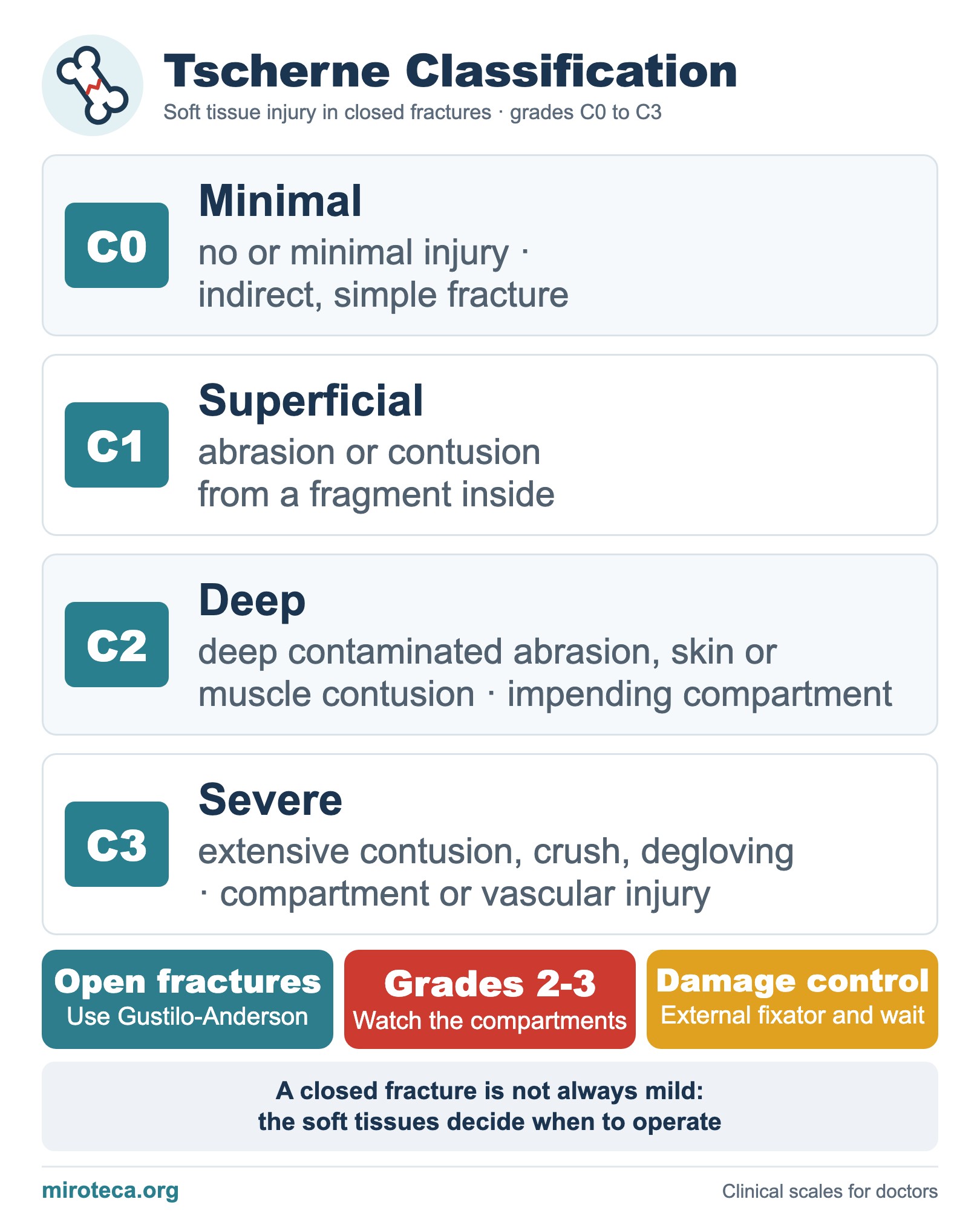
Grade 0 is minimal injury from an indirect mechanism; grade 1 a superficial abrasion or contusion from a fragment pressing from inside; grade 2 a deep contaminated abrasion with skin or muscle contusion and impending compartment syndrome; grade 3 extensive contusion, crush, degloving, established compartment syndrome or major vascular injury.
In exam questions
A closed fracture is not necessarily a mild one. Pain out of proportion and pain with passive stretch are early signs of compartment syndrome; loss of pulse is late. Severe soft tissue injury is often managed with an external fixator first (damage control). Interobserver agreement is only moderate.
Keep practicing
This page is the visual summary. To test yourself with real clinical reasoning, Medicinedle, a Wordle-inspired game, gives you one clinical case a day: guess the diagnosis in six tries, with a new clue after every miss. It is free.
Prefer quick questions? The clinical scores quiz gives you 5 case-based questions in about a minute, with the answer explained.