
What the diagram shows
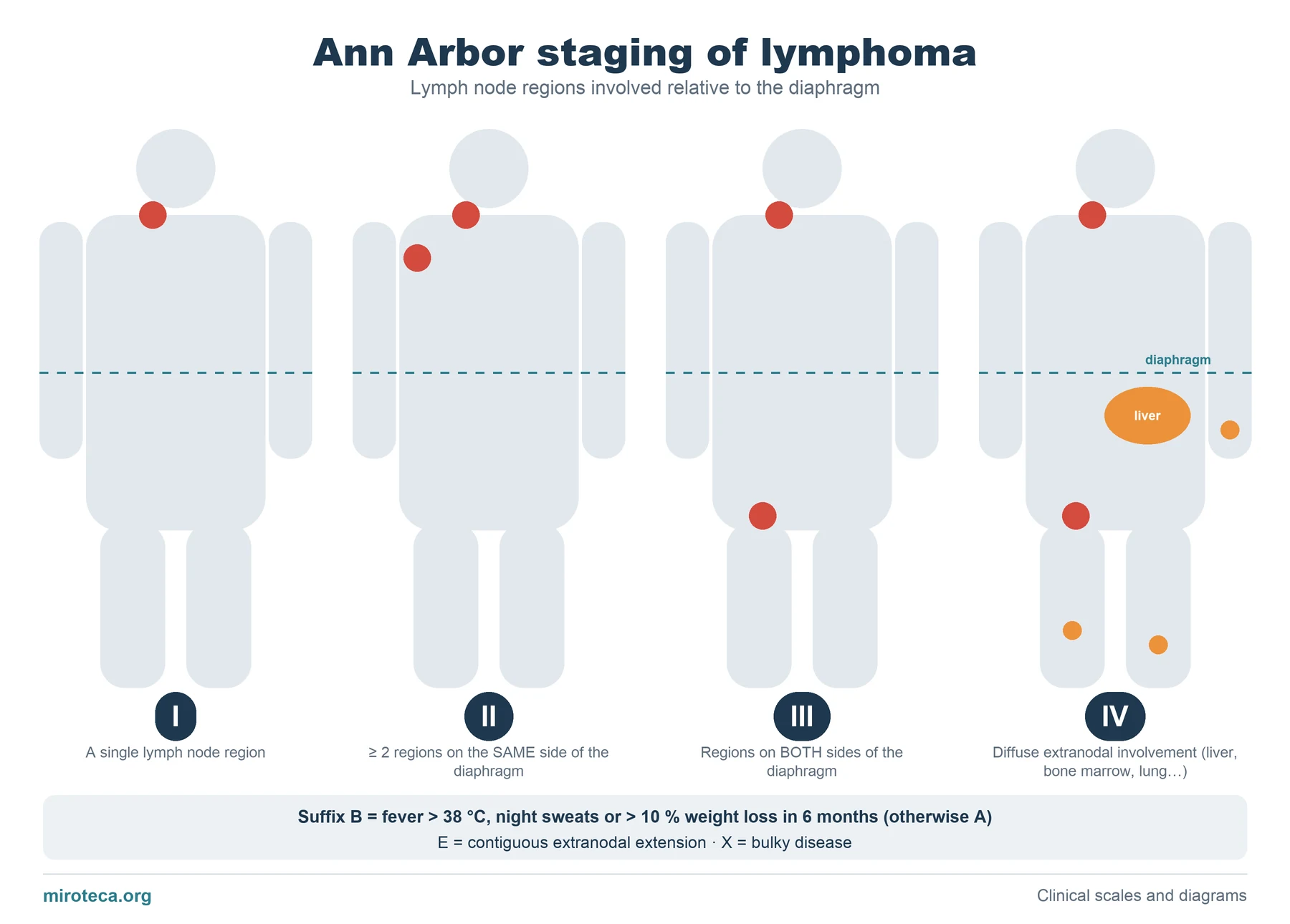
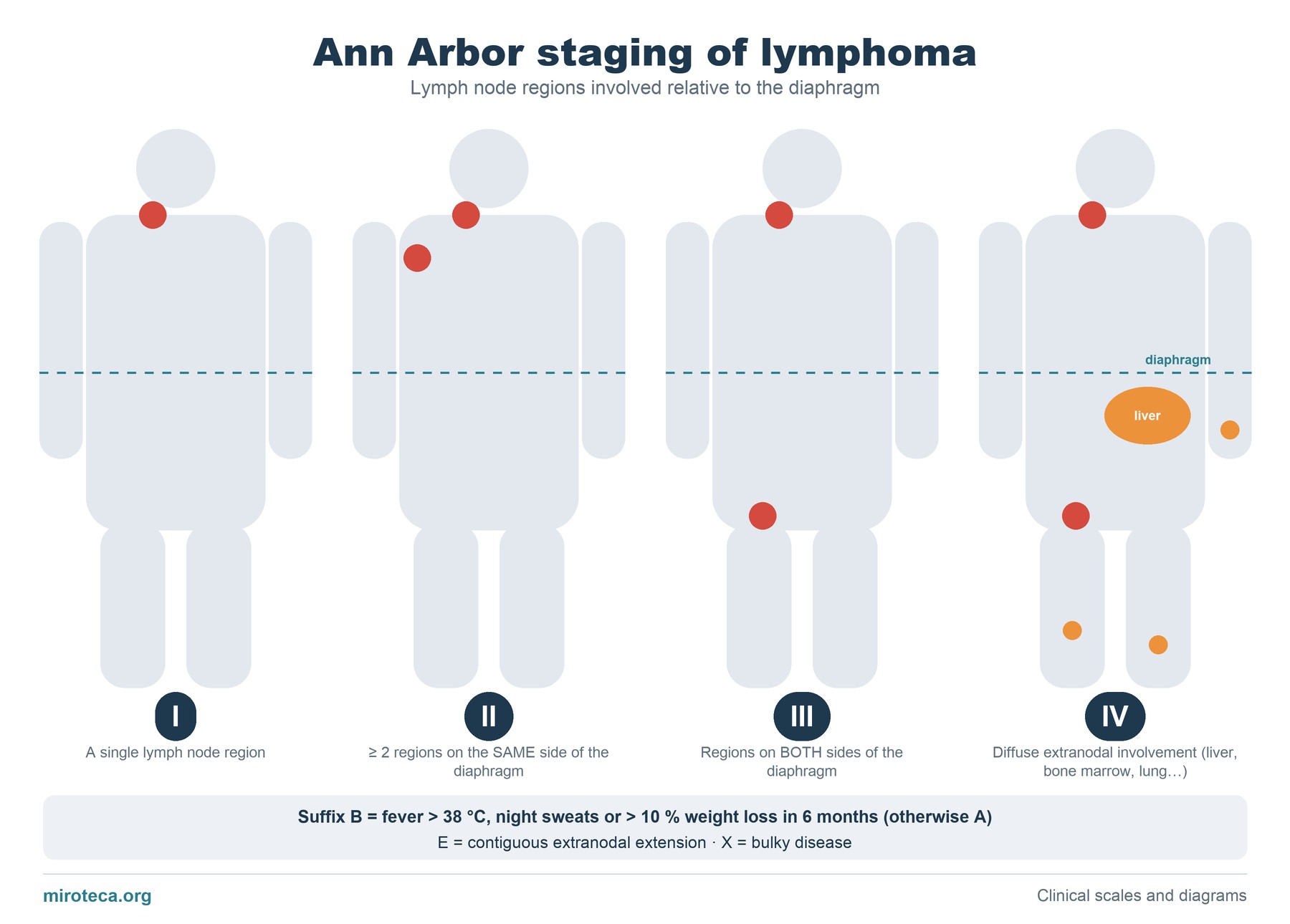
Four silhouettes with the diaphragm drawn as a dashed line. The red dots are involved lymph node regions and the orange ones are organs outside the lymph nodes (liver, bone marrow, lung).
Ann Arbor staging, with the Cotswolds modification, is used above all in Hodgkin lymphoma and orders the extent of disease relative to the diaphragm.
The detail that settles it
A letter is added to each stage: B if there are B symptoms (fever above 38 °C, drenching night sweats or loss of more than 10 % of body weight in the previous 6 months) and A if there are none. B symptoms worsen the prognosis and change treatment.
The letter E indicates a single extranodal site contiguous with an involved node, which does not turn the stage into IV. The letter X marks bulky disease.
Common mistakes
The classic error is upgrading to stage IV any involvement outside the lymph nodes. If it is localized and next to an involved node, the stage is kept and E is added. Stage IV is diffuse or disseminated involvement of organs such as the liver or bone marrow.
Pruritus is also often mistaken for a B symptom: it is common in Hodgkin lymphoma, but it is not one of the B symptoms.
In exam questions
Questions describe the lymph nodes and symptoms and ask for the full stage, letter included. First decide which side of the diaphragm is involved; then whether there are B symptoms.
Keep practicing
This page is the visual summary. To test yourself with real clinical reasoning, Medicinedle, the medical Wordle, gives you one clinical case a day: guess the diagnosis in six tries, with a new clue after every miss. It is free and available in English.