
What the diagram shows
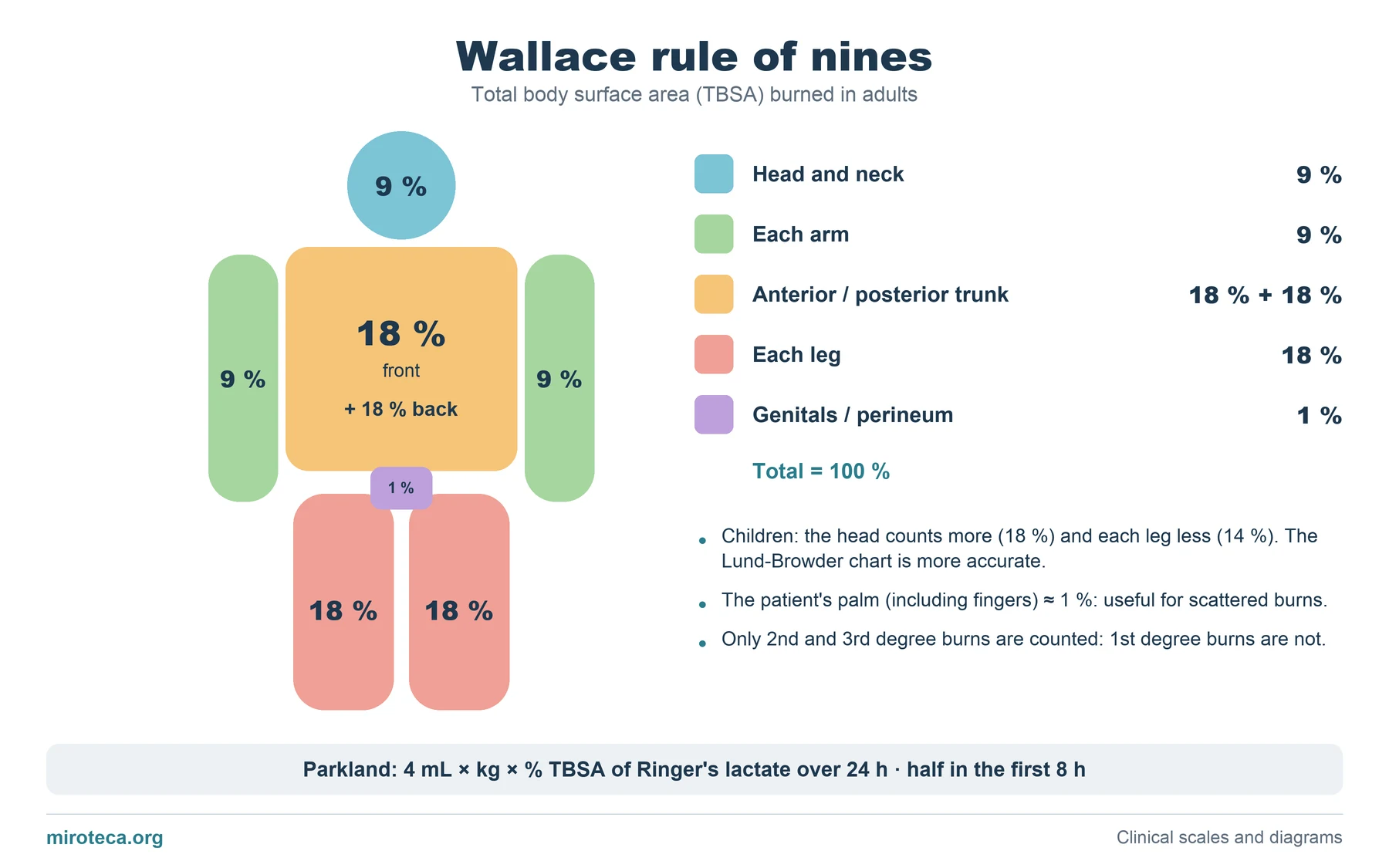
The Wallace rule of nines divides the adult body surface into blocks of 9 % or 18 %, to estimate the total body surface area (TBSA) burned at the bedside. It is a quick approximation that needs no charts or calculations.
The trunk and each leg count double (18 %); that is why the trunk shows two figures, one for the front and one for the back. The perineum completes the 100 % with the remaining 1 %.
The detail that settles it
A child is not a small adult: the head is proportionally larger and the legs smaller. In infants the head approaches 18 % and each leg 14 %. That is why the Lund-Browder chart, which adjusts the percentages for age, is preferred in children.
For scattered or irregular burns, the patient's own palm, including the fingers, is used; it is roughly 1 % of their body surface.
Common mistakes
The most frequent error is adding first-degree burns (erythema without blisters). They do not count: TBSA is calculated only with second and third degree burns. Adding them overestimates the area and leads to giving too much fluid.
TBSA is the basis of fluid replacement with the Parkland formula: 4 mL × kg × % TBSA of Ringer's lactate over 24 hours, half in the first 8 hours counted from the time of the burn (not from arrival at hospital) and the rest over the next 16 hours. It is then adjusted to urine output.
In exam questions
Questions describe the burned areas and ask for the TBSA, or give the weight and TBSA and ask for the volume of the first 8 hours. Two common traps: including first-degree areas and counting the 8 hours from admission.
Keep practicing
This page is the visual summary. To test yourself with real clinical reasoning, Medicinedle, the medical Wordle, gives you one clinical case a day: guess the diagnosis in six tries, with a new clue after every miss. It is free and available in English.