
What the diagram shows
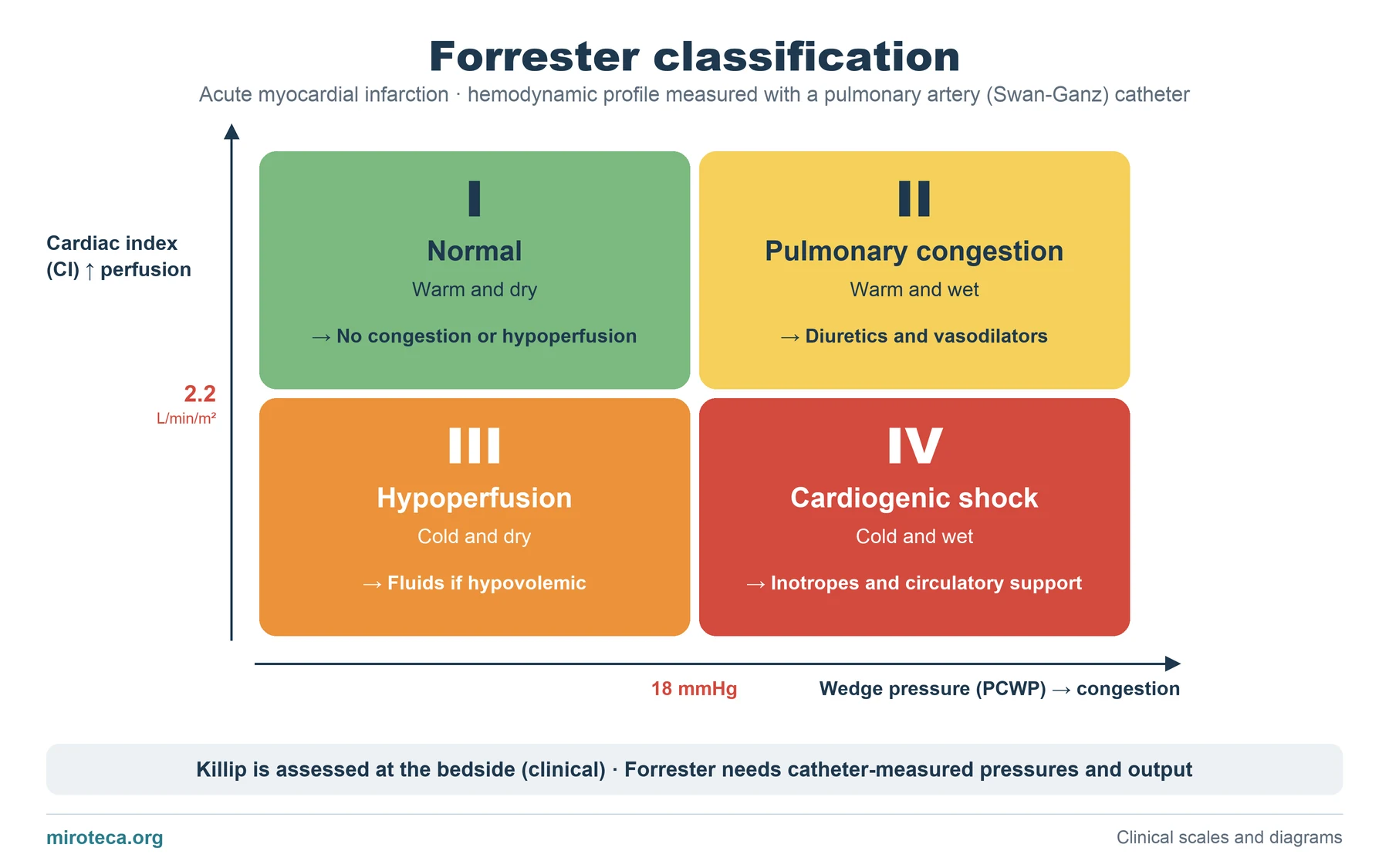
Forrester classifies patients with myocardial infarction by two measurements obtained with a pulmonary artery (Swan-Ganz) catheter: the cardiac index (vertical axis, perfusion) and the pulmonary capillary wedge pressure (horizontal axis, congestion).
Crossing the two cut-offs gives four quadrants. Preserved perfusion is at the top and hypoperfusion at the bottom; no congestion on the left and congestion on the right. The color goes from green (subset I) to red (subset IV, cardiogenic shock).
The detail that settles it
Each quadrant calls for a different treatment, and that is what is asked most. Subset II has excess volume in the lungs: diuretics and vasodilators. Subset III has low volume or low preload: the treatment is fluids if there is hypovolemia, and it is the only subset in which giving volume makes sense. Subset IV needs inotropes and often circulatory support.
The terms "warm/cold" and "dry/wet" are the clinical translation of the same axes: warm means good perfusion and wet means congestion.
Common mistakes
The classic error is confusing Forrester with Killip. Killip is assessed at the bedside, from the examination (crackles, third heart sound, acute pulmonary edema, shock), and needs no catheter. Forrester is measured hemodynamics. Both stratify prognosis, but they are built from different data.
Another mistake is giving diuretics to a subset III patient: a cold and dry patient gets worse if volume is removed. Right ventricular infarction should not be forgotten either; it usually behaves like subset III (hypotension without pulmonary congestion).
In exam questions
Questions usually give the Swan-Ganz figures (for example, CI 1.8 and PCWP 25) and ask for the subset or the treatment. With the two cut-offs in the diagram they take seconds.
Keep practicing
This page is the visual summary. To test yourself with real clinical reasoning, Medicinedle, the medical Wordle, gives you one clinical case a day: guess the diagnosis in six tries, with a new clue after every miss. It is free and available in English.