
What the diagram shows
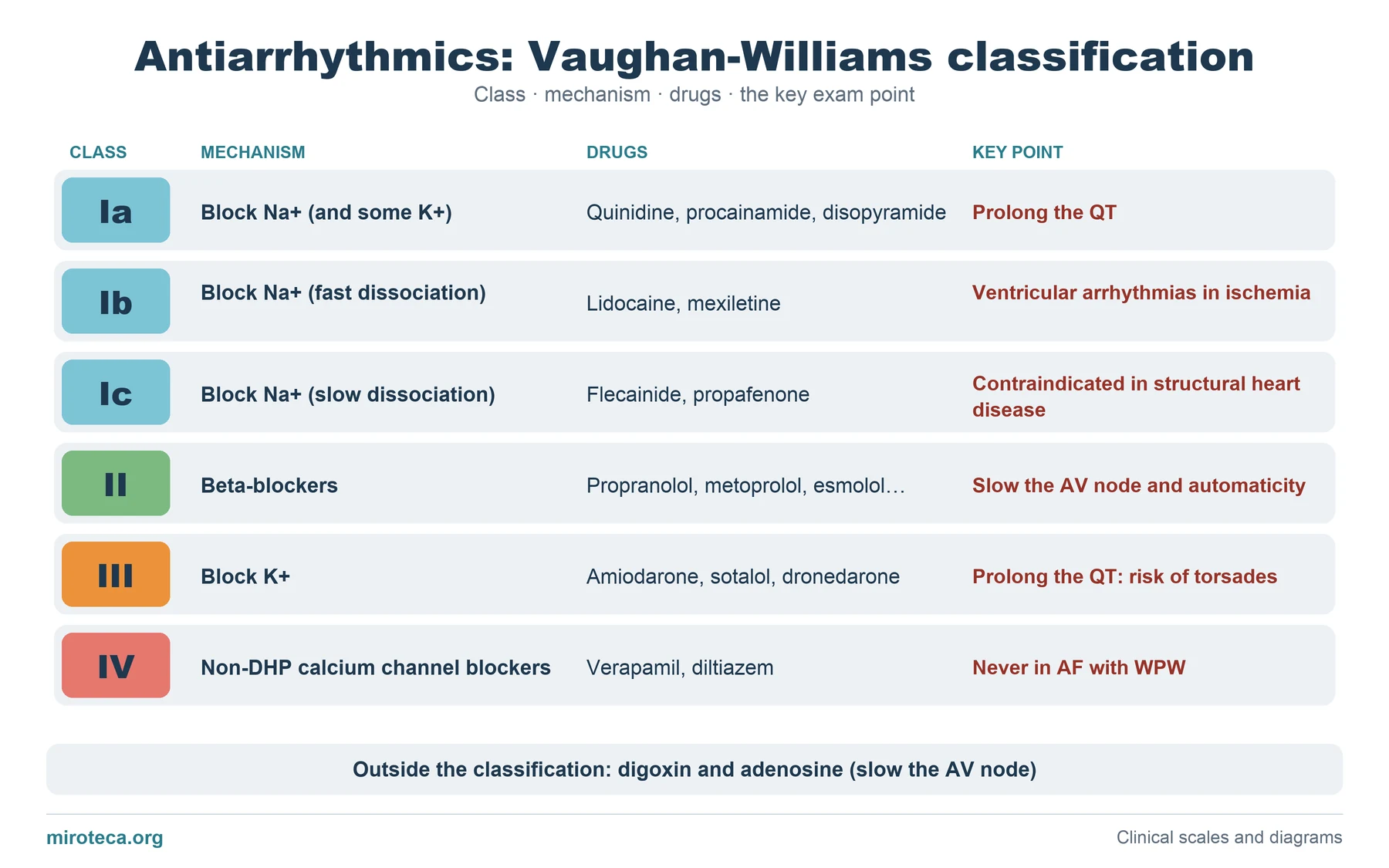
The table sorts antiarrhythmic drugs by their main mechanism: sodium channels (class I), beta receptors (II), potassium channels (III) and calcium channels (IV). Each row adds the best-known drugs and the point that comes up most often in questions.
Class I is subdivided by how the drug dissociates from the sodium channel: fast in Ib (lidocaine), slow in Ic (flecainide) and intermediate in Ia, which also prolongs repolarization.
The detail that settles it
What is asked most is not the mechanism but the contraindication. Class Ic drugs (flecainide, propafenone) are contraindicated in structural or ischemic heart disease, because in those patients they increase mortality. Class Ia and III drugs prolong the QT interval and can cause torsades de pointes.
Verapamil and diltiazem slow the AV node; in atrial fibrillation with an accessory pathway (Wolff-Parkinson-White) they can favor conduction down the pathway and trigger ventricular fibrillation.
Common mistakes
A frequent error is thinking that amiodarone is "only" class III. It has actions of all four classes, although it is placed in class III for its main effect. Another is putting digoxin or adenosine in a class: they are outside the original classification.
Class IV calcium channel blockers should not be confused with dihydropyridines (amlodipine, nifedipine), which act on the vessels and have no antiarrhythmic effect.
In exam questions
Questions usually describe a patient (ischemic heart disease, long QT, pre-excitation) and ask which antiarrhythmic to avoid. The right-hand column of the diagram summarizes those traps.
Keep practicing
This page is the visual summary. To test yourself with real clinical reasoning, Medicinedle, the medical Wordle, gives you one clinical case a day: guess the diagnosis in six tries, with a new clue after every miss. It is free and available in English.