
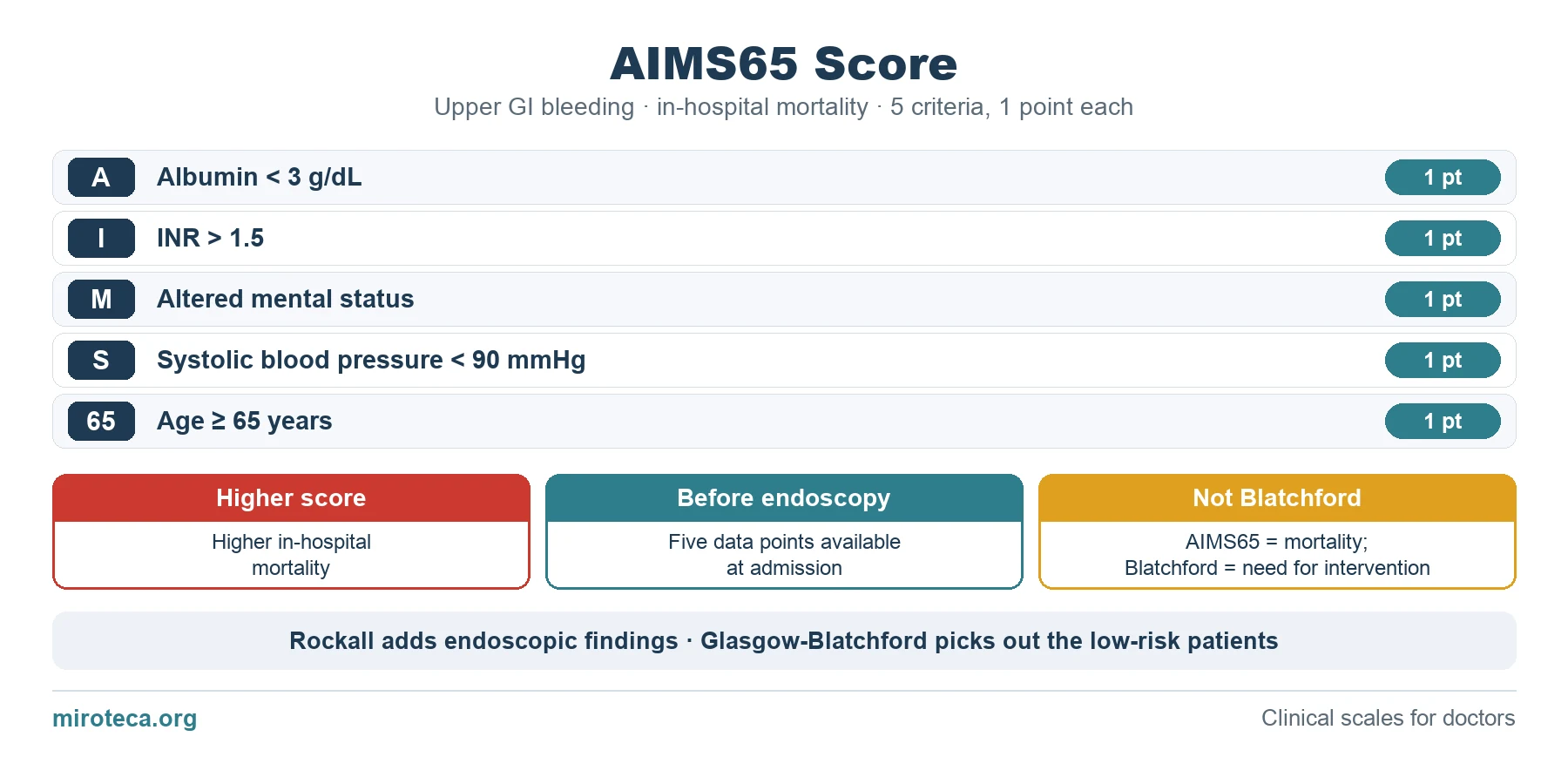
What the diagram shows
The AIMS65 score estimates the mortality of upper gastrointestinal bleeding with five simple data points available at admission, with no need for a previous endoscopy. It adds 1 point for each criterion, from 0 to 5.
The name is the mnemonic: Albumin, INR, Mental status, Systolic blood pressure and age 65.
The detail that settles it
It is easy to remember and is calculated before endoscopy. It lets the risk be stratified quickly, to decide the level of monitoring and the urgency of the endoscopy. A 70-year-old with bleeding, low albumin and a high INR already adds 3 points.
Common mistakes
Confusing its objective (mortality) with that of the Glasgow-Blatchford score (need for intervention).
In exam questions
Questions usually group the scores of upper GI bleeding: Glasgow-Blatchford selects low-risk patients who could be managed as outpatients, the Rockall score estimates rebleeding and mortality (with a part that adds endoscopic findings) and AIMS65 estimates mortality with admission data. In all of them the initial management is the same: stabilize, fluids, restrictive transfusion, proton pump inhibitors and early endoscopy.
Keep practicing
This page is the visual summary. To test yourself with real clinical reasoning, Medicinedle, a Wordle-inspired game, gives you one clinical case a day: guess the diagnosis in six tries, with a new clue after every miss. It is free and available in English.