
What the diagram shows
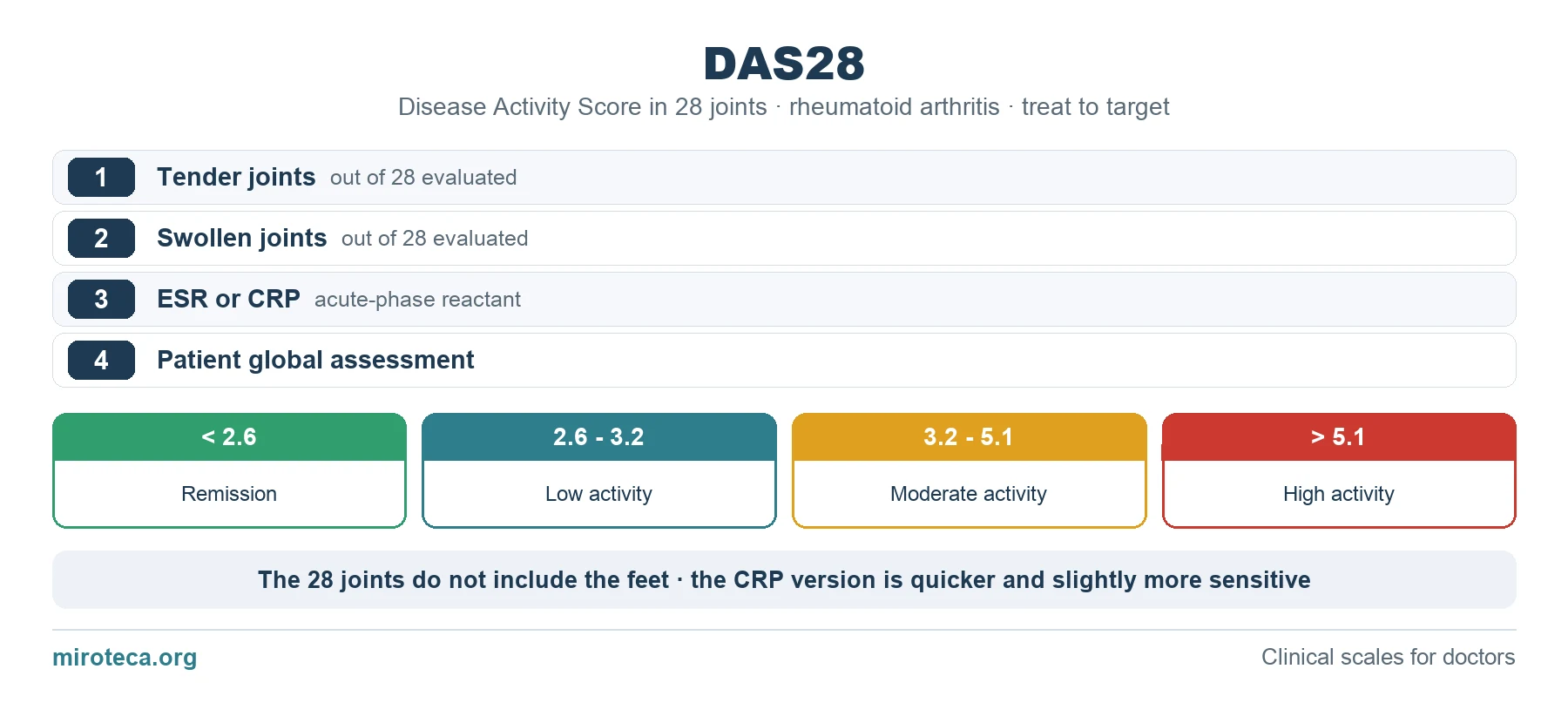
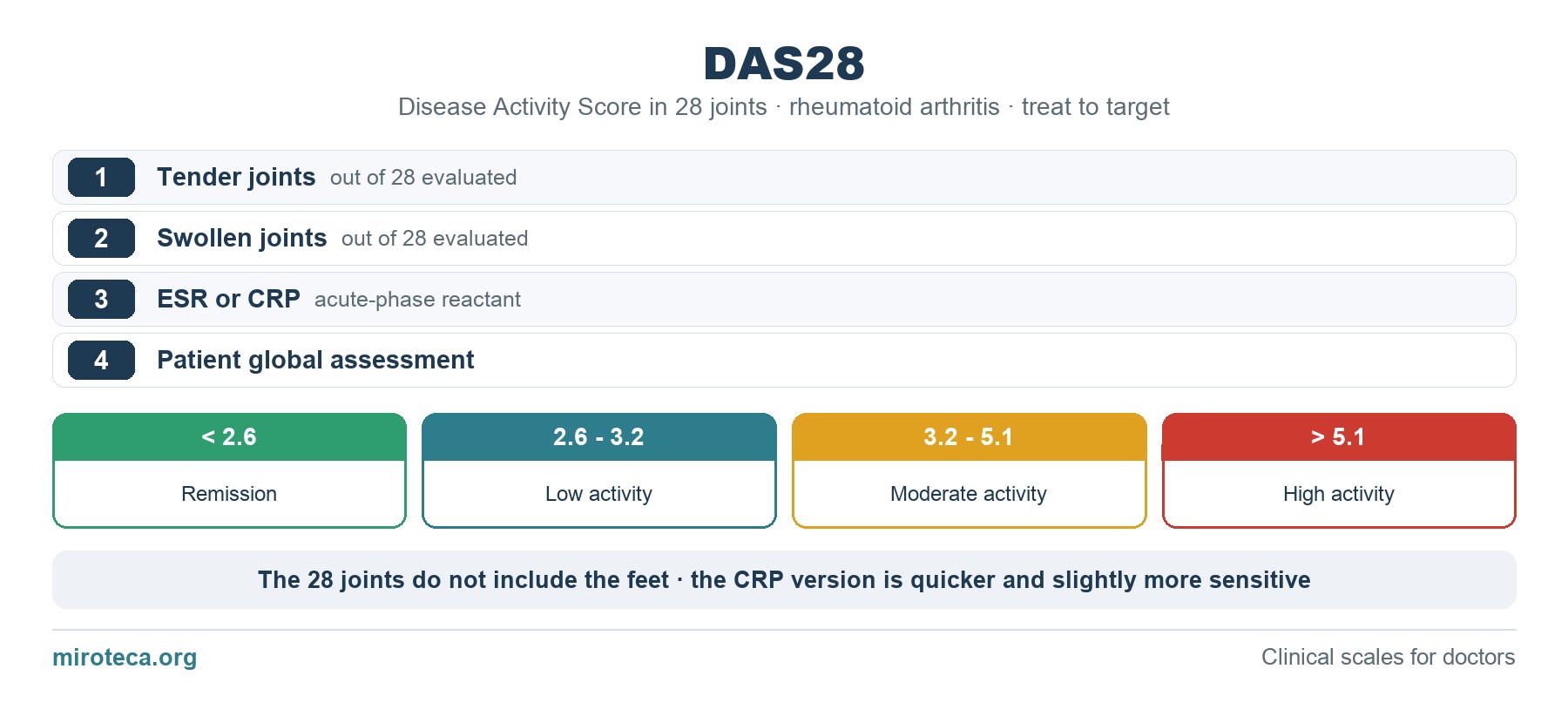
The DAS28 quantifies the activity of rheumatoid arthritis. It is the reference to follow the disease over time and to decide treatment changes according to targets.
It combines the number of tender and swollen joints (out of 28 evaluated), an acute-phase reactant (ESR or CRP) and the patient global assessment. The data are entered into a formula or calculator that returns a continuous value.
The detail that settles it
It allows treat to target: adjusting treatment until remission or low activity is achieved. Treatment is not guided "by eye" but by this score, adjusting disease-modifying drugs (methotrexate first line) or escalating to biologics if the target is not reached. A patient with several swollen joints and a high ESR whose DAS28 is 5.5 has high activity, and treatment must be intensified.
Common mistakes
Forgetting that it assesses 28 specific joints and does not include the feet, which can lead to underestimating activity. There is also a CRP version (DAS28-CRP), quicker to obtain and slightly more sensitive than the classic one calculated with ESR.
In exam questions
Questions usually ask for the cut-offs (below 2.6 remission, above 5.1 high activity) or for the concept of treat to target. The source sheet gives 3.2 as the boundary between low and moderate activity, so a value of exactly 3.2 should be read with the local protocol.
Keep practicing
This page is the visual summary. To test yourself with real clinical reasoning, Medicinedle, a Wordle-inspired game, gives you one clinical case a day: guess the diagnosis in six tries, with a new clue after every miss. It is free and available in English.