
What the diagram shows
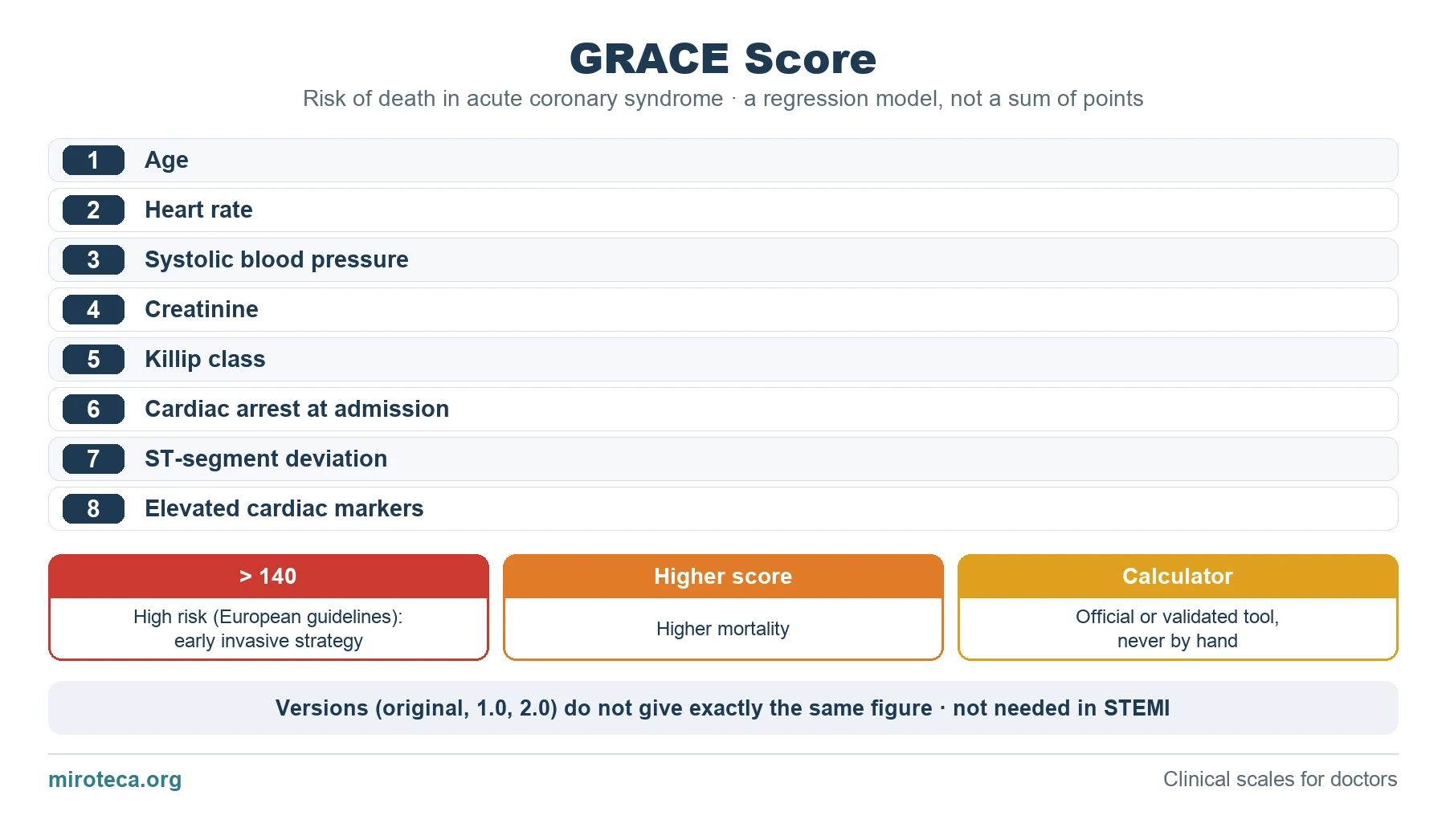
The GRACE score estimates the risk of death in acute coronary syndrome. Because of its accuracy, guidelines recommend it to decide which patients benefit from an early invasive strategy.
It combines clinical and laboratory variables: age, heart rate, systolic blood pressure, creatinine, Killip class, cardiac arrest at admission, ST-segment deviation and elevated cardiac markers.
Why it is not added up by hand
GRACE does not work like CURB-65 or CHA₂DS₂-VASc, where each criterion adds a fixed number. It is a regression model: each variable enters with its own non-linear weight, so the same rise in heart rate does not add the same amount if the patient starts from 60 or from 110. The result comes from a nomogram or a calculator.
Several versions exist (the original, 1.0 and 2.0) and they do not give exactly the same figure, because the variables and the outcome they predict change. The official calculator or a validated tool should be used.
Common mistakes
Trying to calculate it from memory. Another mistake is confusing GRACE (ischemic risk and mortality) with the CRUSADE score (bleeding risk), which is assessed in parallel to balance antiplatelet therapy.
In exam questions
Questions usually ask what GRACE is for in non-ST-elevation ACS: a high score (above 140 in the European guidelines) supports early catheterization within 24 hours, while a low risk allows a more conservative strategy. In ST-elevation ACS it is not needed to decide: the indication is urgent reperfusion. It is more accurate than the TIMI score for mortality.
Keep practicing
This page is the visual summary. To test yourself with real clinical reasoning, Medicinedle, a Wordle-inspired game, gives you one clinical case a day: guess the diagnosis in six tries, with a new clue after every miss. It is free and available in English.