
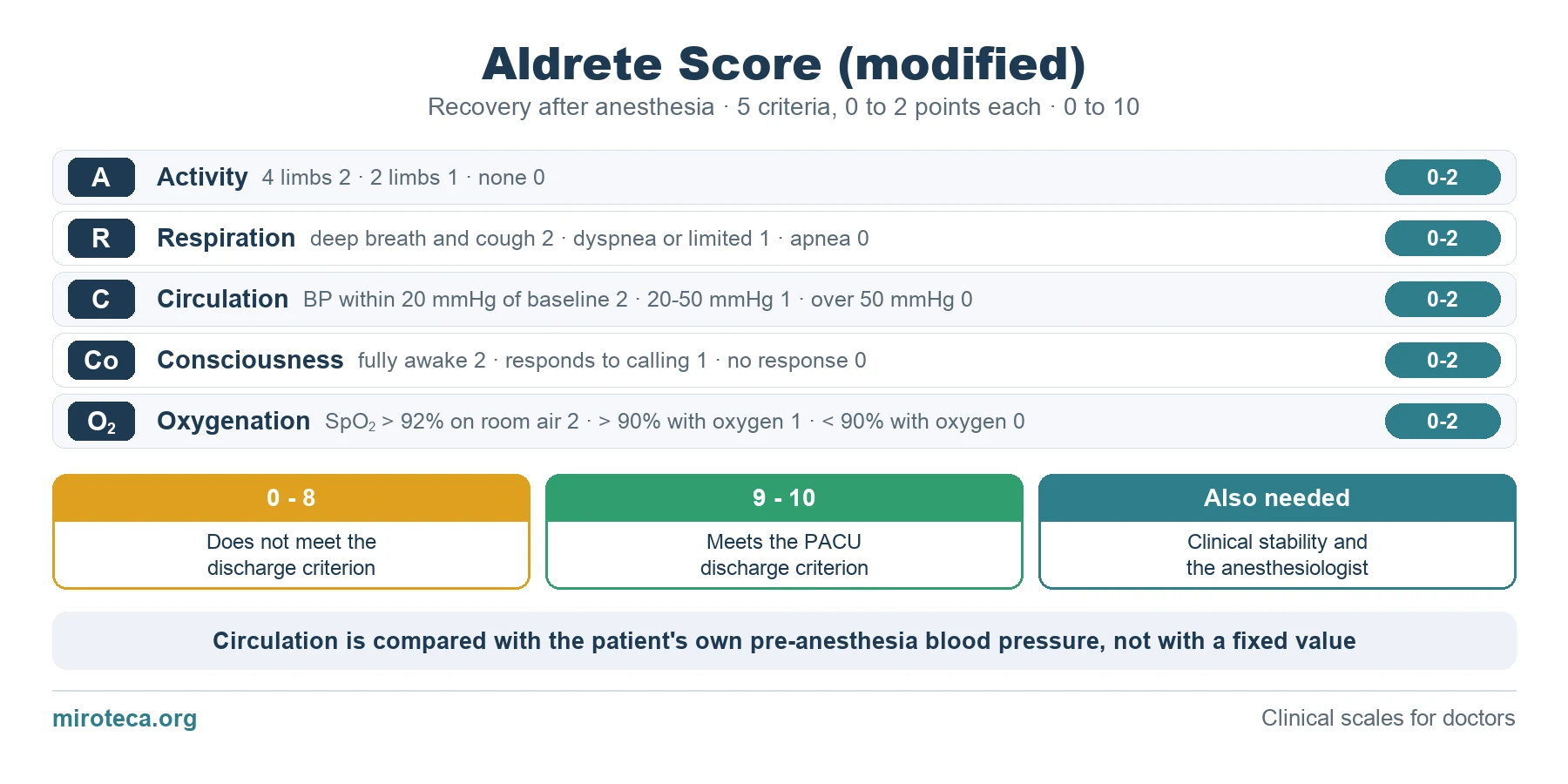
What the diagram shows
The Aldrete score assesses how a patient recovers after anesthesia and helps to decide whether they can leave the post-anesthesia care unit (PACU). The version used today is the modified one, published by Aldrete in 1995, which replaces the original criterion of skin color with oxygen saturation.
Five criteria are scored from 0 to 2 points each and added up, for a total of 0 to 10.
The detail that settles it
A total of 9 or more meets the criterion for discharge from phase I of recovery; with 8 or less it does not. The score is an aid: discharge also depends on clinical stability and on the judgment of the anesthesiologist.
The circulation criterion is compared with the patient's own blood pressure before anesthesia, not with a fixed value.
Where sources differ
The sources consulted agree on the five criteria, on the 0 to 2 points and on the cut-off of 9. The description of some criteria varies a little: for example, how the intermediate oxygenation level is worded. This page follows the most repeated wording; each hospital may have its own form, and the one in the local protocol should be used.
Common mistakes
Using a fixed blood pressure instead of the baseline value, mixing the original version (with color) and the modified one (with saturation), and discharging on the number alone without assessing the rest of the clinical picture.
Keep practicing
This page is the visual summary. To test yourself with real clinical reasoning, Medicinedle, a Wordle-inspired game, gives you one clinical case a day: guess the diagnosis in six tries, with a new clue after every miss. It is free and available in English.