
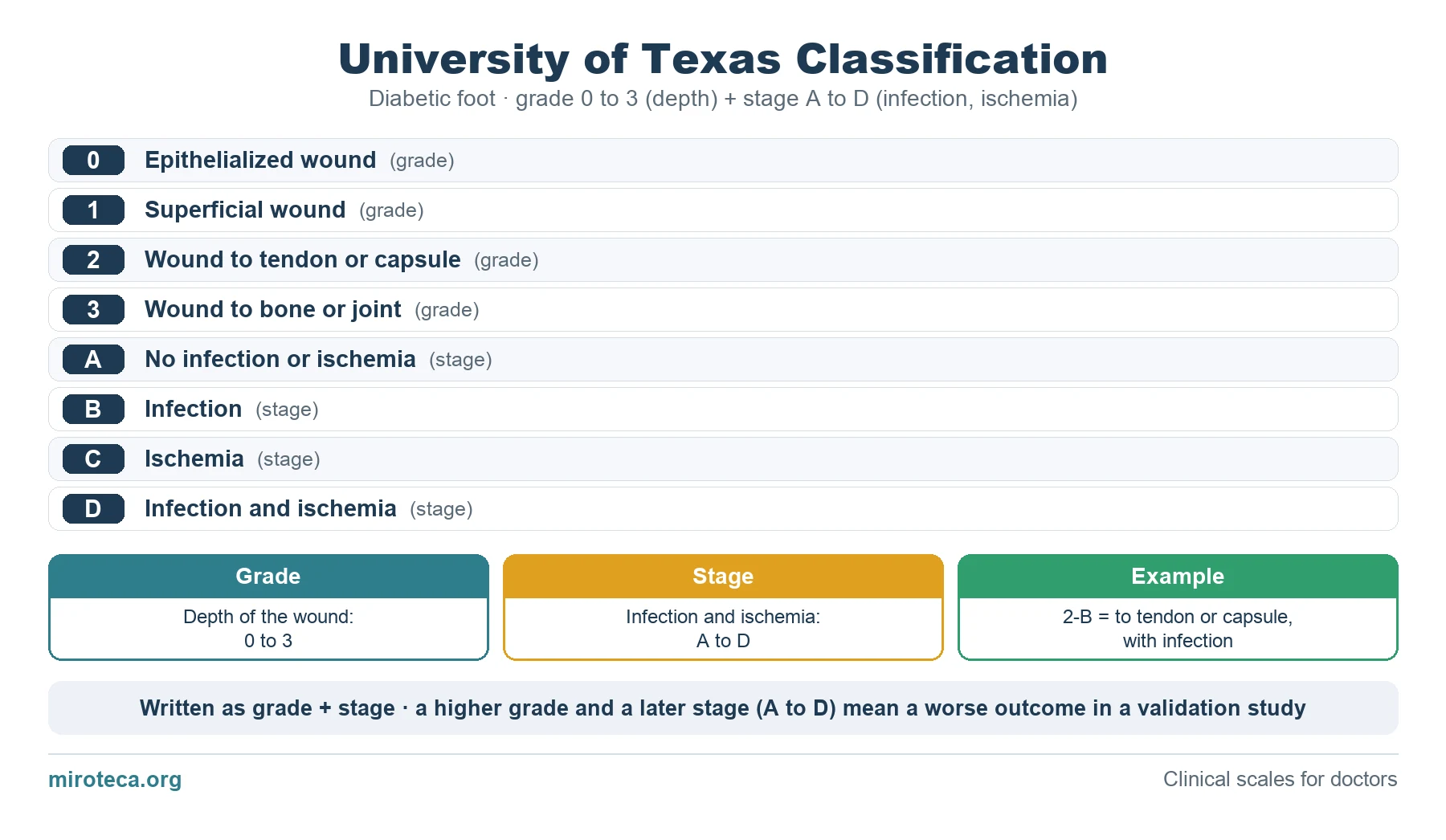
What the diagram shows
The University of Texas classification describes diabetic foot wounds along two axes: the depth of the wound (grades 0 to 3) and the presence of infection, ischemia or both (stages A to D). It was proposed in 1996 as an alternative to the Wagner classification, which does not specifically record infection or ischemia.
Nothing is added: one grade and one stage are assigned and combined.
The detail that settles it
A higher grade and a later stage (from A to D) mean a worse outcome: in a validation study, outcome worsened as grade and stage went up, and patients in stage D were much more likely to need an amputation at the midfoot level or above.
Depth and infection or ischemia are two independent axes: stage A is the only one with neither infection nor ischemia.
Where sources differ
In the Texas classification a wound that reaches bone or joint is grade 3, while in the most widespread wording of Wagner an ulcer that reaches bone without osteomyelitis or abscess is grade 2. The two systems are not equivalent, and the same foot can receive different grades in each.
Common mistakes
Giving a single number, as in Wagner, and forgetting the stage; confusing stage B (infection) with stage C (ischemia); and treating Texas grades as equivalent to Wagner grades.
Keep practicing
This page is the visual summary. To test yourself with real clinical reasoning, Medicinedle, a Wordle-inspired game, gives you one clinical case a day: guess the diagnosis in six tries, with a new clue after every miss. It is free and available in English.