
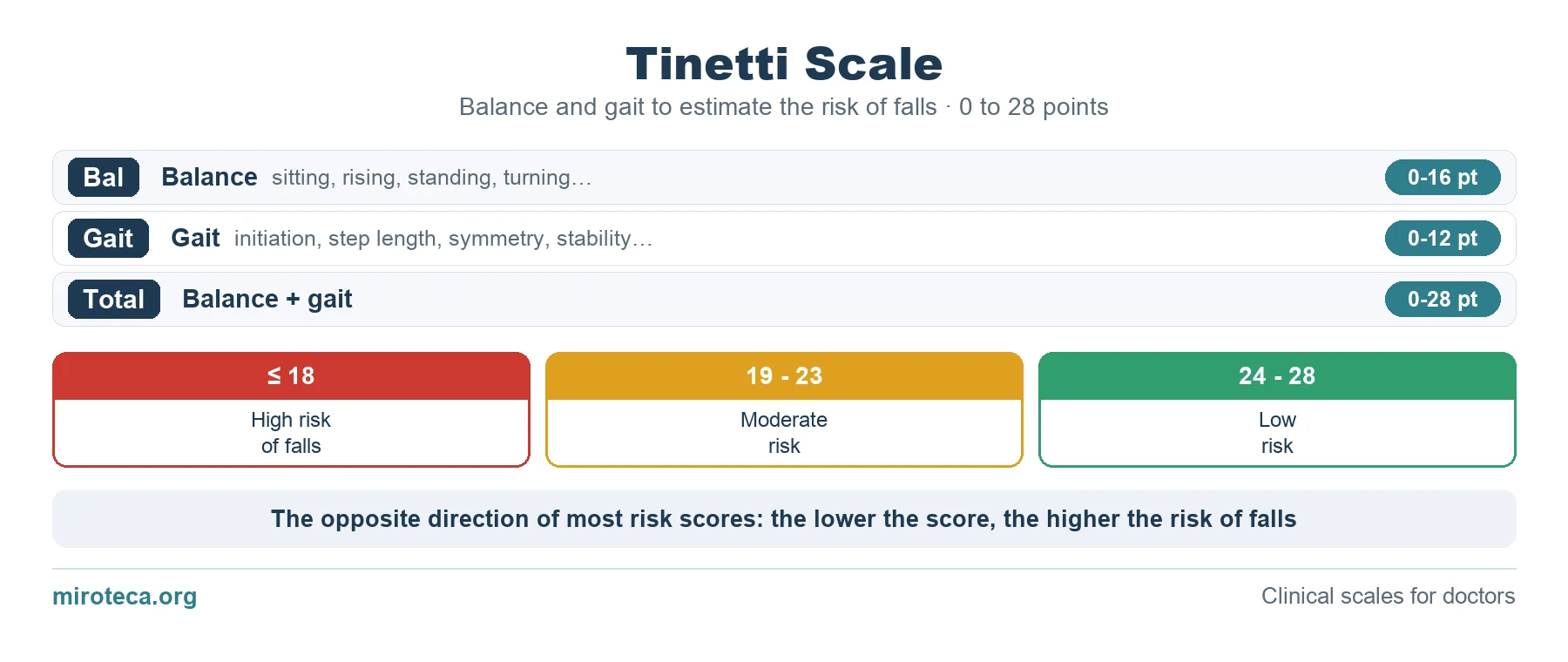
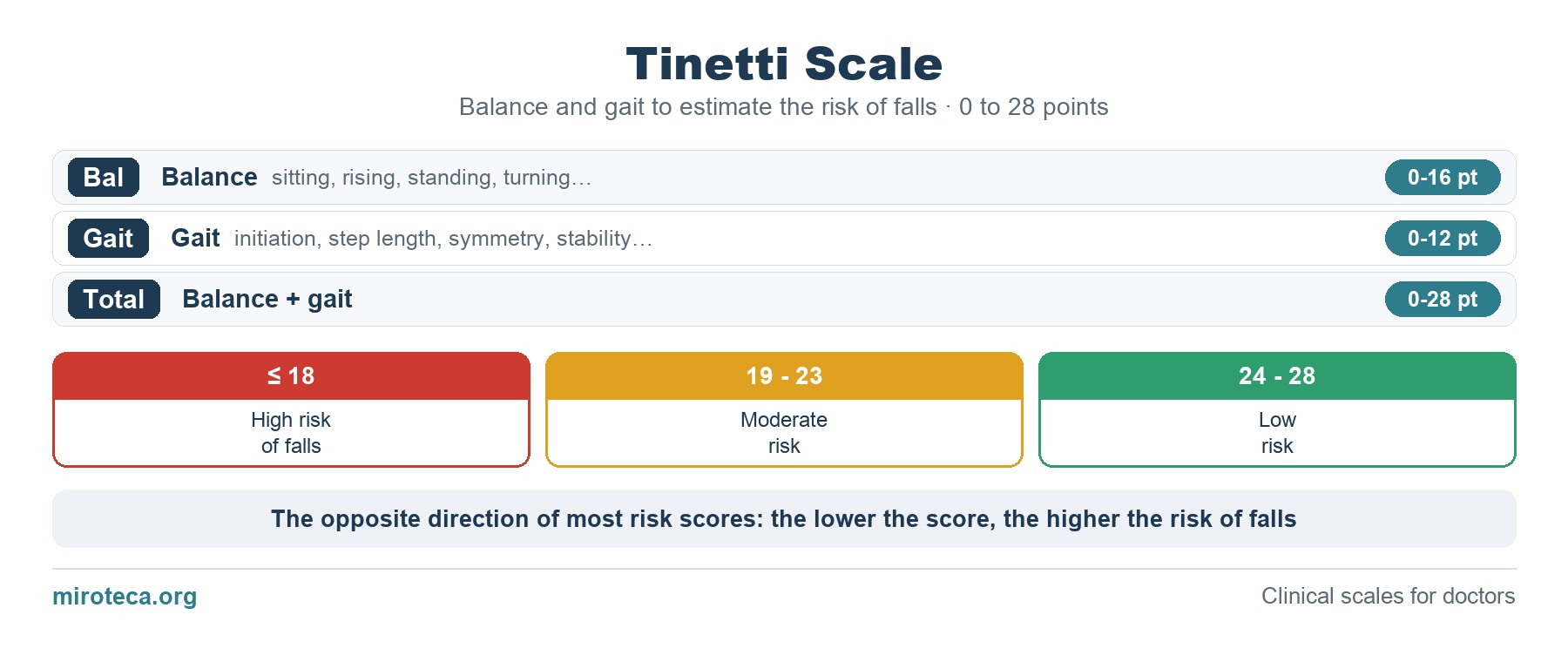
What the diagram shows
The Tinetti scale assesses the balance and gait of an older person to estimate the risk of falls. Falls are a very important cause of fractures, dependence and admissions in older adults, so detecting patients at risk is key.
It has two parts that are examined by observing the patient: balance (sitting, on rising, standing, turning…), which adds up to 16 points, and gait (initiation, step length, symmetry, stability…), which adds up to 12. The two parts are added, from 0 to 28 points.
The detail that settles it
The detail that misleads is that it runs the opposite way from the risk scores: the lower the score, the higher the risk (below 19, high risk of falls; 19 to 23, moderate; 24 or more, low). A higher score means better balance and gait.
Common mistakes
Calculating it "by hearsay" without seeing the patient move: the patient must be observed. Another is stopping at the number without putting measures in place, which is what actually prevents the fall.
A low result justifies fall-prevention measures (exercise, medication review, adapting the home).
In exam questions
A typical case: an older person who rises from the chair with several attempts, sways on standing and walks with short, unsteady steps scores below 19 of 28, a high risk of falls. Falls are approached as a geriatric syndrome: look for and correct their multiple causes (drugs such as benzodiazepines and antihypertensives, visual deficits, orthostatic hypotension, environment, sarcopenia) and intervene with strength and balance exercise. See also the SPPB and the article on functional and frailty scales.
Keep practicing
This page is the visual summary. To test yourself with real clinical reasoning, Medicinedle, a Wordle-inspired game, gives you one clinical case a day: guess the diagnosis in six tries, with a new clue after every miss. It is free and available in English.