
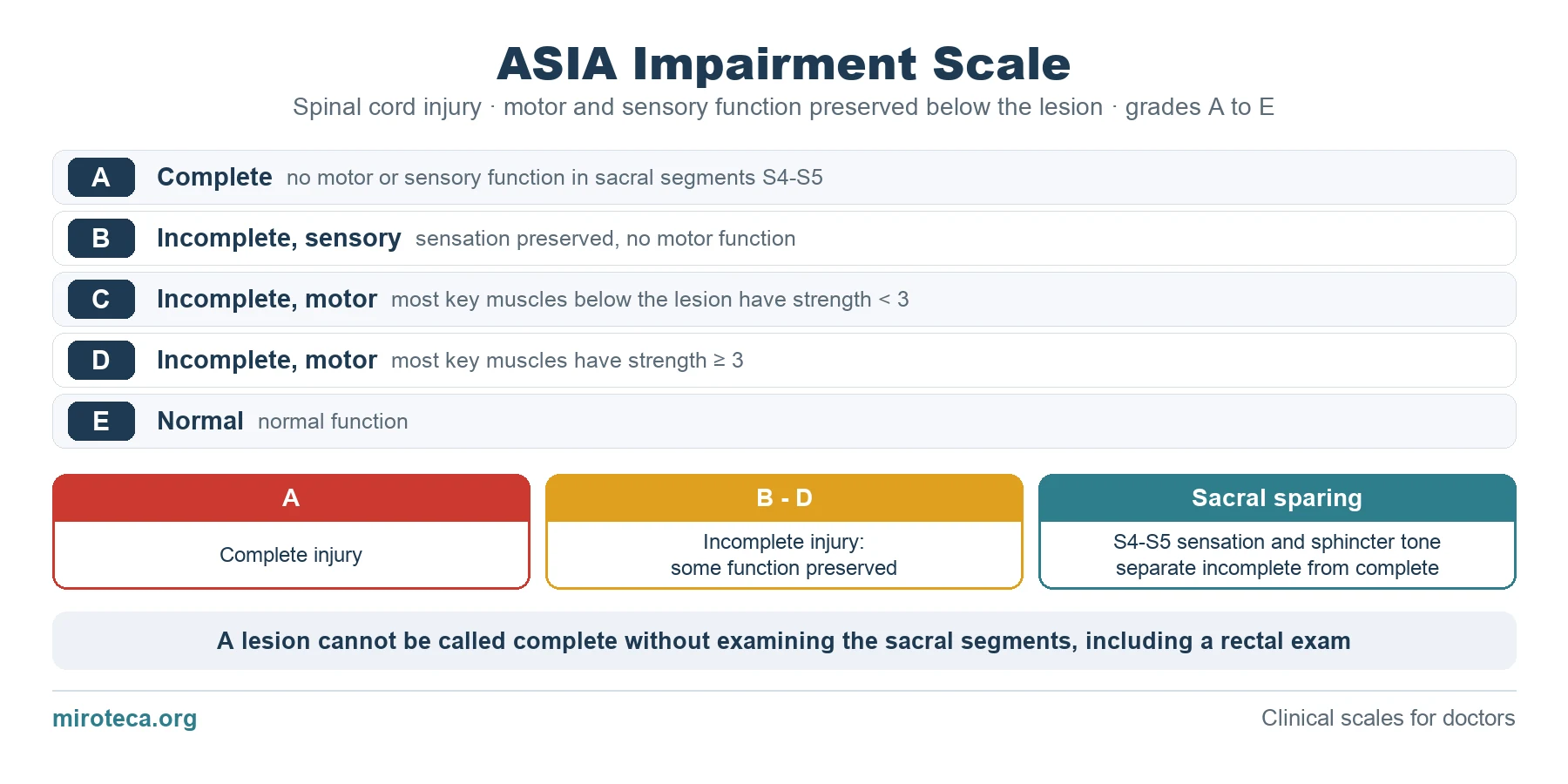
What the diagram shows
The ASIA scale (American Spinal Injury Association) classifies the severity of a spinal cord injury by the motor and sensory function that is preserved. It is the common language to describe the deficit and its prognosis.
Five grades are used, from A (complete) to E (normal). Strength and sensation are examined, paying special attention to the sacral segments.
The detail that settles it
Sacral sparing (perianal sensation at S4-S5 and sphincter tone) separates a complete lesion (A) from an incomplete one (B to D), with great prognostic value: an incomplete lesion has a chance of recovery. That is why the rectal examination is part of the initial assessment of a patient with spinal cord injury.
Common mistakes
Labeling a lesion as complete without examining the sacral segments.
In exam questions
Questions usually describe preserved perianal sensation without movement below the lesion: ASIA B, incomplete. Related incomplete syndromes are also asked: central cord (more deficit in the arms, typical of older people after hyperextension), Brown-Séquard (ipsilateral motor and proprioceptive deficit with contralateral pain and temperature loss) and anterior cord (worse prognosis). Acute management prioritizes immobilization and avoiding secondary injury, keeping blood pressure and oxygenation.
Keep practicing
This page is the visual summary. To test yourself with real clinical reasoning, Medicinedle, a Wordle-inspired game, gives you one clinical case a day: guess the diagnosis in six tries, with a new clue after every miss. It is free and available in English.