
What the diagram shows
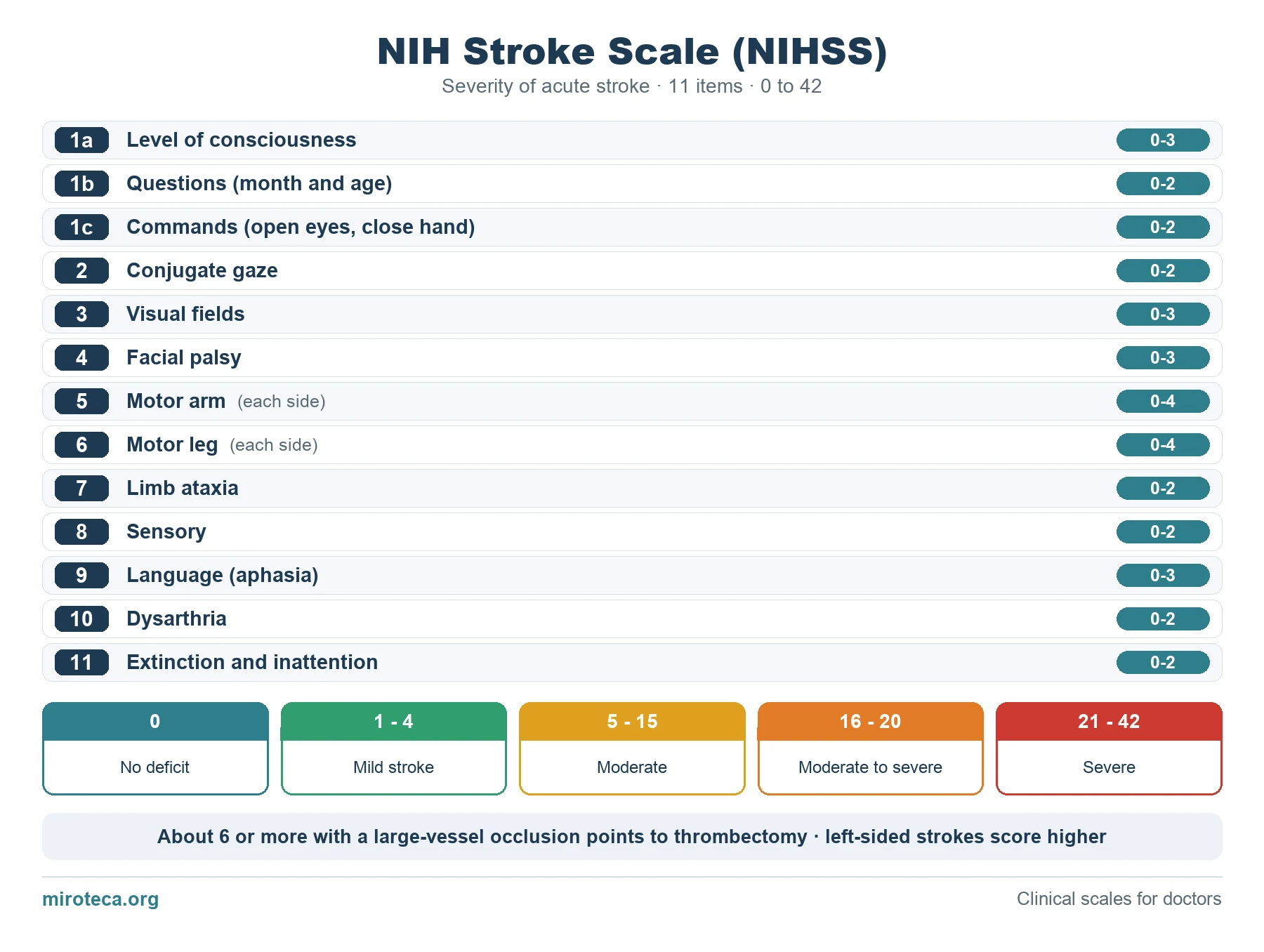
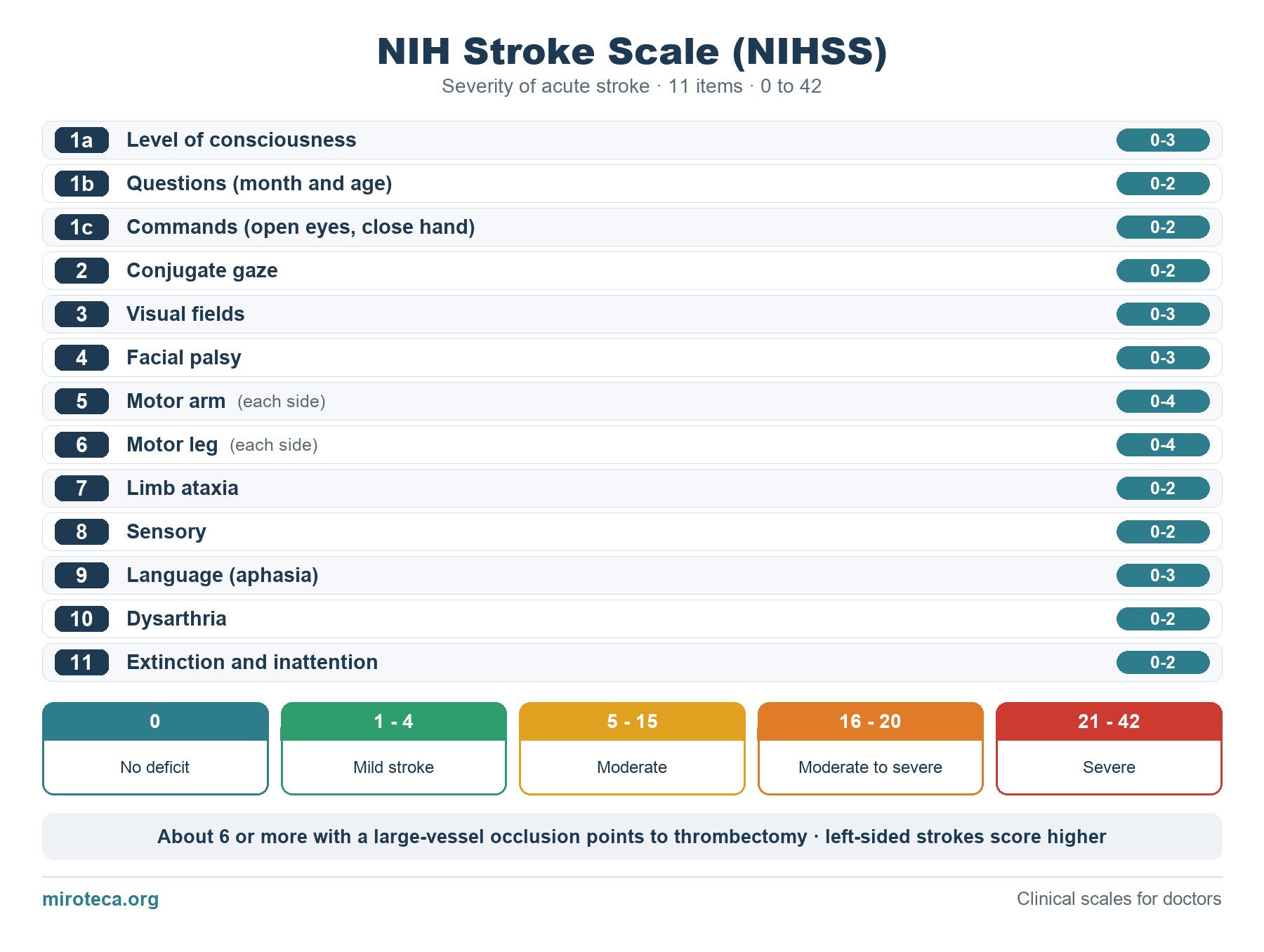
The NIHSS is the standard scale to measure the severity of an acute stroke. It quantifies the neurological deficit in a reproducible way, follows its course, allows comparison between professionals and helps in decisions such as thrombolysis or thrombectomy.
It examines 11 items: level of consciousness, conjugate gaze, visual fields, facial palsy, arm and leg strength, limb ataxia, sensation, language, dysarthria, and extinction or inattention. Each item adds points according to severity, for a total from 0 (no deficit) to 42.
The detail that settles it
A high NIHSS (roughly 6 or more) together with a large-vessel occlusion points toward mechanical thrombectomy. The scale has a known bias: strokes of the left hemisphere, which affect language, score higher than right-hemisphere strokes of the same size.
Common mistakes
Trying to estimate it "by eye" without examining all 11 items: every one counts. Another mistake is forgetting the language bias, since an extensive right-hemisphere stroke can have a low NIHSS because it does not affect speech.
A posterior fossa stroke can also be serious with a low NIHSS, as the scale scores the vertebrobasilar territory poorly.
In exam questions
Questions usually ask how the NIHSS is used to decide treatment and estimate prognosis, or ask to tell it apart from the modified Rankin Scale, which measures functional outcome at 90 days. The underlying message is that time is brain: activate the stroke code, obtain an urgent CT to exclude hemorrhage and act within the therapeutic window.
Keep practicing
This page is the visual summary. To test yourself with real clinical reasoning, Medicinedle, a Wordle-inspired game, gives you one clinical case a day: guess the diagnosis in six tries, with a new clue after every miss. It is free and available in English.