
What the chart shows
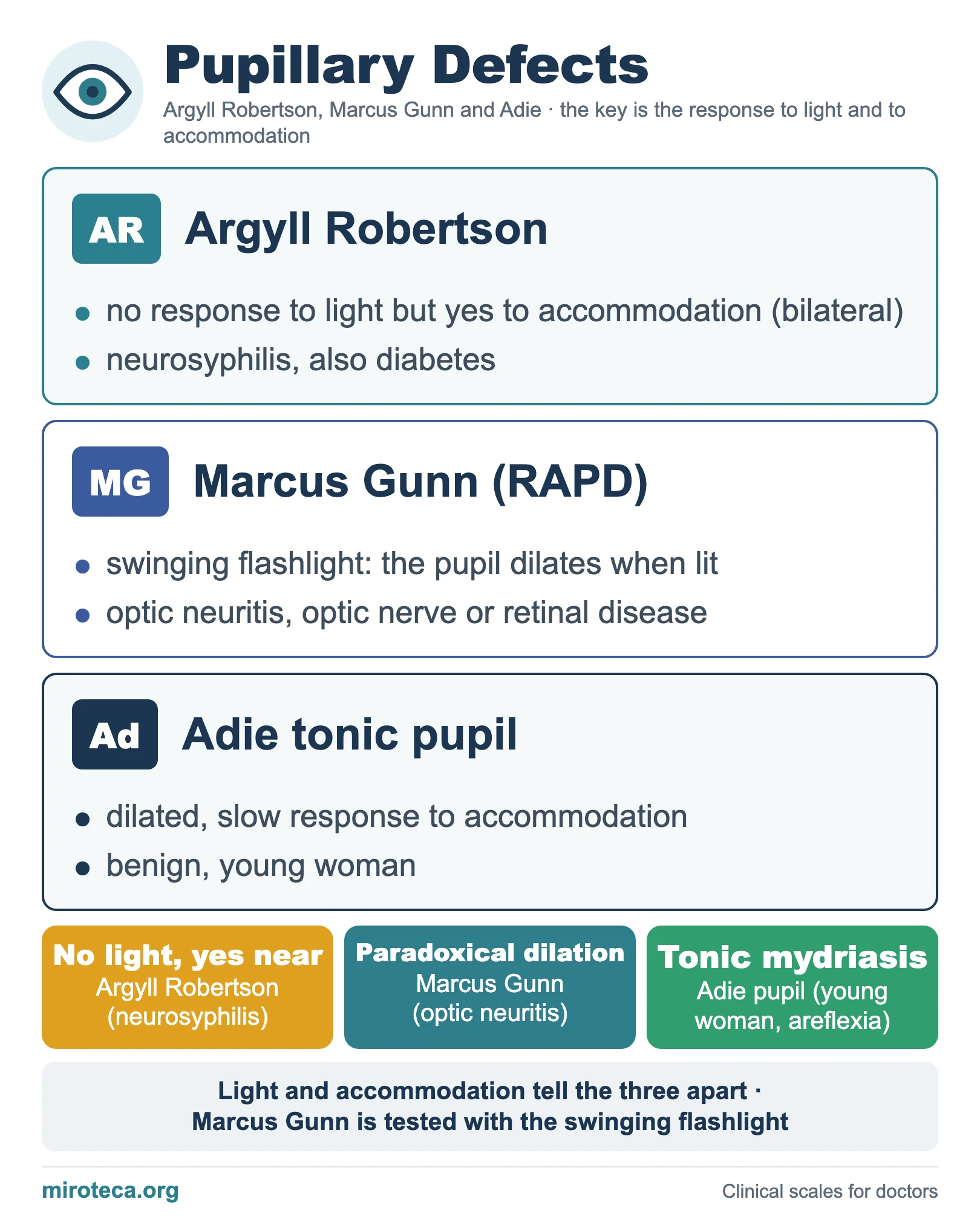
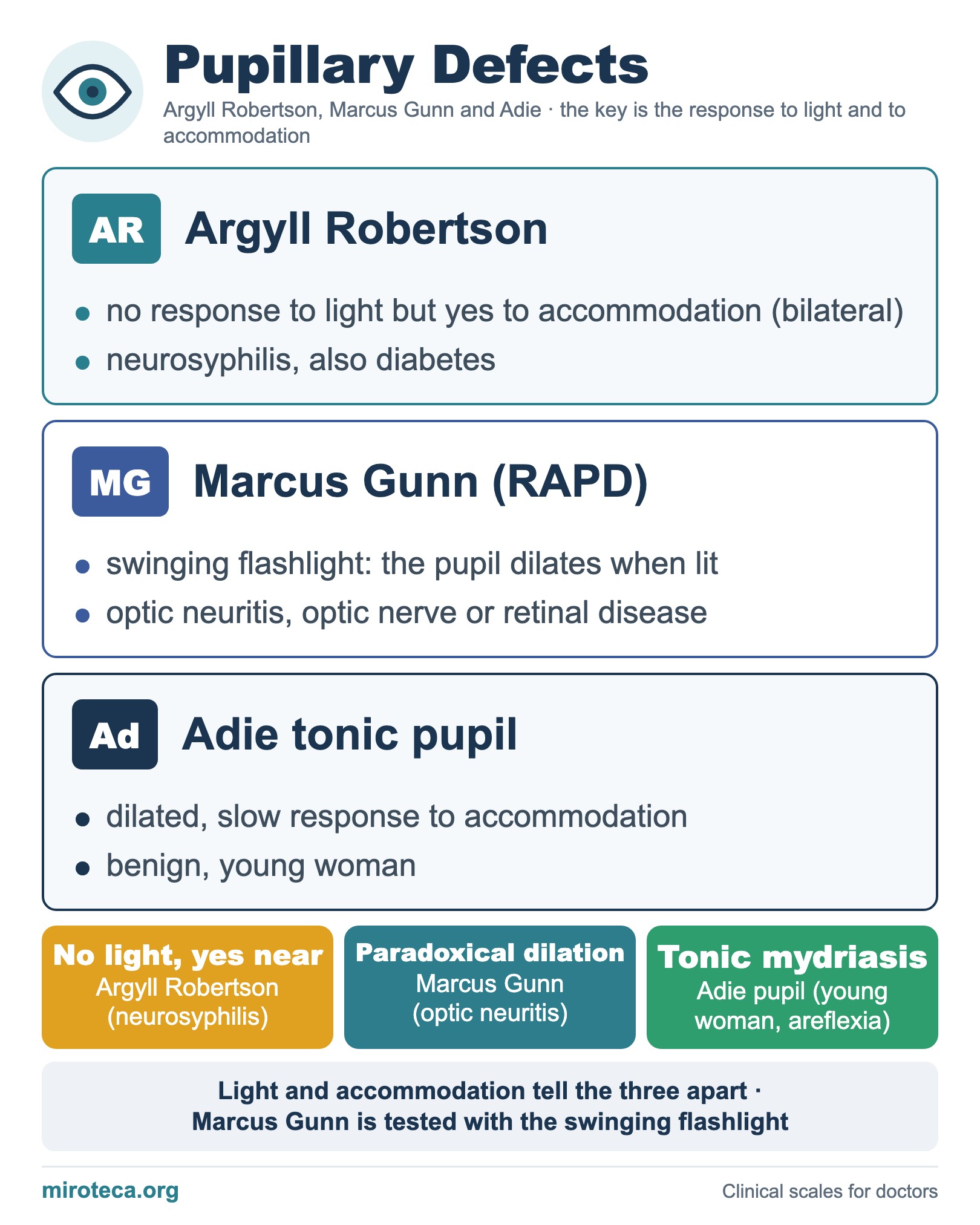
Three classic pupillary abnormalities have a very characteristic examination that can be used to localize the lesion. The chart sets them side by side: the Argyll Robertson pupil, the Marcus Gunn pupil (relative afferent pupillary defect, RAPD) and the Adie tonic pupil.
The detail that settles it
The Argyll Robertson pupil, seen in neurosyphilis, does not react to light but does react to accommodation ("it accommodates but does not react"). The relative afferent pupillary defect (Marcus Gunn pupil) appears in optic neuritis: with the swinging flashlight test, when the affected eye is lit the pupils dilate paradoxically. The Adie pupil, typical of a young woman, is a dilated pupil with a slow response and associated areflexia.
Memory aid: "accommodates but does not react" points to Argyll Robertson (syphilis); a swinging flashlight with paradoxical dilation points to Marcus Gunn (optic neuritis); a tonic mydriasis in a young woman with areflexia points to the Adie pupil.
In exam questions
Questions usually describe the light and near responses and ask which defect it is and what disease or lesion it points to. Reading the response to light and to accommodation is enough to tell the three apart.
Keep practicing
This page is the visual summary. To test yourself with real clinical reasoning, Medicinedle, a Wordle-inspired game, gives you one clinical case a day: guess the diagnosis in six tries, with a new clue after every miss. It is free and available in English.