
What the diagram shows
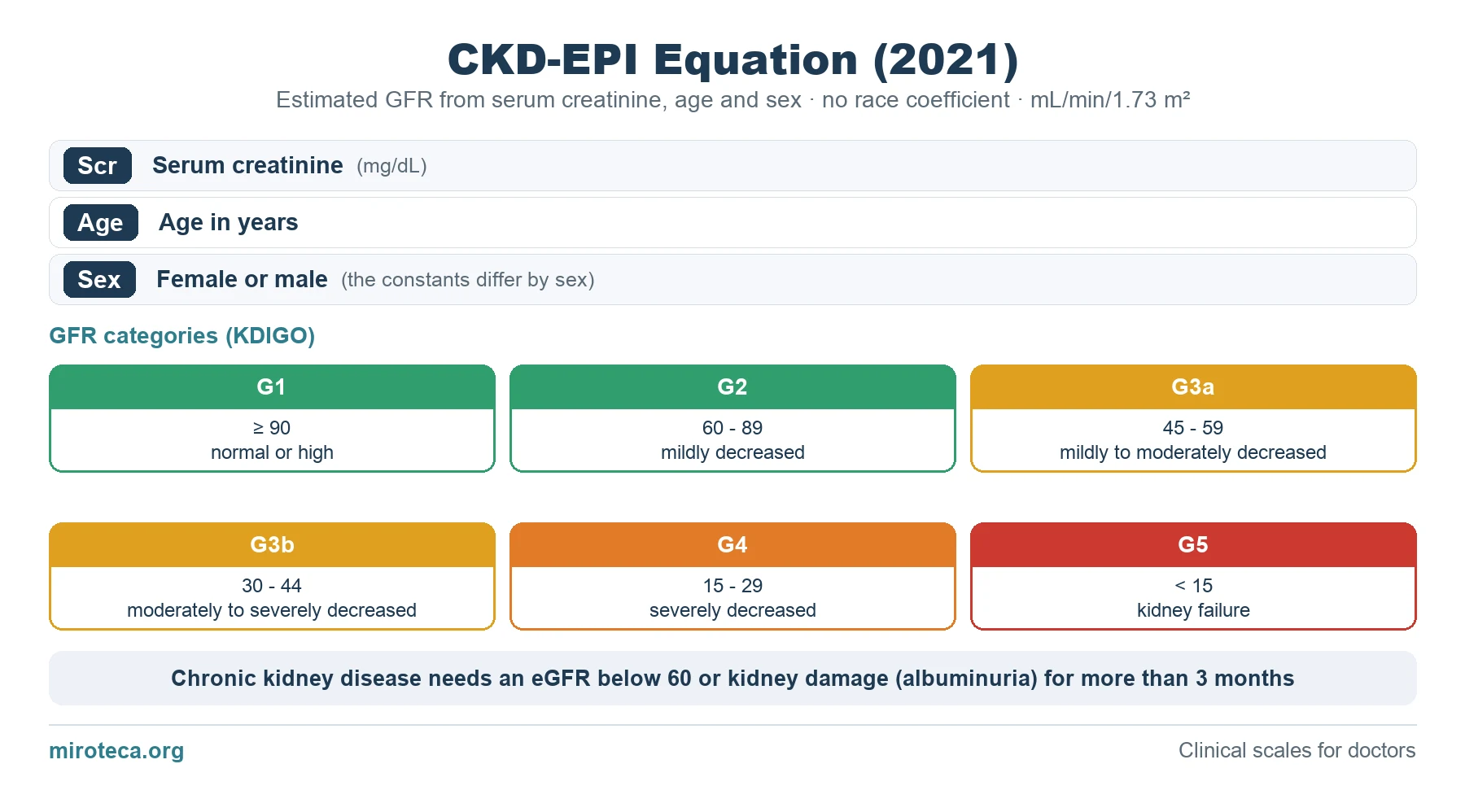
The CKD-EPI equation calculates the estimated glomerular filtration rate (eGFR) from serum creatinine. It is the formula currently recommended to assess kidney function and to classify chronic kidney disease (CKD). It uses the serum creatinine, the age and the sex, and the recent version (2021) removed the adjustment for race.
The result is given in mL/min/1.73 m² and is placed in one of the six categories G1 to G5 shown on the chart, from 90 or more down to below 15.
The 2021 equation in the calculator on this page is: eGFR = 142 × min(Scr/κ, 1)α × max(Scr/κ, 1)−1.200 × 0.9938age × 1.012 if female, with κ = 0.7 and α = −0.241 in women, and κ = 0.9 and α = −0.302 in men; creatinine in mg/dL.
The detail that settles it
CKD-EPI is more precise than the older MDRD equation, above all when the filtration rate is high or close to normal. For that reason it is preferred to MDRD to classify CKD and to adjust drugs at values near normal.
Creatinine on its own is misleading: it depends on muscle mass, age and sex, which is why an equation that adjusts for them is used instead of the raw value.
Where it does not apply
These equations are not reliable in unstable situations such as acute kidney injury, pregnancy, amputees or a very large muscle mass; there a measured clearance is preferable. The diagnosis of CKD requires the abnormality (eGFR below 60 or kidney damage such as albuminuria) to persist for more than 3 months, which is why the KDIGO classification combines the eGFR with albuminuria.
Common mistakes
Using MDRD at high filtration rates, where it is less accurate. Calling a result in G1 or G2 chronic kidney disease: by themselves they do not define it, and there must also be kidney damage. Applying the equation in acute kidney injury or other unstable situations.
In exam questions
In a patient with a slightly raised creatinine, CKD-EPI estimates the filtration rate more reliably than MDRD. Questions tend to ask for the concept: why plain creatinine misleads, why an equation is used, and why the equation is not reliable when the situation is unstable.
Keep practicing
This page is the visual summary. To test yourself with real clinical reasoning, Medicinedle, a Wordle-inspired game, gives you one clinical case a day: guess the diagnosis in six tries, with a new clue after every miss. It is free and available in English.