
What the chart shows
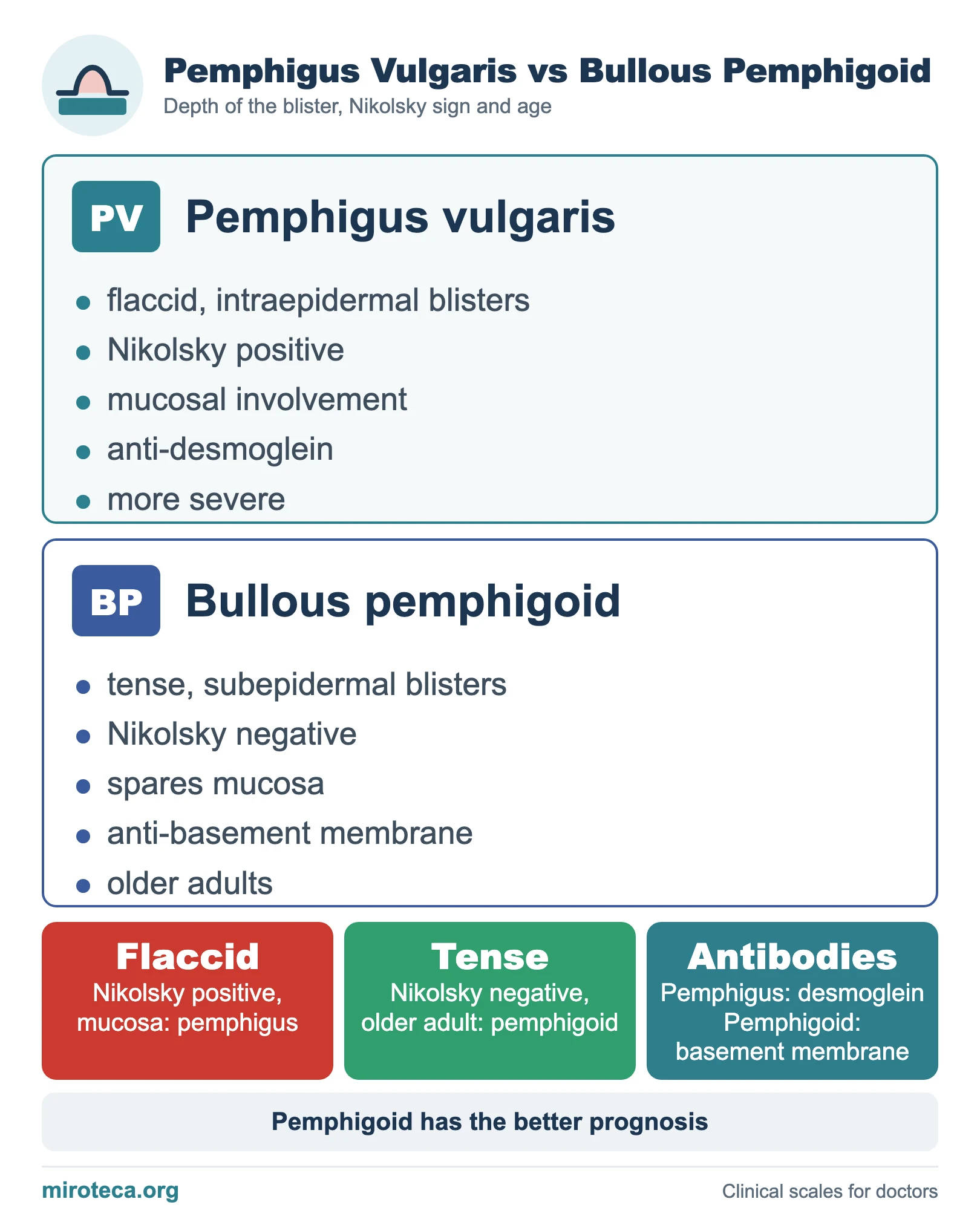
Two autoimmune blistering diseases that are told apart by the depth of the blister, the Nikolsky sign and the age of the patient. The chart lines up the findings of each.
The detail that settles it
Pemphigus vulgaris has intraepidermal, flaccid blisters, a positive Nikolsky sign, mucosal involvement and anti-desmoglein antibodies (desmosomes); it is severe. Bullous pemphigoid has subepidermal, tense blisters, a negative Nikolsky sign, spares the mucosa more, affects older adults and has antibodies against the basement membrane (a better prognosis).
Short rules: flaccid + Nikolsky positive + mucosa means pemphigus vulgaris; tense + Nikolsky negative + older adult means pemphigoid. Pemphigus is desmoglein; pemphigoid is basement membrane.
In exam questions
Questions describe the blister and the biopsy or immunofluorescence finding and ask which disease it is; the depth of the blister and the target antigen settle it.
Keep practicing
This page is the visual summary. To test yourself with real clinical reasoning, Medicinedle, a Wordle-inspired game, gives you one clinical case a day: guess the diagnosis in six tries, with a new clue after every miss. It is free and available in English.