Skip to content

Forrest classification: bleeding peptic ulcer and rebleeding risk

Reviewed by doctors · Last reviewed: November 2026▶ Play today's clinical caseMedicinedle · a Wordle-style case game · free
Advertisement
Advertisement

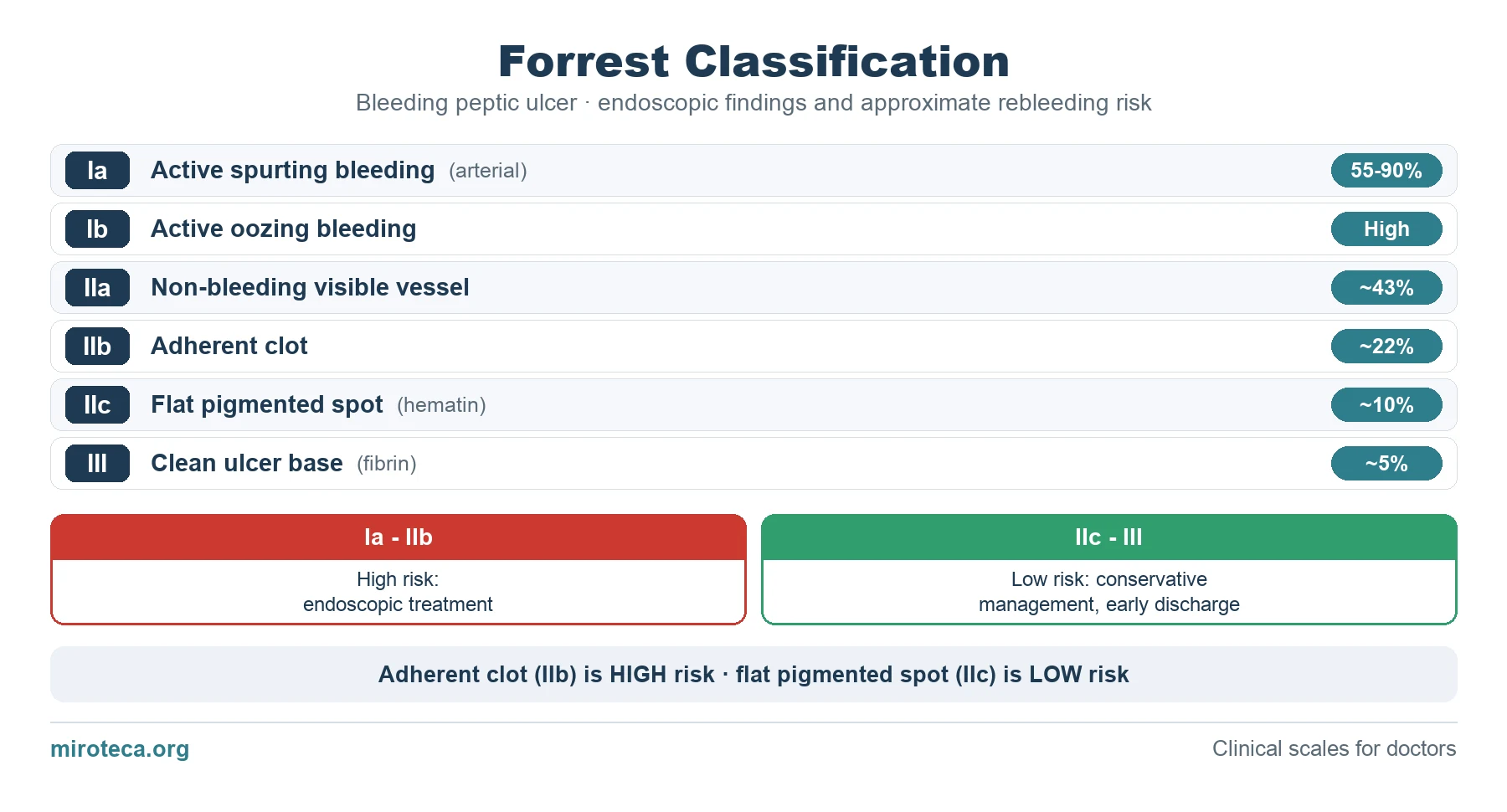
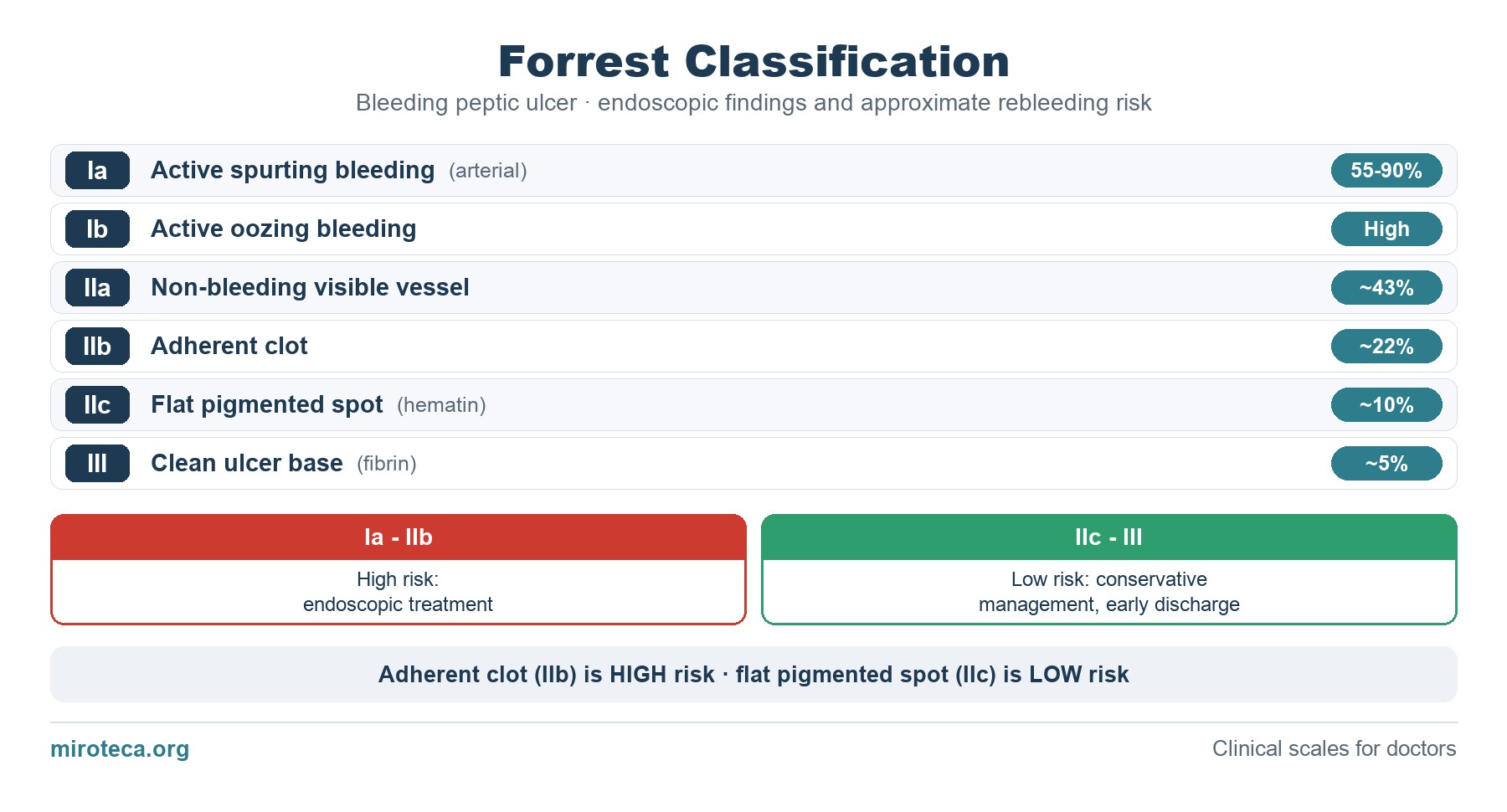
The Forrest classification describes the endoscopic stigmata of a bleeding peptic ulcer, from Ia (spurting) to III (clean base), and predicts the risk of rebleeding.

Forrest classification chart: Ia spurting, Ib oozing, IIa visible vessel, IIb adherent clot, IIc flat pigmented spot and III clean base, with approximate rebleeding risk
⬇ Download the diagramView full size⬇ Download as PDF

Free to use for study and teaching with attribution to MIROTECA · terms of use

Forrest I to IIb: high risk, endoscopic treatment. IIc and III: low risk, conservative management.

More diagrams: Ottawa ankle rules · Modified Rankin Scale (mRS) · Confusion Assessment Method (CAM)

What the diagram shows

The Forrest classification describes the endoscopic stigmata of a bleeding peptic ulcer and predicts the risk of rebleeding. The right-hand column shows the approximate rebleeding risk of each type.

The detail that settles it

The more "active" the lesion looks (spurting, visible vessel), the higher the risk and the clearer the indication for endoscopic treatment. A clean base (Forrest III) usually allows early discharge.

Common mistakes

Discharging a high-risk ulcer (Forrest I to IIb) early without treating it.

Confusing the adherent clot (IIb, high risk) with the flat pigmented spot (IIc, low risk).

In exam questions

Questions usually describe what the endoscopist sees and ask whether to treat endoscopically or how high the rebleeding risk is.

Keep practicing

This page is the visual summary. To test yourself with real clinical reasoning, Medicinedle, a Wordle-inspired game, gives you one clinical case a day: guess the diagnosis in six tries, with a new clue after every miss. It is free and available in English.

Play today's case →

Advertisement

Frequently asked questions

What are the Forrest classification types?

Ia: active spurting bleeding (arterial). Ib: active oozing. IIa: non-bleeding visible vessel. IIb: adherent clot. IIc: flat pigmented spot (hematin). III: clean ulcer base (fibrin).

Which Forrest types need endoscopic treatment?

Forrest I to IIb are high risk and need endoscopic treatment; IIc and III are low risk and are managed conservatively. A clean base (Forrest III) usually allows early discharge.

What is the most common mistake?

Confusing the adherent clot (IIb, high risk) with the flat pigmented spot (IIc, low risk), or discharging a high-risk ulcer early without treating it.

Related

See all medical diagrams