
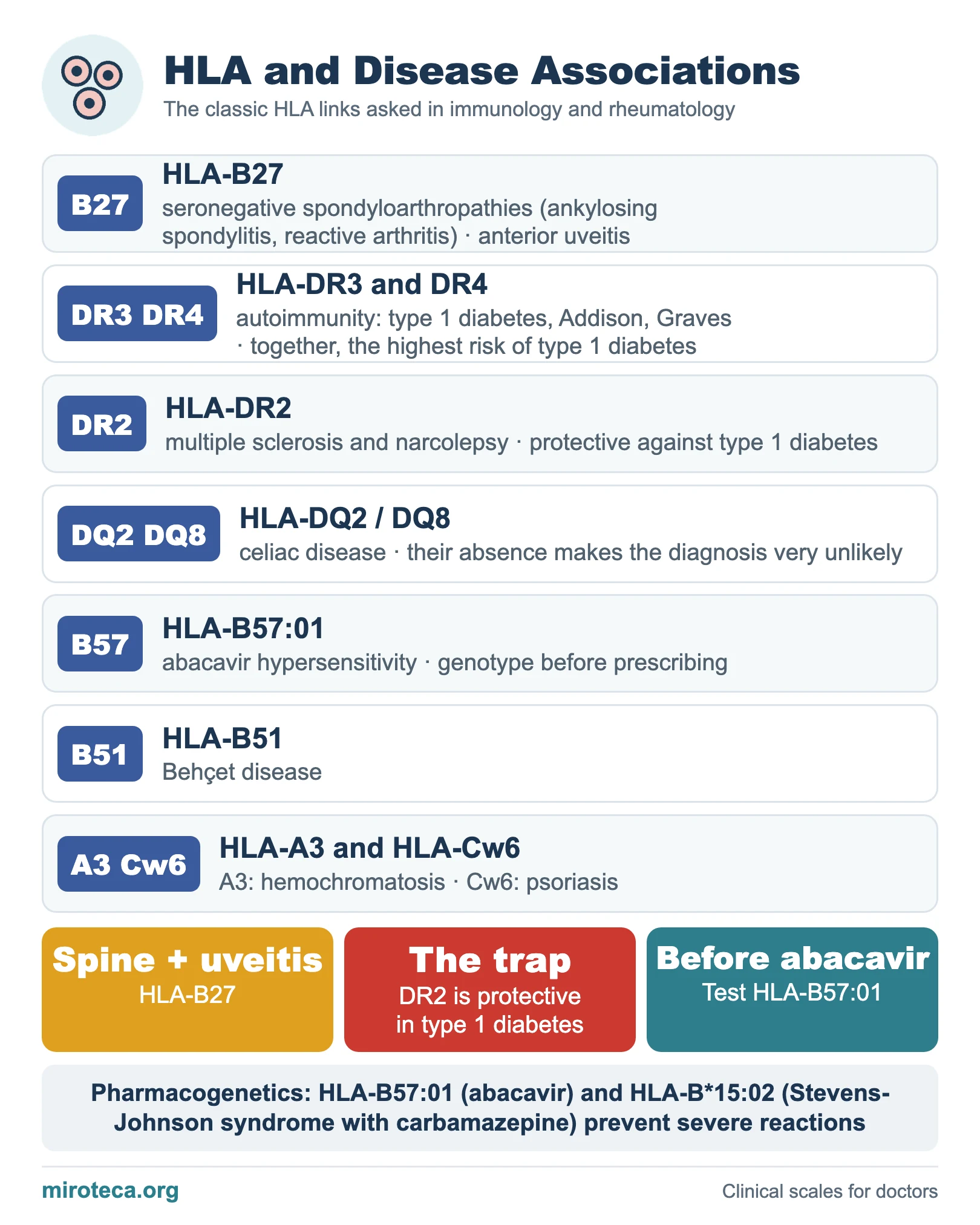
What the chart shows
The associations between HLA antigens and diseases are a classic of immunology and rheumatology exams. The chart gathers the most asked ones, including the main trap, the protective HLA-DR2.
The detail that settles it
HLA-B27 links to the seronegative spondyloarthropathies (ankylosing spondylitis, reactive arthritis) and anterior uveitis. HLA-DR3 and DR4 are strongly autoimmune (type 1 diabetes, Addison disease, Graves disease); together they give the highest risk of type 1 diabetes. HLA-DR2 is associated with multiple sclerosis and narcolepsy and is protective against type 1 diabetes. HLA-DQ2 and DQ8 point to celiac disease, and their absence makes the diagnosis very unlikely (high negative predictive value). HLA-B57:01 means abacavir hypersensitivity and is genotyped before prescribing. HLA-B51 is linked to Behçet disease; also HLA-Cw6 to psoriasis and HLA-A3 to hemochromatosis.
In exam questions
Questions ask for the disease tied to an HLA type, or the reverse, and almost always include the DR2 trap. A practical application that scores: HLA-B57:01 and HLA-B*15:02 (the latter, risk of Stevens-Johnson syndrome with carbamazepine) are examples of pharmacogenetics that avoid severe reactions. See also DAS28.
Keep practicing
This page is the visual summary. To test yourself with real clinical reasoning, Medicinedle, a Wordle-inspired game, gives you one clinical case a day: guess the diagnosis in six tries, with a new clue after every miss. It is free and available in English.