
What the diagram shows
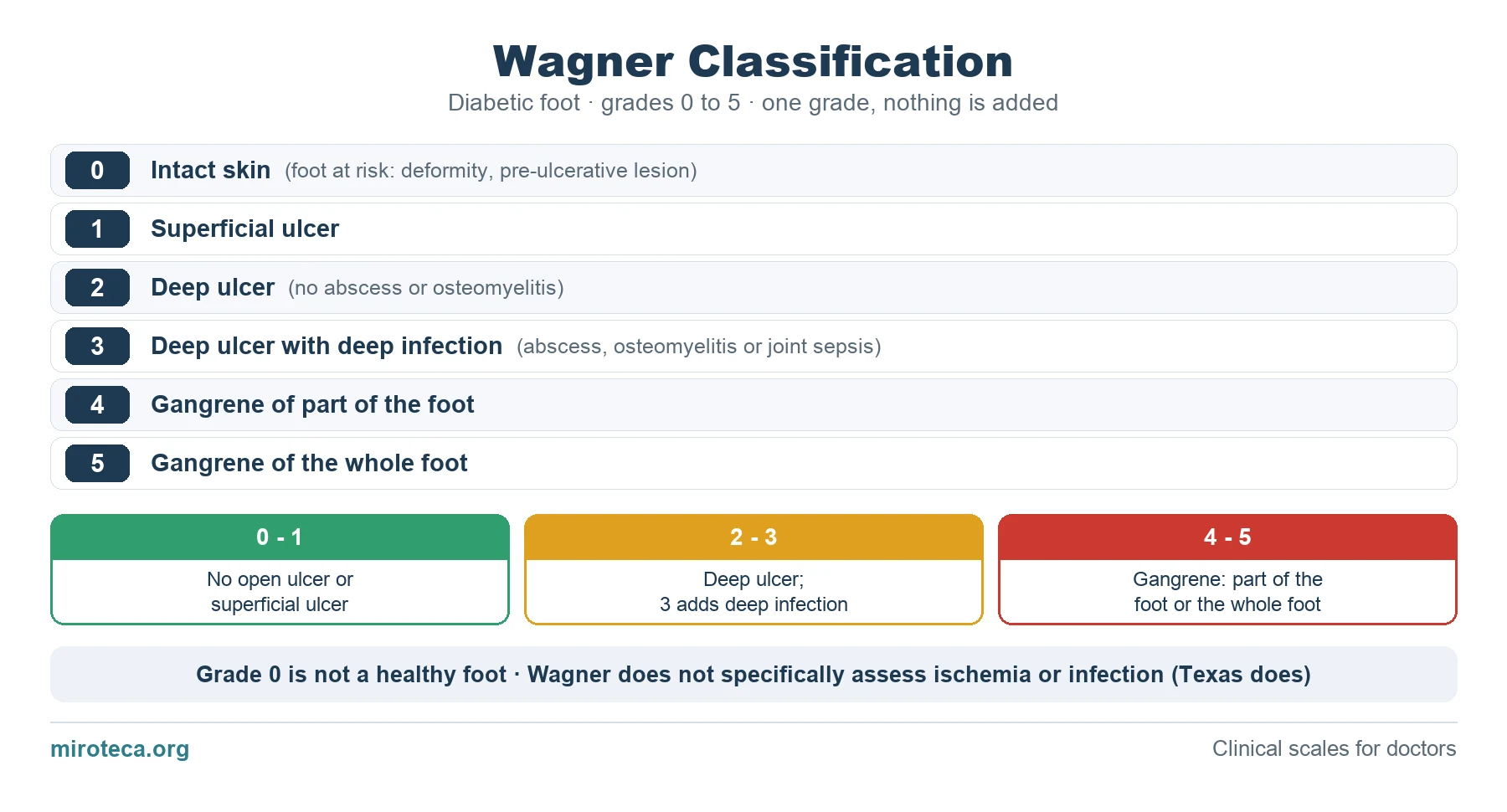
The Wagner classification describes the severity of diabetic foot lesions in six grades, from 0 to 5. It is based mainly on the depth of the ulcer, on the presence of abscess or osteomyelitis and on the extent of gangrene.
Grades 1 to 3 follow depth, grade 3 adds deep infection, and grades 4 and 5 describe partial or whole-foot gangrene.
The detail that settles it
Nothing is added: one single grade is assigned, the one that best describes the lesion. Grade 0 is not a "normal foot": it describes a foot at risk with no open ulcer.
The classification does not specifically assess ischemia or infection, something the University of Texas system does.
Where sources differ
In the most widespread wording of Wagner, an ulcer that reaches bone without osteomyelitis or abscess is grade 2, whereas in the University of Texas classification a wound that penetrates to bone or joint is grade 3. The same foot can therefore be "grade 2" in one system and "grade 3" in the other. Teaching sources also word grades 0 and 2 slightly differently; the text of the local protocol should be checked.
Common mistakes
Reading grade 0 as a normal foot, forgetting that it does not measure ischemia or infection, and comparing Wagner grades with Texas grades as if they were equivalent.
Keep practicing
This page is the visual summary. To test yourself with real clinical reasoning, Medicinedle, a Wordle-inspired game, gives you one clinical case a day: guess the diagnosis in six tries, with a new clue after every miss. It is free and available in English.