
What the diagram shows
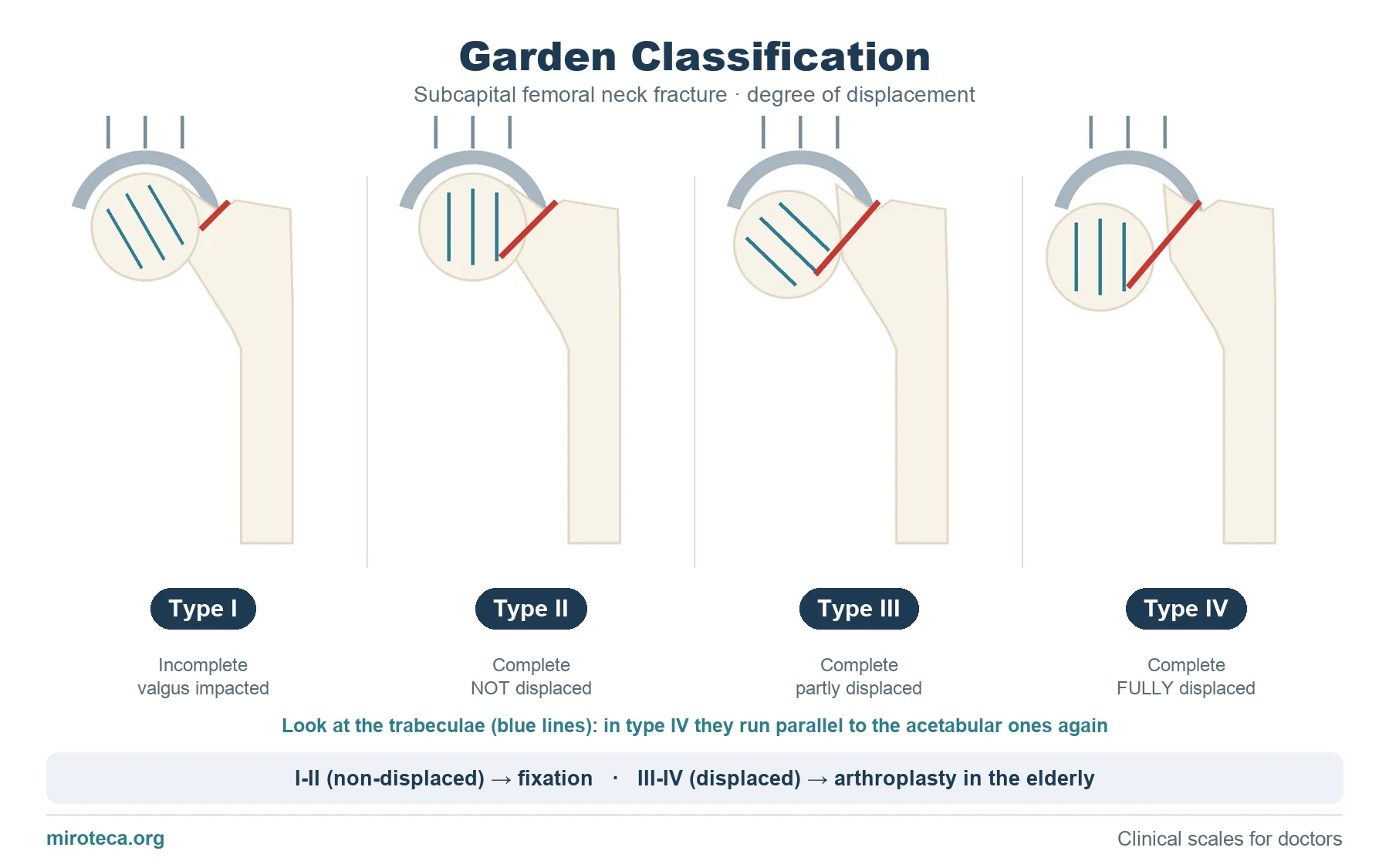
Garden classifies subcapital femoral neck fractures by how far the head has moved, which a drawing shows at a glance.
The clue most people miss is the trabeculae: the blue lines inside the femoral head, to be compared with those of the acetabulum (the gray ones above).
The detail that settles it
The Garden IV paradox is the most frequently tested point: the trabeculae are parallel to the acetabular ones again, just as in type II. What separates them is that in type IV the head is completely detached from the neck. Look at both things, not only the trabeculae.
Common mistakes
The costliest error is not one of imaging but of decision: trying to fix a displaced fracture with screws in an older patient. Types I and II (non-displaced) go to fixation; III and IV (displaced) go to arthroplasty in the elderly because of the risk of necrosis.
The other mistake is confusing Garden with Pauwels: Garden measures displacement, Pauwels measures the angle of the fracture line.
Keep practicing
This page is the visual summary. To test yourself with real clinical reasoning, Medicinedle, a Wordle-inspired game, gives you one clinical case a day: guess the diagnosis in six tries, with a new clue after every miss. It is free and available in English.