
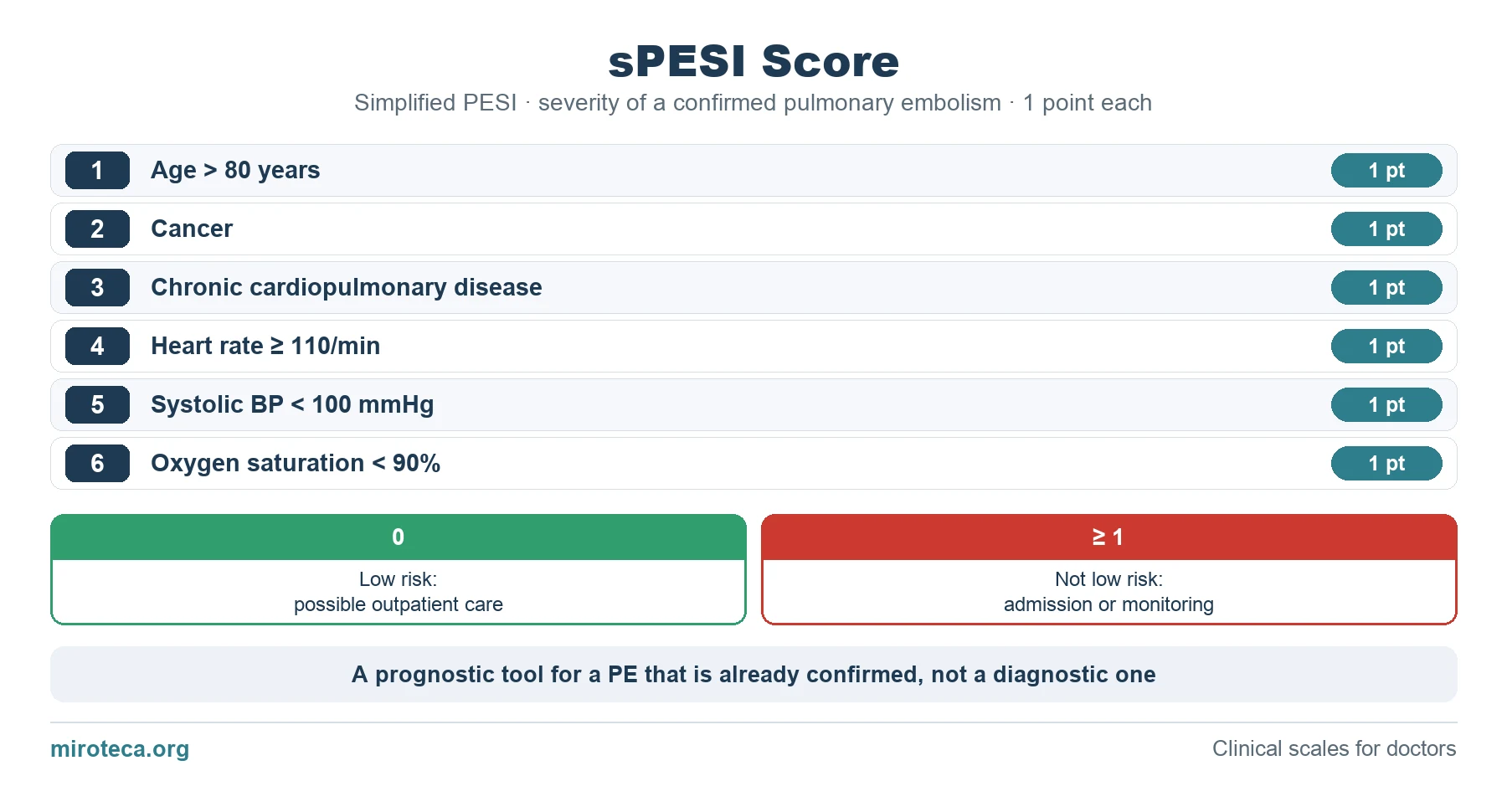
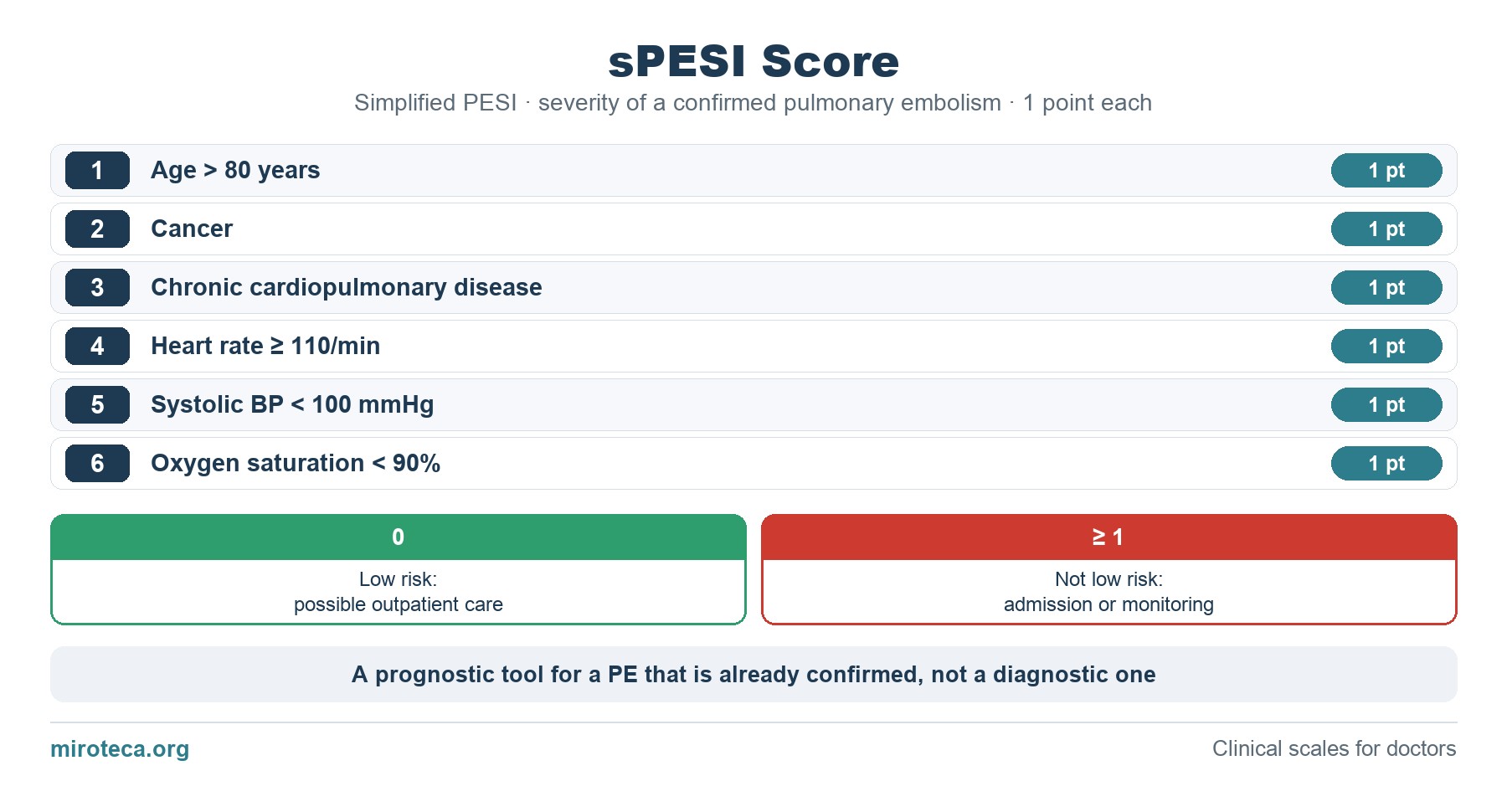
What the diagram shows
The sPESI (simplified PESI) stratifies the severity of a pulmonary embolism that has already been confirmed. Its main purpose is to detect low-risk patients who could be treated as outpatients or discharged early.
It adds 1 point for each of six factors: age over 80, cancer, chronic cardiopulmonary disease, heart rate of 110 or more, systolic pressure below 100 mmHg and oxygen saturation below 90%.
The detail that settles it
A score of 0 means low risk and possible home management with anticoagulation if everything else fits. A score of 1 or more is not low risk and calls for admission or monitoring. It is the simplified version of the original PESI, easier to remember and with the same prognostic ability.
Common mistakes
Applying it to diagnose PE: it is a prognostic tool, not a diagnostic one.
In exam questions
Questions usually ask where it fits: first the diagnosis is confirmed (clinical probability, D-dimer and CT angiography; see Revised Geneva and Wells) and then risk is stratified. Patients at high risk, with hemodynamic instability, are a different story and need thrombolysis. In the intermediate group, markers of right ventricular dysfunction (troponin, BNP, echocardiogram) are monitored.
Keep practicing
This page is the visual summary. To test yourself with real clinical reasoning, Medicinedle, a Wordle-inspired game, gives you one clinical case a day: guess the diagnosis in six tries, with a new clue after every miss. It is free and available in English.