
What the diagram shows
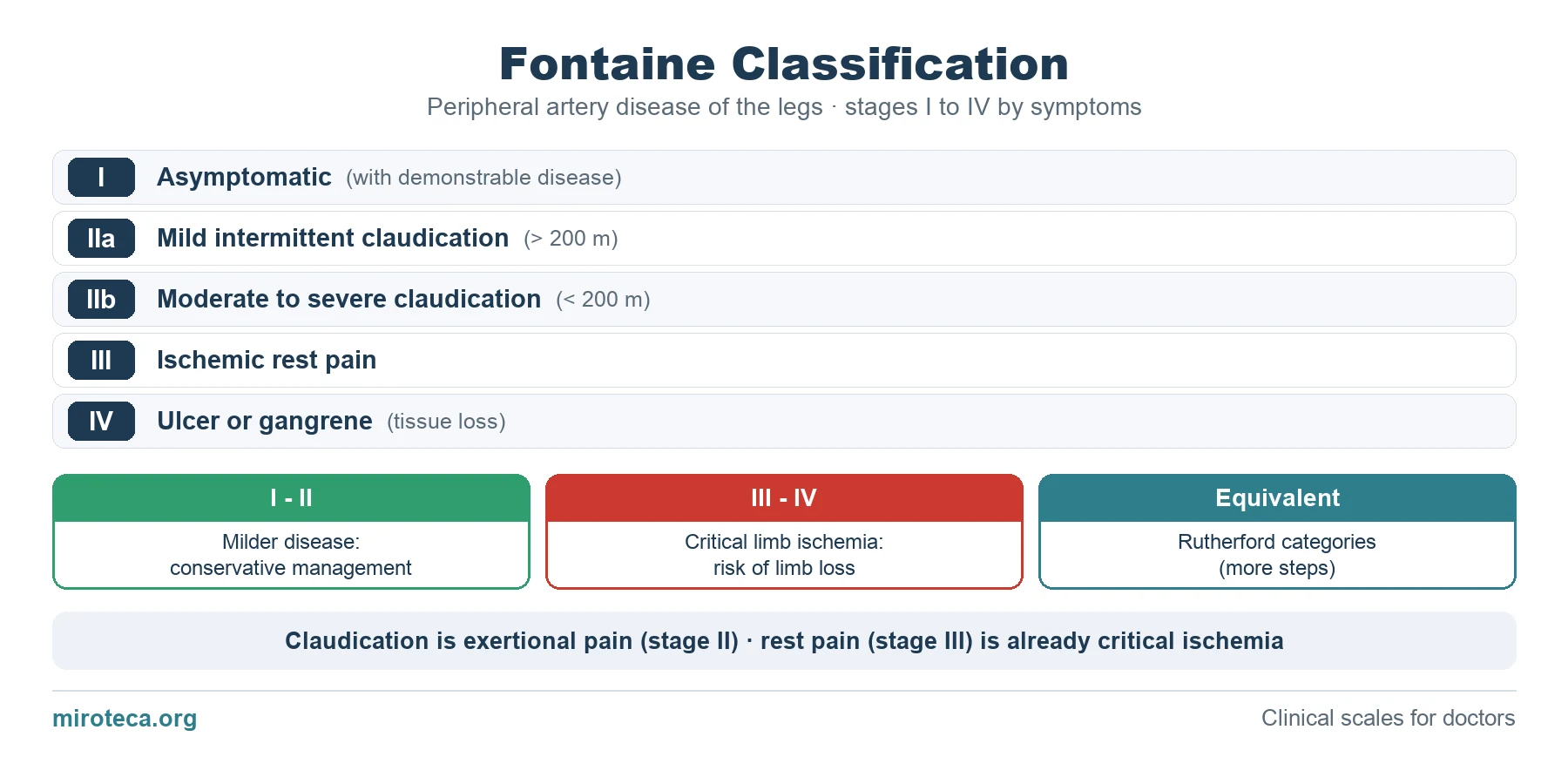
The Fontaine classification describes the stage of peripheral artery disease of the legs (poor circulation through the leg arteries) according to symptoms. It helps to understand severity and to decide treatment.
It is based on symptoms only: no symptoms, intermittent claudication (pain when walking), rest pain and trophic lesions (ulcers or gangrene).
The detail that settles it
The key jump is between claudication (stages I to II) and critical ischemia (stages III to IV). The first is managed conservatively: strict control of risk factors, antiplatelet therapy, statins and, above all, supervised exercise and quitting smoking. Critical ischemia means a risk of losing the limb and calls for urgent assessment for revascularization.
The ankle-brachial index confirms the disease when it is below 0.9; a value above 1.4 suggests calcification, typical of diabetes.
Common mistakes
Confusing the pain of claudication (it appears with effort, stage II) with rest pain (stage III, already critical ischemia). Another mistake is overlooking that stages III and IV need urgent assessment for revascularization.
In exam questions
Questions usually describe a patient who feels calf pain when walking less than 200 meters that stops when resting: Fontaine IIb. Fontaine is equivalent to the Rutherford classification, which has more steps. Remember that peripheral artery disease is a marker of global cardiovascular risk: these patients die more often from infarction or stroke than from the leg itself.
Keep practicing
This page is the visual summary. To test yourself with real clinical reasoning, Medicinedle, a Wordle-inspired game, gives you one clinical case a day: guess the diagnosis in six tries, with a new clue after every miss. It is free and available in English.