
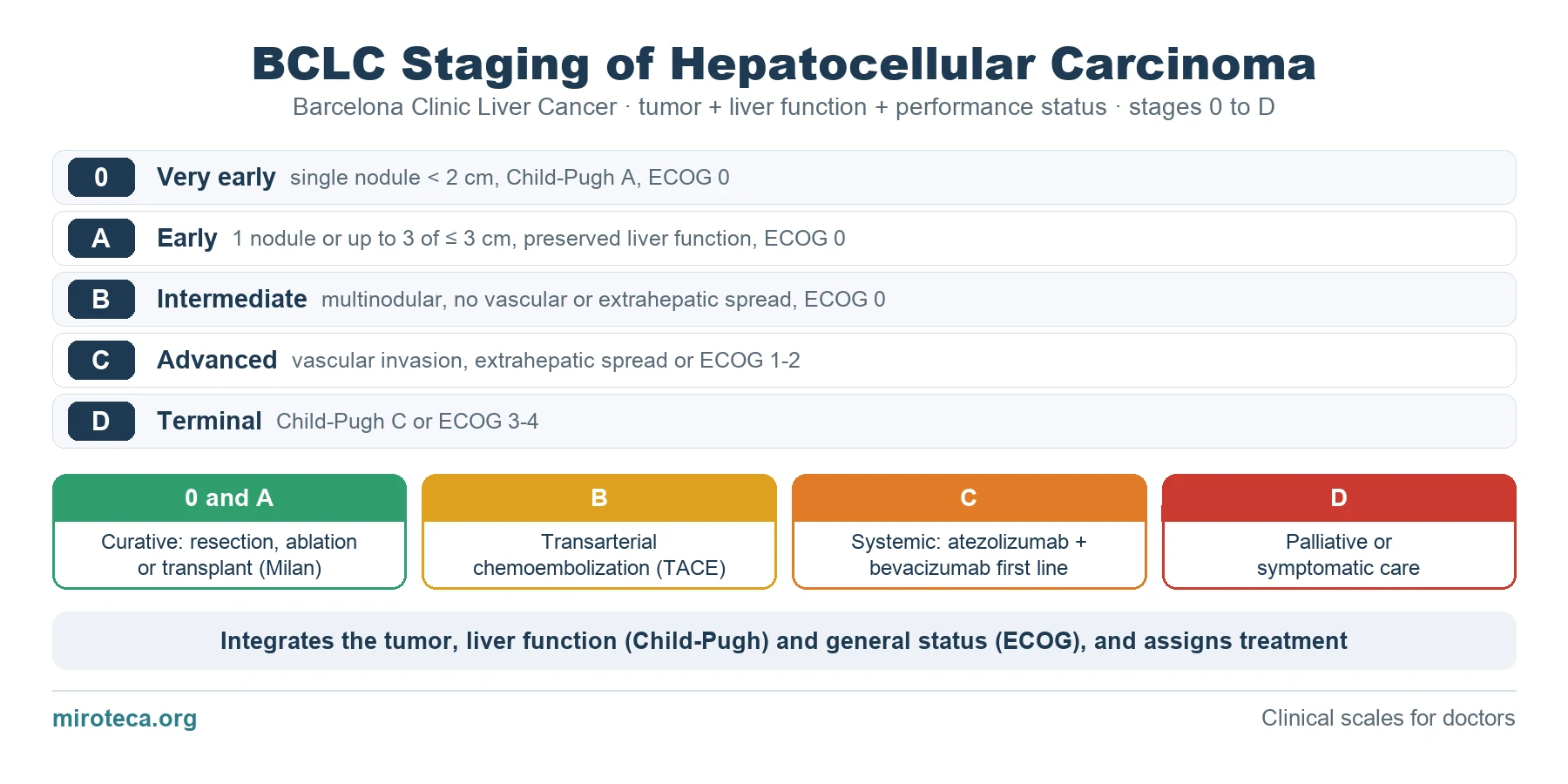
What the diagram shows
The Barcelona Clinic Liver Cancer (BCLC) classification is the most used for hepatocellular carcinoma. Its great advantage is that it does not only stage: it integrates three dimensions, tumor extent, liver function (Child-Pugh) and general status (ECOG), and links each stage to the recommended treatment.
The stages are 0 (very early), A (early), B (intermediate), C (advanced) and D (terminal).
The detail that settles it
Early stages (0 and A) get curative treatment: resection, ablation or transplant if the Milan criteria are met (a single nodule of 5 cm or less, or up to 3 nodules of 3 cm or less, with no vascular or extrahepatic invasion). Stage B gets transarterial chemoembolization. In advanced stage C the treatment is systemic: atezolizumab plus bevacizumab is first line, with sorafenib and lenvatinib as alternatives, and immunotherapy has displaced sorafenib. Stage D gets palliative care.
Common mistakes
Thinking that BCLC looks only at the tumor: it also assesses liver function and general status. Confusing the Milan criteria (transplant) with the BCLC stage. Indicating TACE in advanced disease with vascular invasion, where the treatment is systemic.
In exam questions
Questions usually give a case and ask for the therapeutic approach. A hepatocellular carcinoma with a single 4 cm nodule, Child-Pugh A and ECOG 0 is BCLC A, a candidate for curative treatment. Prognosis depends as much on the tumor as on the underlying liver, since most of these tumors arise on a cirrhosis.
Keep practicing
This page is the visual summary. To test yourself with real clinical reasoning, Medicinedle, a Wordle-inspired game, gives you one clinical case a day: guess the diagnosis in six tries, with a new clue after every miss. It is free and available in English.