
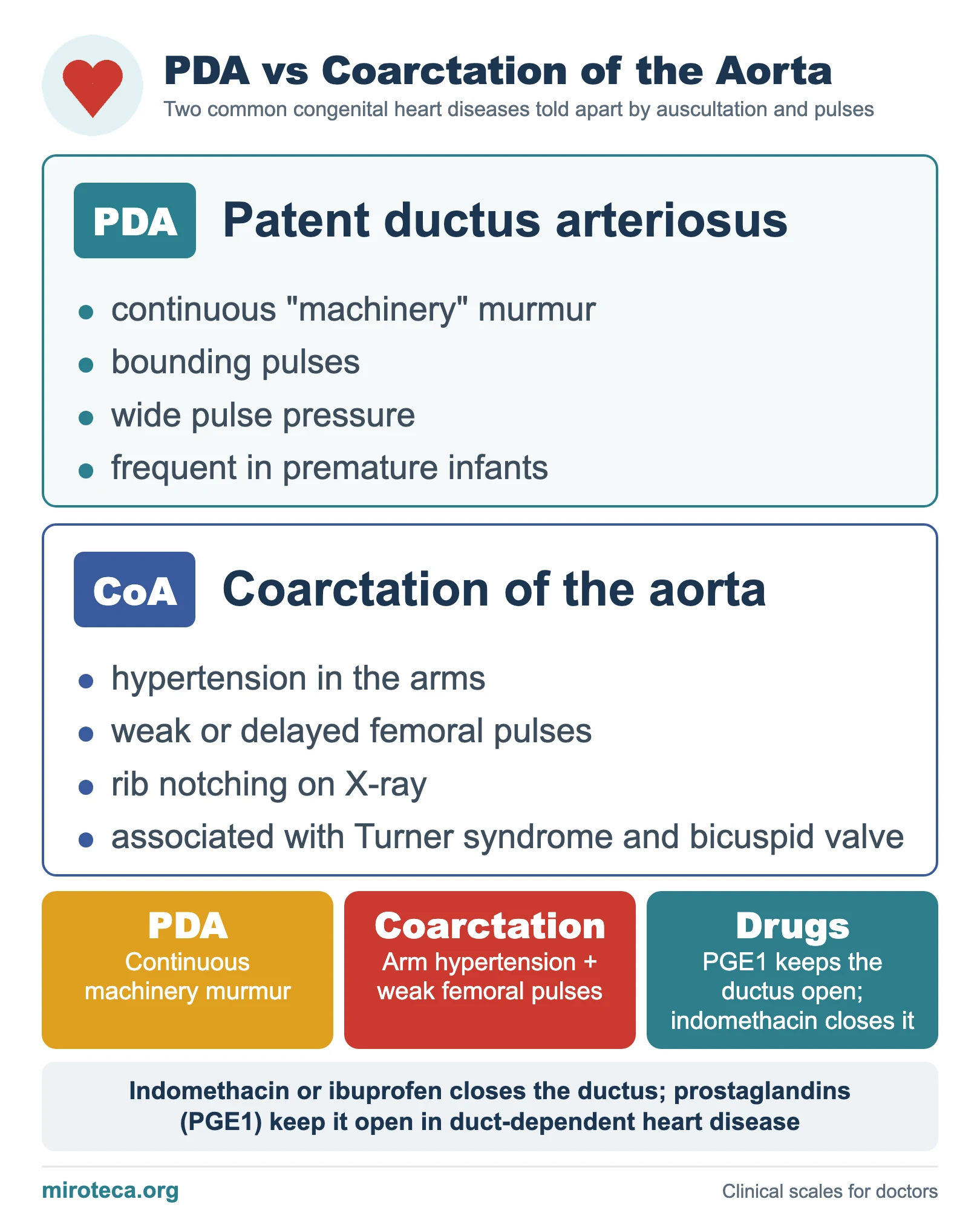
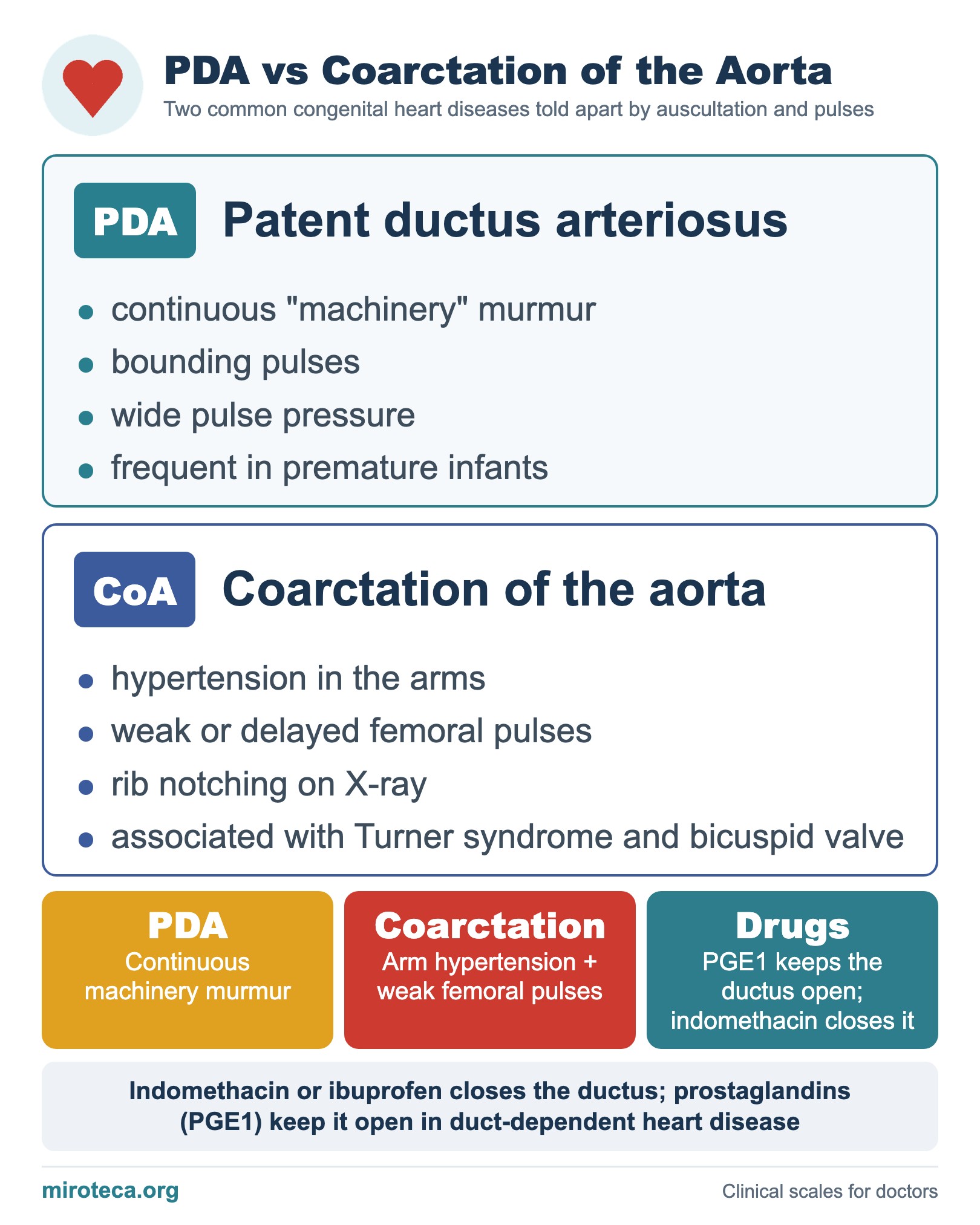
What the chart shows
Two very frequently asked congenital heart diseases that are told apart by auscultation and pulses. The chart sets the findings of patent ductus arteriosus (PDA) next to those of coarctation of the aorta.
The detail that settles it
The patent ductus gives a continuous "machinery" murmur under the left clavicle and bounding pulses; it is frequent in premature infants. Indomethacin or ibuprofen closes it and prostaglandins (PGE1) keep it open, which is useful in duct-dependent heart disease. Coarctation of the aorta runs with hypertension in the upper limbs and weak or delayed femoral pulses, the "rib notching" sign on X-ray and an association with Turner syndrome.
In exam questions
Short rules: a continuous machinery murmur means ductus; hypertension in the arms with weak femoral pulses means coarctation; PGE1 opens the ductus and indomethacin closes it.
Keep practicing
This page is the visual summary. To test yourself with real clinical reasoning, Medicinedle, a Wordle-inspired game, gives you one clinical case a day: guess the diagnosis in six tries, with a new clue after every miss. It is free and available in English.