
What the diagram shows
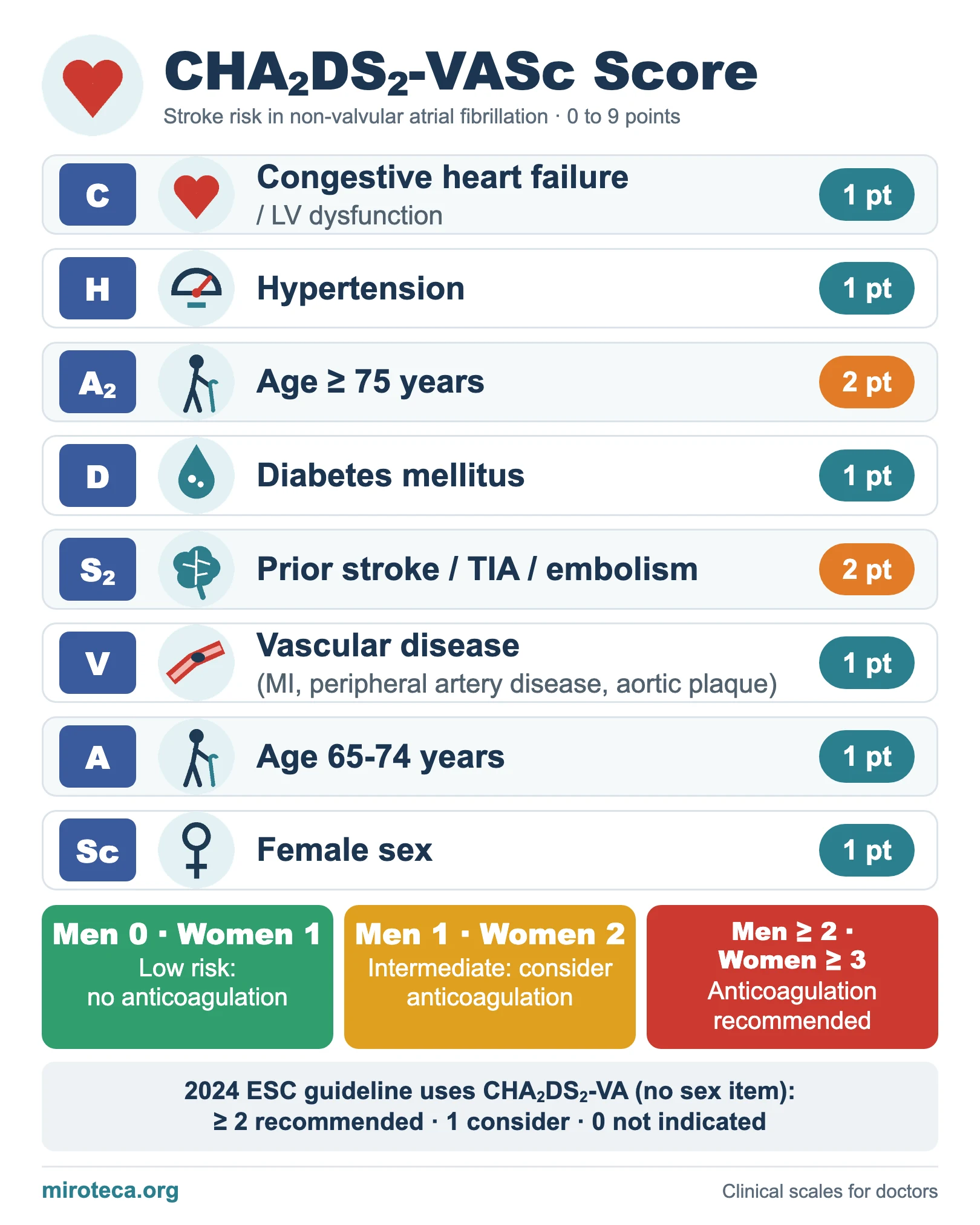
CHA₂DS₂-VASc estimates the risk of stroke or embolism in non-valvular atrial fibrillation and guides the decision to anticoagulate.
Each row is a letter of the rule with its points. The total runs from 0 to 9, and the cards below separate low risk, the intermediate zone and recommended anticoagulation.
Where the guidelines differ
The 2023 US guideline recommends anticoagulation at ≥ 2 in men and ≥ 3 in women, with a score of 1 in men and 2 in women in the intermediate zone.
The 2024 ESC guideline uses CHA₂DS₂-VA, which removes sex from the score: anticoagulation is recommended at ≥ 2, should be considered at 1 and is not indicated at 0. The diagram shows both.
The detail that settles it
Age scores in steps and is not added twice: 65 to 74 years is worth 1 and 75 or over is worth 2. A prior stroke is also worth 2, so on its own it reaches the threshold in a man.
Common mistakes
The most repeated mistake is applying the same number to men and women. In CHA₂DS₂-VASc, a woman with no other factors scores 1 for her sex alone and is still low risk.
Nor should it be confused with HAS-BLED: this score estimates stroke risk, the reason to anticoagulate, and HAS-BLED estimates bleeding risk, the main complication of treatment.
Keep practicing
This page is the visual summary. To test yourself with real clinical reasoning, Medicinedle, a Wordle-inspired game, gives you one clinical case a day: guess the diagnosis in six tries, with a new clue after every miss. It is free and available in English.