
What the diagram shows
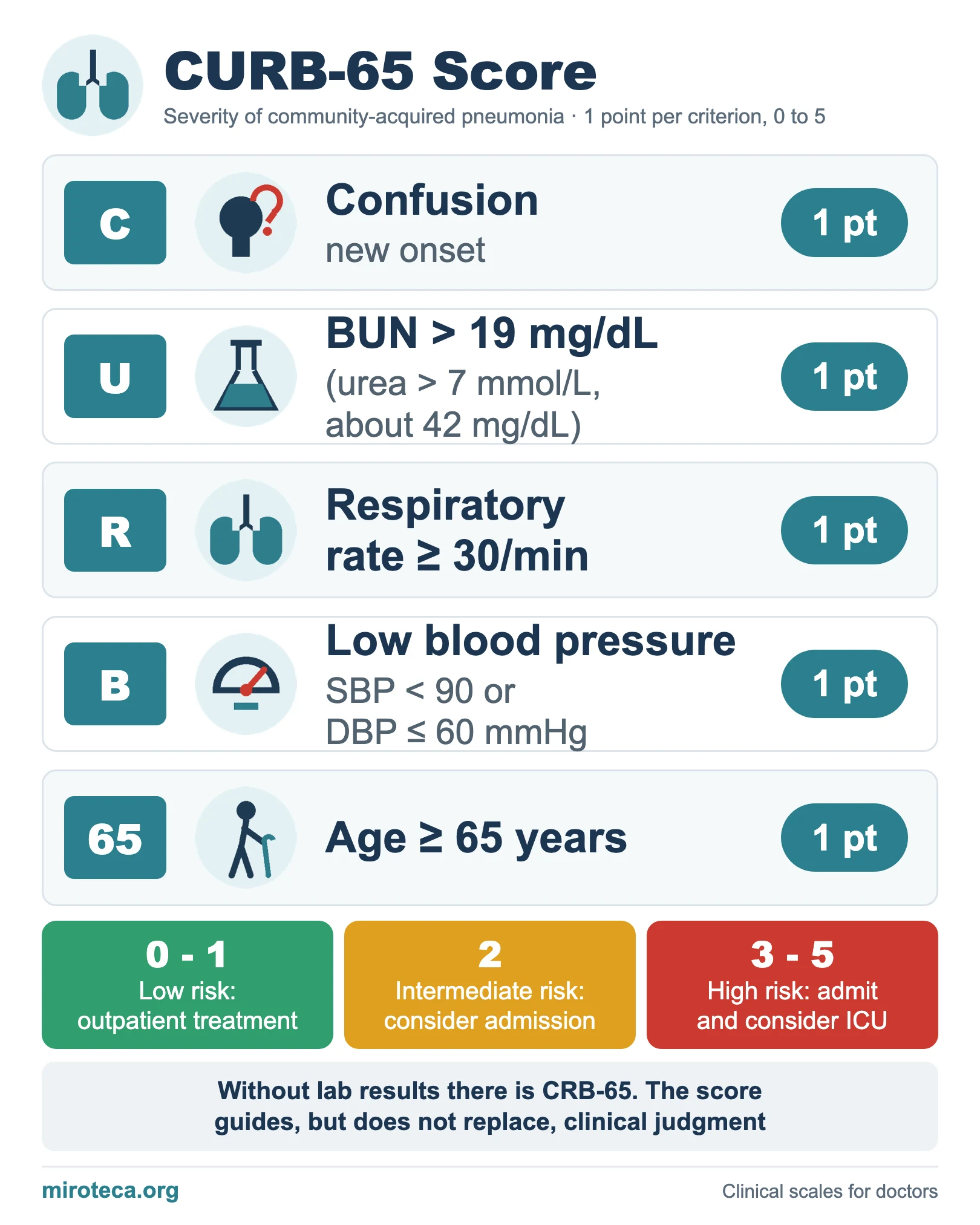
CURB-65 helps to decide whether community-acquired pneumonia can be treated at home, needs admission or even the ICU.
Each letter is a criterion and all are worth the same, 1 point. The cards below turn the sum into three risk categories.
The detail that settles it
The cut-off signs cause the most confusion: urea is strictly above 7 mmol/L (BUN above 19 mg/dL; 7 mmol/L of urea is about 42 mg/dL), while respiratory rate (≥ 30/min) and age (≥ 65 years) include the exact value.
The same goes for blood pressure: systolic below 90 mmHg or diastolic of 60 mmHg or less.
Common mistakes
The score guides disposition, but it does not replace clinical judgment or data it does not include, such as oxygen saturation or comorbidity.
When lab results are not immediately available, as in primary care, there is CRB-65, the same rule without urea.
Keep practicing
This page is the visual summary. To test yourself with real clinical reasoning, Medicinedle, a Wordle-inspired game, gives you one clinical case a day: guess the diagnosis in six tries, with a new clue after every miss. It is free and available in English.