
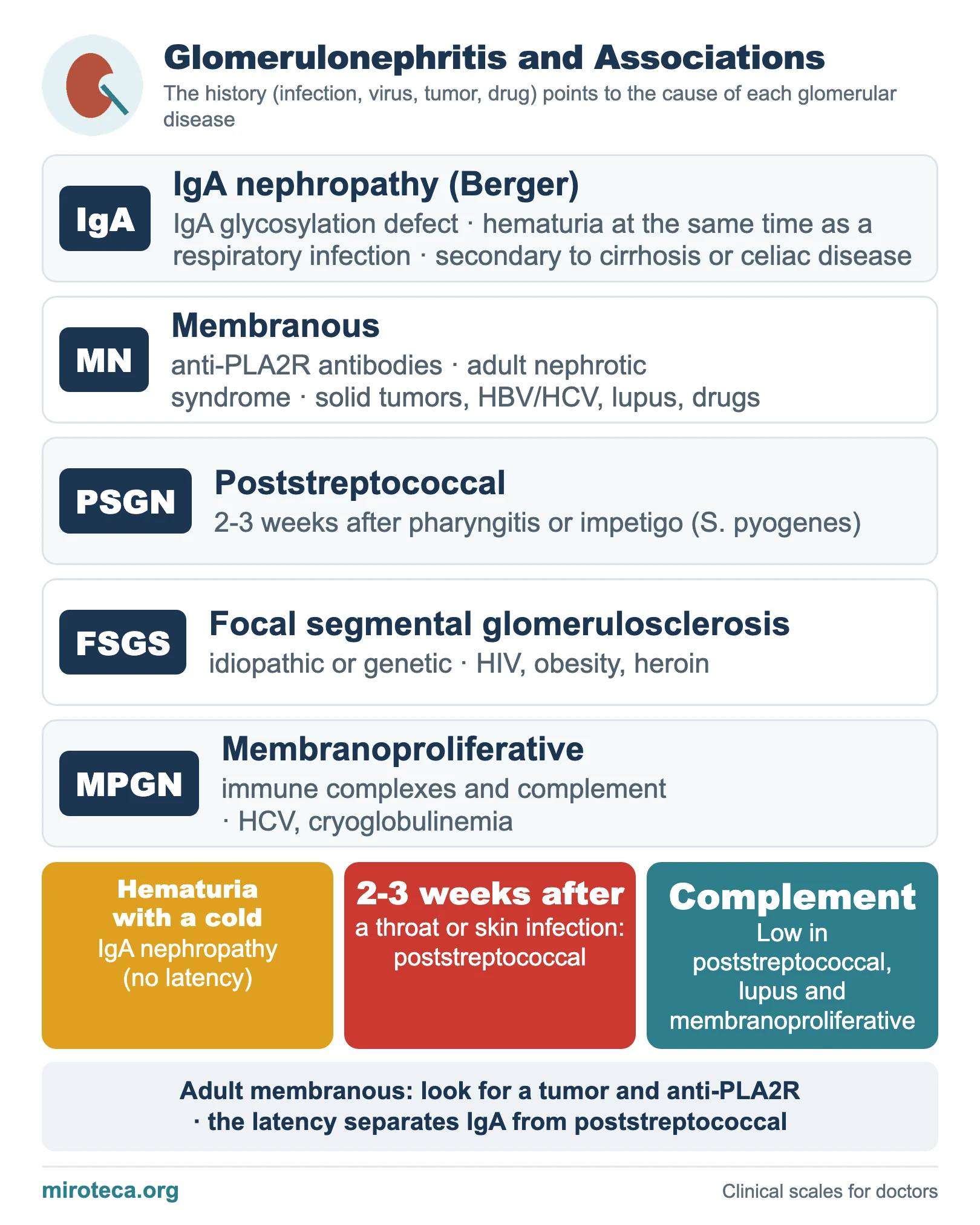
What the chart shows
Each glomerulonephritis has primary or secondary associations that exams use to identify it from a piece of history. The chart lists the five classic ones. For the clinical syndromes, see nephritic vs nephrotic syndrome.
The detail that settles it
These questions are solved by reading the history: an infection, a virus, a tumor or a drug points to the cause. IgA nephropathy (Berger) gives hematuria at the same time as a respiratory infection. Membranous nephropathy is linked to anti-PLA2R antibodies, solid tumors, hepatitis B and drugs. The poststreptococcal form appears 2-3 weeks after pharyngitis or impetigo. Focal segmental glomerulosclerosis relates to HIV, obesity and heroin, and membranoproliferative disease to hepatitis C and cryoglobulinemia.
Look at the complement as well: it is low in poststreptococcal, lupus and membranoproliferative disease.
In exam questions
Short rules: hematuria at the same time as the cold means IgA (Berger); adult membranous means look for a tumor or anti-PLA2R. The latency, with no delay in IgA and 2-3 weeks in the poststreptococcal form, is one of the most repeated traps. See also creatinine.
Keep practicing
This page is the visual summary. To test yourself with real clinical reasoning, Medicinedle, a Wordle-inspired game, gives you one clinical case a day: guess the diagnosis in six tries, with a new clue after every miss. It is free and available in English.