
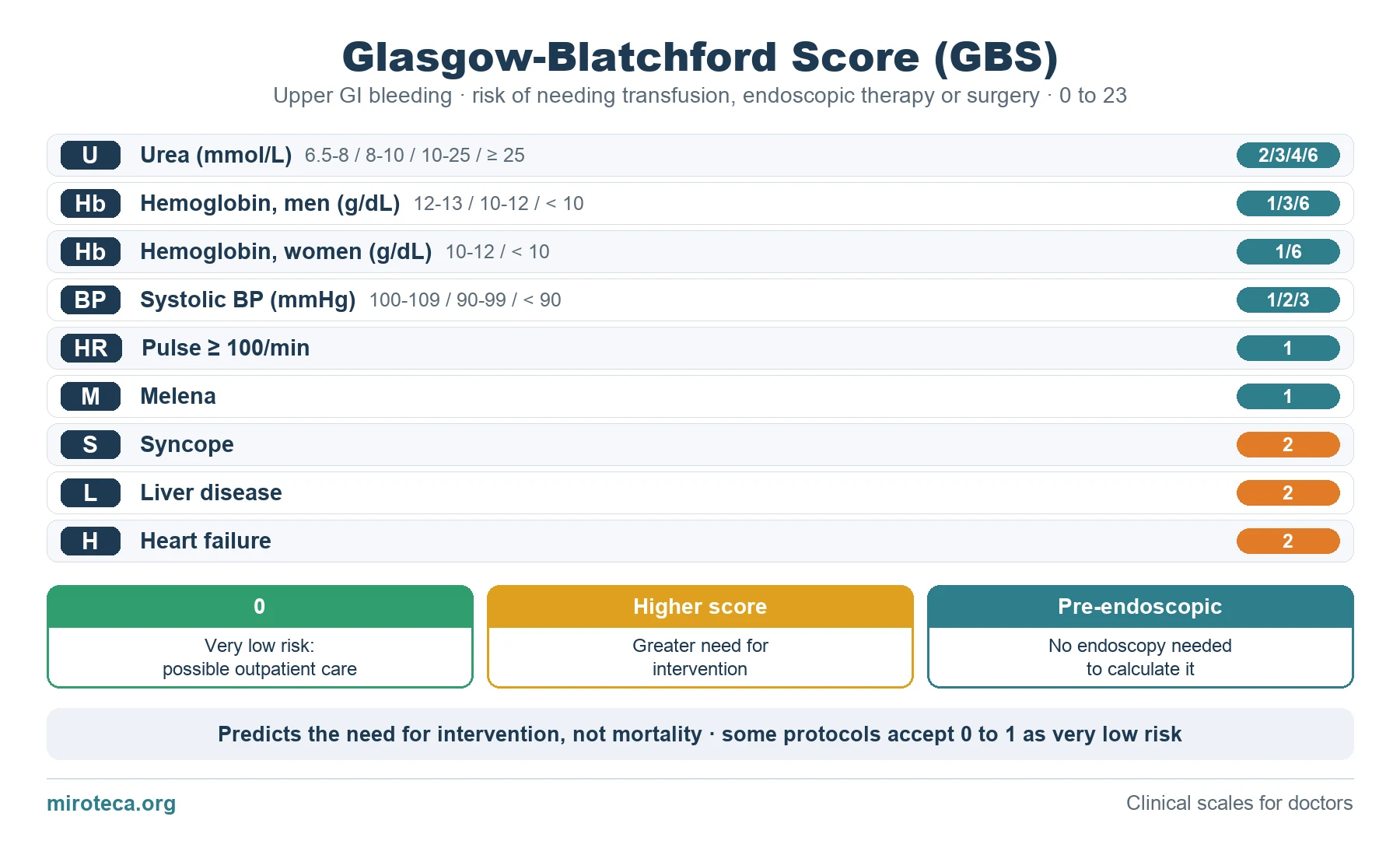
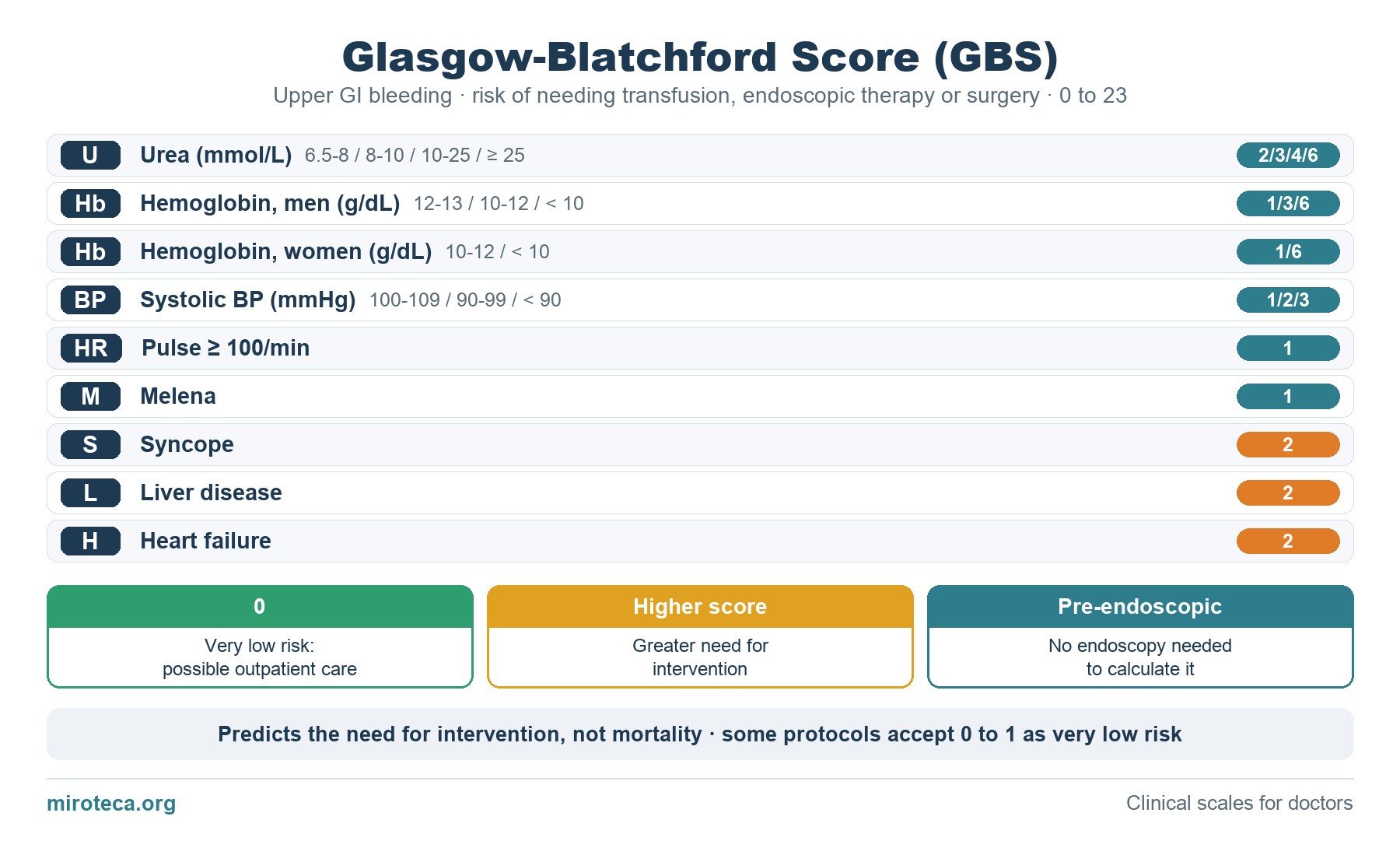
What the diagram shows
The Glasgow-Blatchford score (GBS) estimates, before endoscopy, the risk that an upper gastrointestinal bleed will need an intervention: transfusion, endoscopic therapy or surgery. Its great use is to identify very-low-risk patients who can be managed as outpatients.
It uses simple clinical and laboratory data and adds up to a maximum of 23 points. Urea is given in mmol/L as in the source sheet.
The detail that settles it
The GBS is a pre-endoscopic score: no endoscopy is needed to calculate it. A score of 0 (up to 1 in some protocols) means very low risk and a candidate for outpatient management with a preferential endoscopy. The higher the score, the greater the need for intervention.
Common mistakes
Using it to predict mortality: that is closer to the Rockall score, while Glasgow-Blatchford predicts the need for intervention. Another error is forgetting that no endoscopy is required to calculate it.
In exam questions
Questions usually ask to tell apart the scores of upper GI bleeding: GBS uses clinical and laboratory data and predicts the need for intervention, Rockall predicts rebleeding and mortality, and the Forrest classification describes the appearance of the ulcer. For the rest of patients the management is the usual one: stabilize, restrictive transfusion (hemoglobin threshold around 7 g/dL), intravenous proton pump inhibitor and endoscopy within the first 24 hours.
Keep practicing
This page is the visual summary. To test yourself with real clinical reasoning, Medicinedle, a Wordle-inspired game, gives you one clinical case a day: guess the diagnosis in six tries, with a new clue after every miss. It is free and available in English.