
Skip to content

Light's criteria: diagram of exudate versus transudate

Reviewed by doctors · Last reviewed: November 2026▶ Play today's clinical caseMedicinedle · a Wordle-style case game · free
Advertisement
Advertisement

Light's Criteria Calculator

Enter the pleural fluid and blood values. Meeting just ONE of the three criteria makes the fluid an exudate.

—Enter the valuesThe protein and LDH of the fluid are compared with those of the blood.

More tools: all medical score calculators.

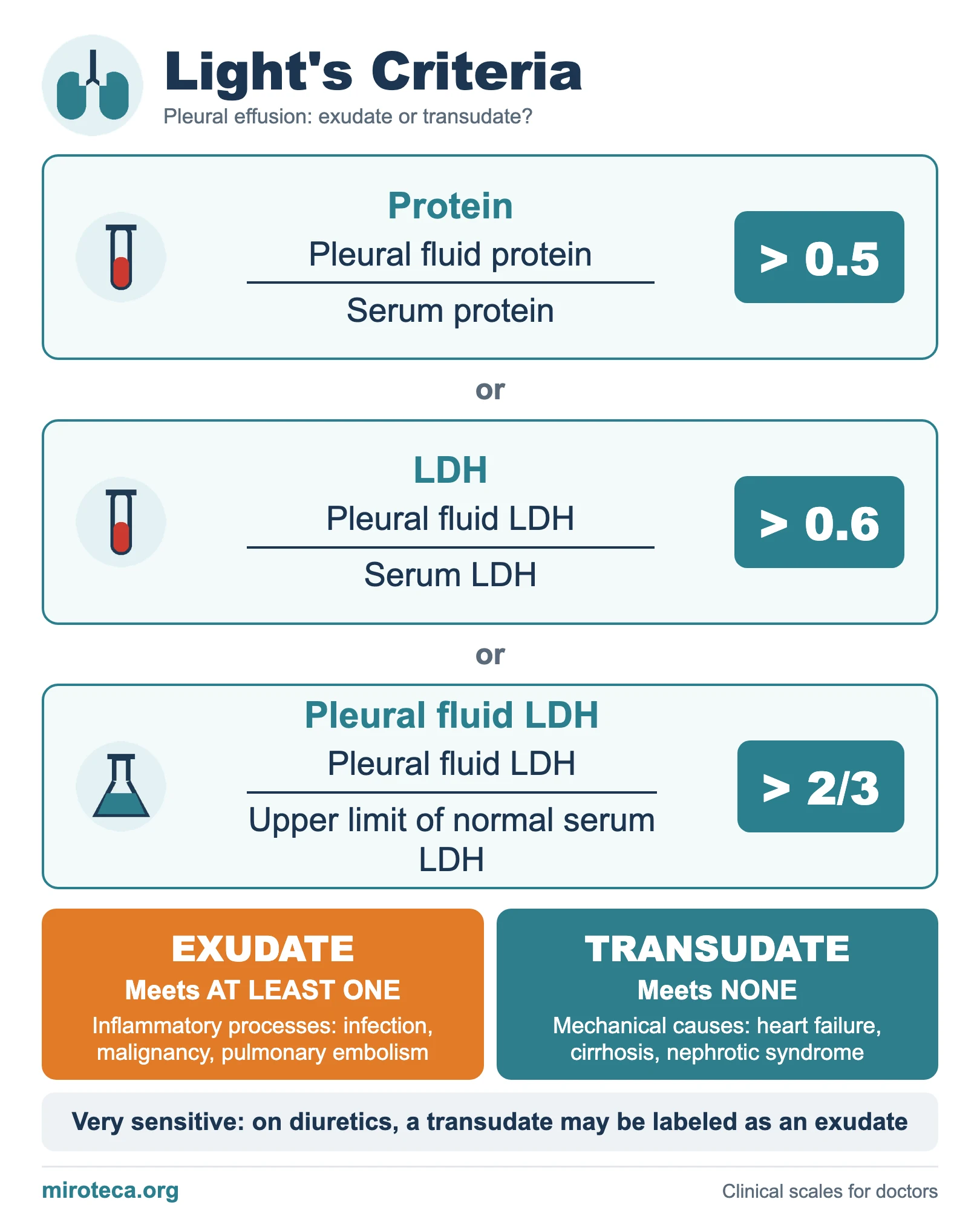
Light's criteria: protein ratio above 0.5, LDH ratio above 0.6, and pleural fluid LDH above two thirds of the upper limit of normal serum LDH; one is enough for an exudate
⬇ Download the diagramView full size⬇ Download as PDF

Free to use for study and teaching with attribution to MIROTECA · terms of use

Meeting ONE of the three is enough for an exudate; meeting none means a transudate.

More diagrams: Glasgow Coma Scale (GCS) · APGAR score · Wells score for pulmonary embolism

What the diagram shows

Light's criteria classify a pleural effusion as an exudate or a transudate, an essential step in working out the cause.

At the top are the three criteria, joined by "or". Below are the two results and their typical causes: a transudate points to mechanical causes, and an exudate to inflammatory processes.

The detail that settles it

The word to remember is "one": a single positive criterion is enough to call it an exudate.

Common mistakes

The usual mistake is requiring all three. The other is forgetting how sensitive they are: they sometimes label a transudate as an exudate, for example in patients taking diuretics.

Keep practicing

This page is the visual summary. To test yourself with real clinical reasoning, Medicinedle, a Wordle-inspired game, gives you one clinical case a day: guess the diagnosis in six tries, with a new clue after every miss. It is free and available in English.

Play today's case →

Advertisement

Related

See all medical diagrams