
What the chart shows
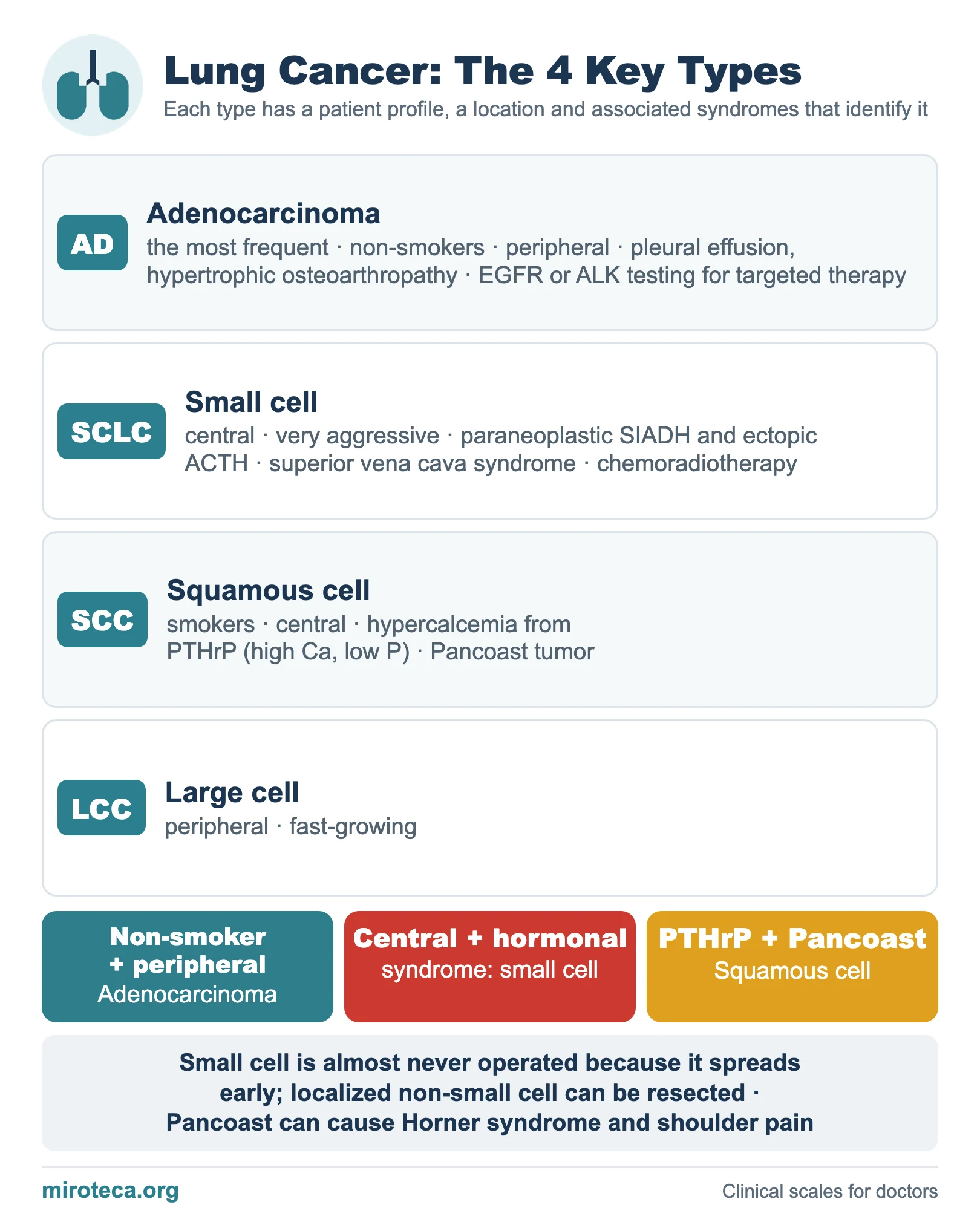
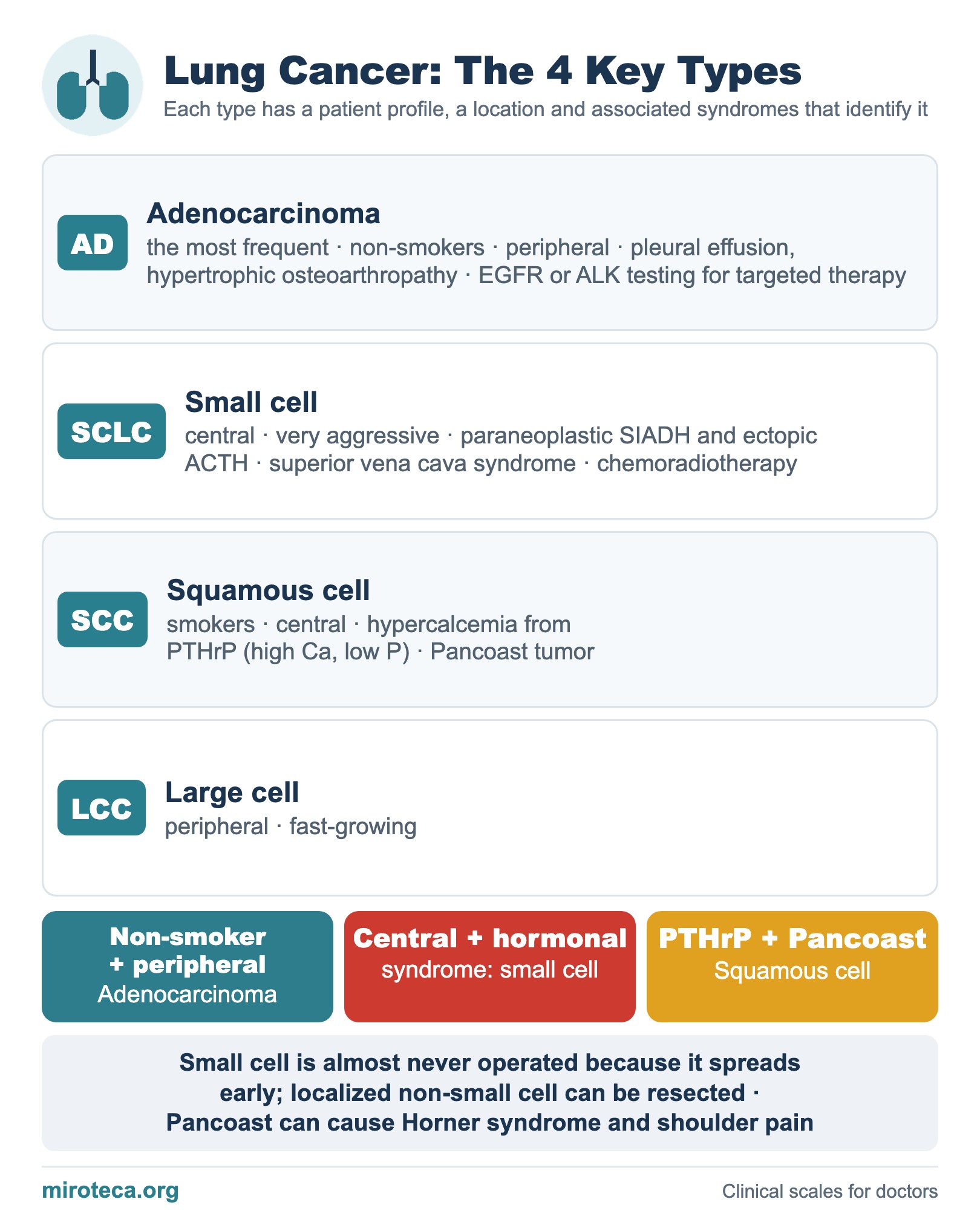
The four main types of lung cancer have a "profile" of patient, location and associated syndromes that lets them be recognized in a clinical case. The chart sets out the profile of adenocarcinoma, small cell, squamous cell and large cell carcinoma.
The detail that settles it
Adenocarcinoma is the most frequent, appears in non-smokers and is peripheral; EGFR or ALK mutations are looked for to guide targeted treatment. Small cell carcinoma is central and very aggressive, causes paraneoplastic syndromes (SIADH, ectopic ACTH) and superior vena cava syndrome, and is treated with chemoradiotherapy. Squamous cell carcinoma is central, typical of smokers, and produces hypercalcemia from PTHrP (high calcium, low phosphorus) and the Pancoast tumor. Large cell carcinoma is peripheral and fast-growing. See calcium and sodium.
In exam questions
The question crosses three clues: smoker or not, central or peripheral tumor, and paraneoplastic syndrome. A common trap: small cell is almost never operated because of its early spread, whereas localized non-small cell can be considered for surgery. The Pancoast tumor can cause Horner syndrome and shoulder pain.
Keep practicing
This page is the visual summary. To test yourself with real clinical reasoning, Medicinedle, a Wordle-inspired game, gives you one clinical case a day: guess the diagnosis in six tries, with a new clue after every miss. It is free and available in English.