
What the chart shows
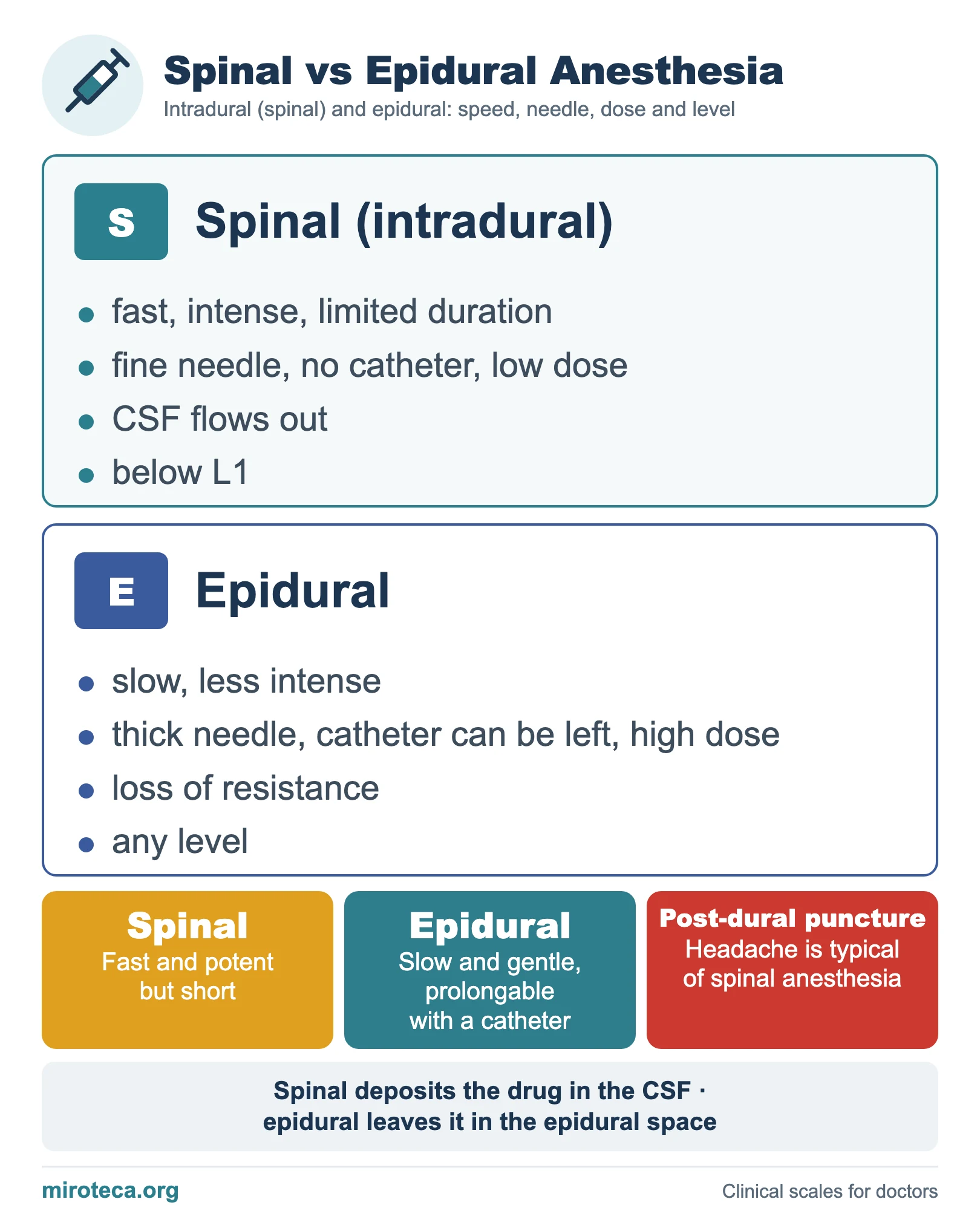
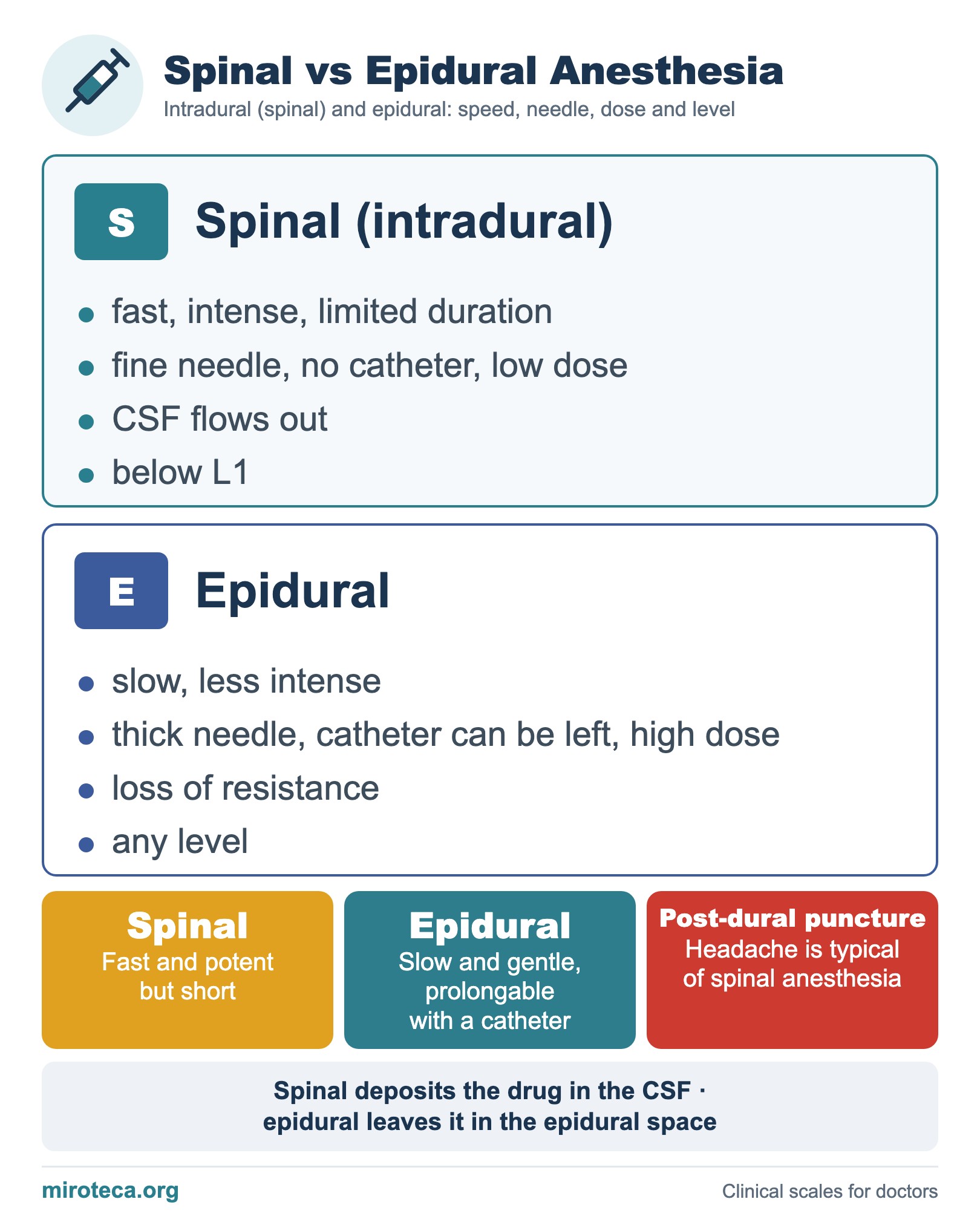
Spinal (intradural) and epidural anesthesia are easily confused; their technical and effect differences are very often asked about. The chart lines them up on speed, intensity, duration, needle, catheter, dose and level.
The detail that settles it
Spinal anesthesia deposits the anesthetic in the CSF (below L1-L2, the end of the spinal cord): fast onset, intense block, low dose, fine needle and limited duration; it is confirmed by the outflow of CSF. Epidural anesthesia leaves the drug in the epidural space: slow onset, less intense block, high dose, thick needle and the possibility of leaving a catheter to prolong it (labor analgesia); it is located by "loss of resistance".
Post-dural puncture headache is typical of spinal anesthesia.
In exam questions
The opposition "fast and short versus slow and prolongable" is what is asked: spinal is fast, potent and short, and epidural is slow, gentler and can be extended with a catheter.
Keep practicing
This page is the visual summary. To test yourself with real clinical reasoning, Medicinedle, a Wordle-inspired game, gives you one clinical case a day: guess the diagnosis in six tries, with a new clue after every miss. It is free and available in English.