
What the diagram shows
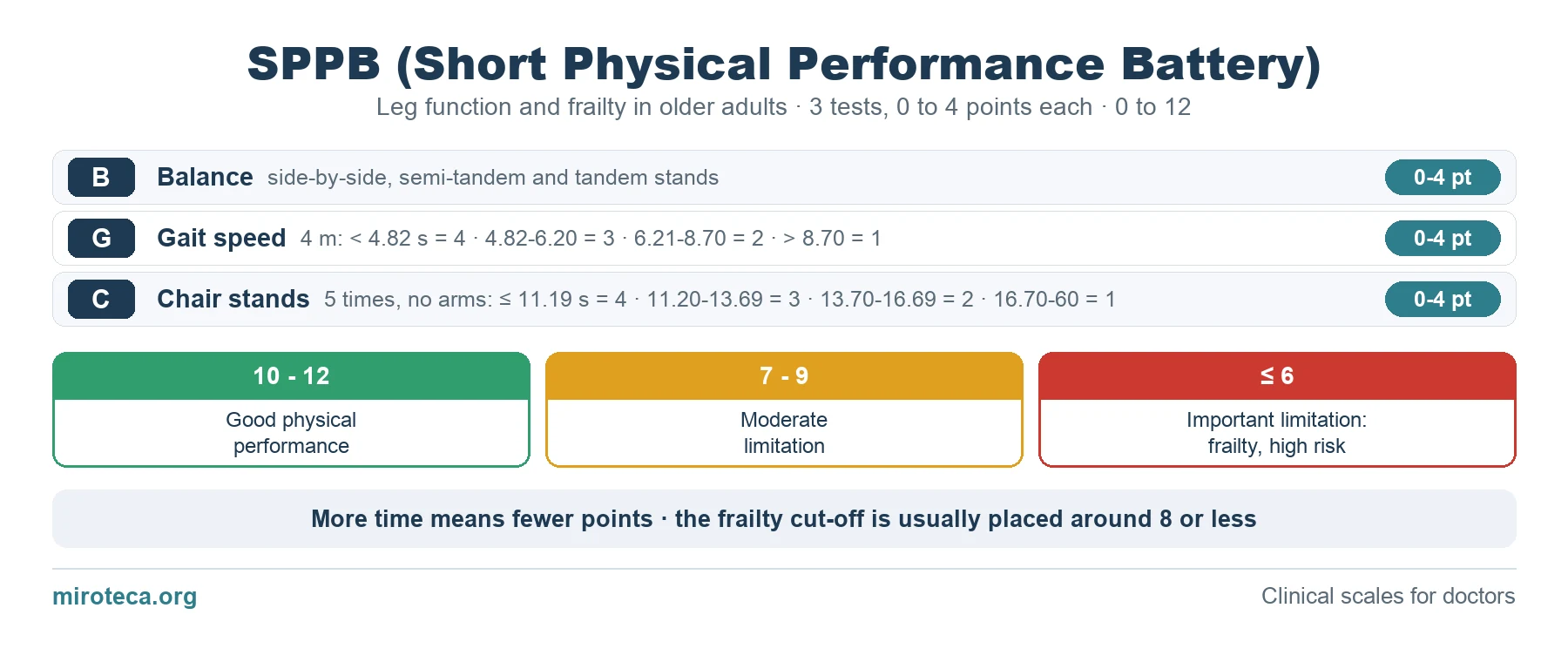
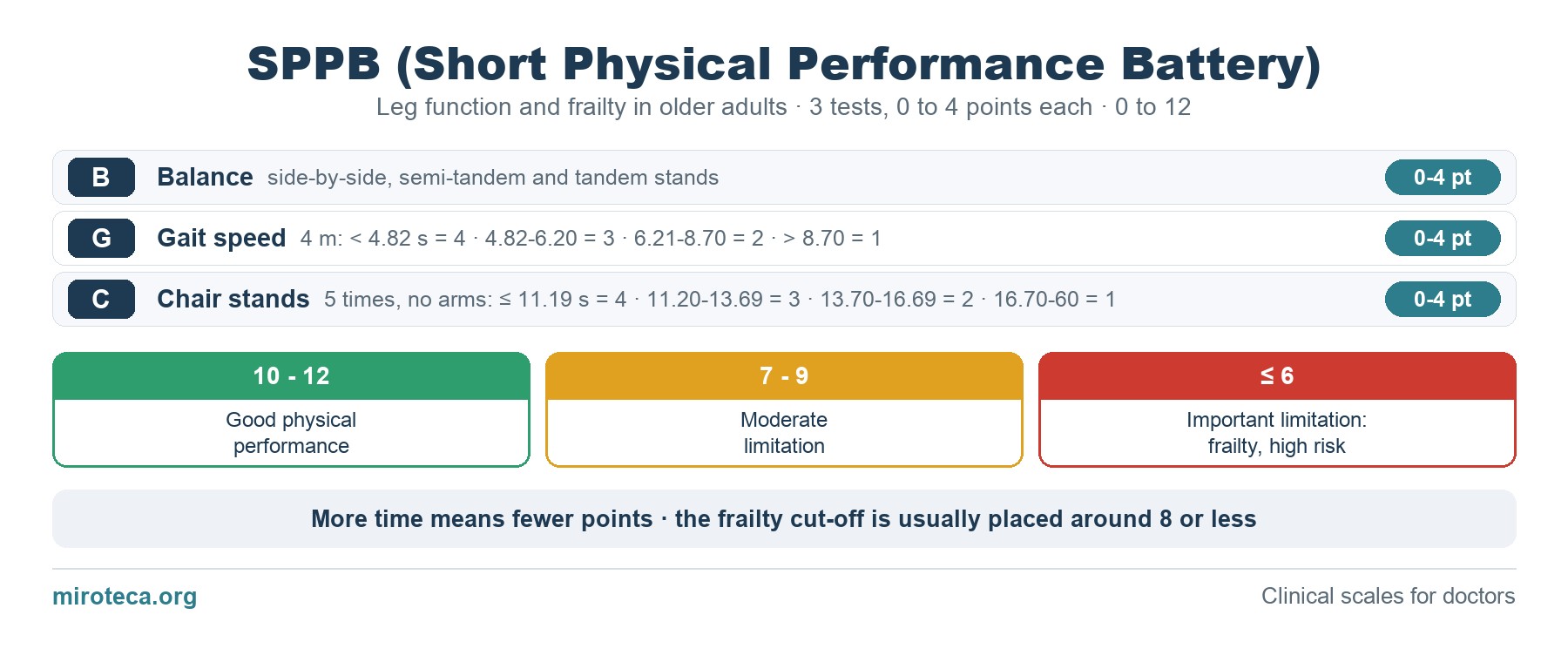
The SPPB is a short battery of physical tests that measures leg function in older people. It is one of the reference tools to detect frailty and to predict the risk of falls, disability and dependence.
It consists of three tests, each scored from 0 to 4: balance (standing in different foot positions), gait speed (time to walk a short distance) and chair stands (time to rise five times from a chair without using the arms). The three are added, from 0 to 12 points.
The detail that settles it
In two of the tests (gait and chair stands) the score depends on time, and that is exactly what is asked. In gait the cut-offs run almost every 5 seconds (below 4.82, 6.20, 8.70) and in the chair test they hover around 11, 14 and 17 seconds. Remember the direction: more time means fewer points.
Balance is not timed over a course but by how long each posture is held: tandem for 10 seconds scores 4, tandem for 3 to 9.99 s scores 3, semi-tandem for 10 s with tandem under 3 s scores 2, feet together for 10 s with semi-tandem under 10 s scores 1, and not holding feet together for 10 s scores 0.
How to read the total
A total of 10 to 12 means good physical performance, 7 to 9 a moderate limitation and 6 or less an important limitation (frailty and high risk). The frailty cut-off is usually placed at around 8 or less.
It predicts adverse events very well (falls, hospitalization, loss of independence). The chair stand test is the one most closely related to muscle strength and to prognosis. See also the Tinetti scale and the article on functional and frailty scales.
Common mistakes
Looking at only one test: all three (balance, gait and chair stands) count. Another is forgetting that the chair test is the one that best reflects muscle strength and prognosis.
In exam questions
Questions usually give times and ask for the score of a test, or describe an older person with poor tandem balance, slow gait and a slow chair test (about 6 of 12) and ask what it indicates: frailty and a high risk of adverse events.
Keep practicing
This page is the visual summary. To test yourself with real clinical reasoning, Medicinedle, a Wordle-inspired game, gives you one clinical case a day: guess the diagnosis in six tries, with a new clue after every miss. It is free and available in English.