
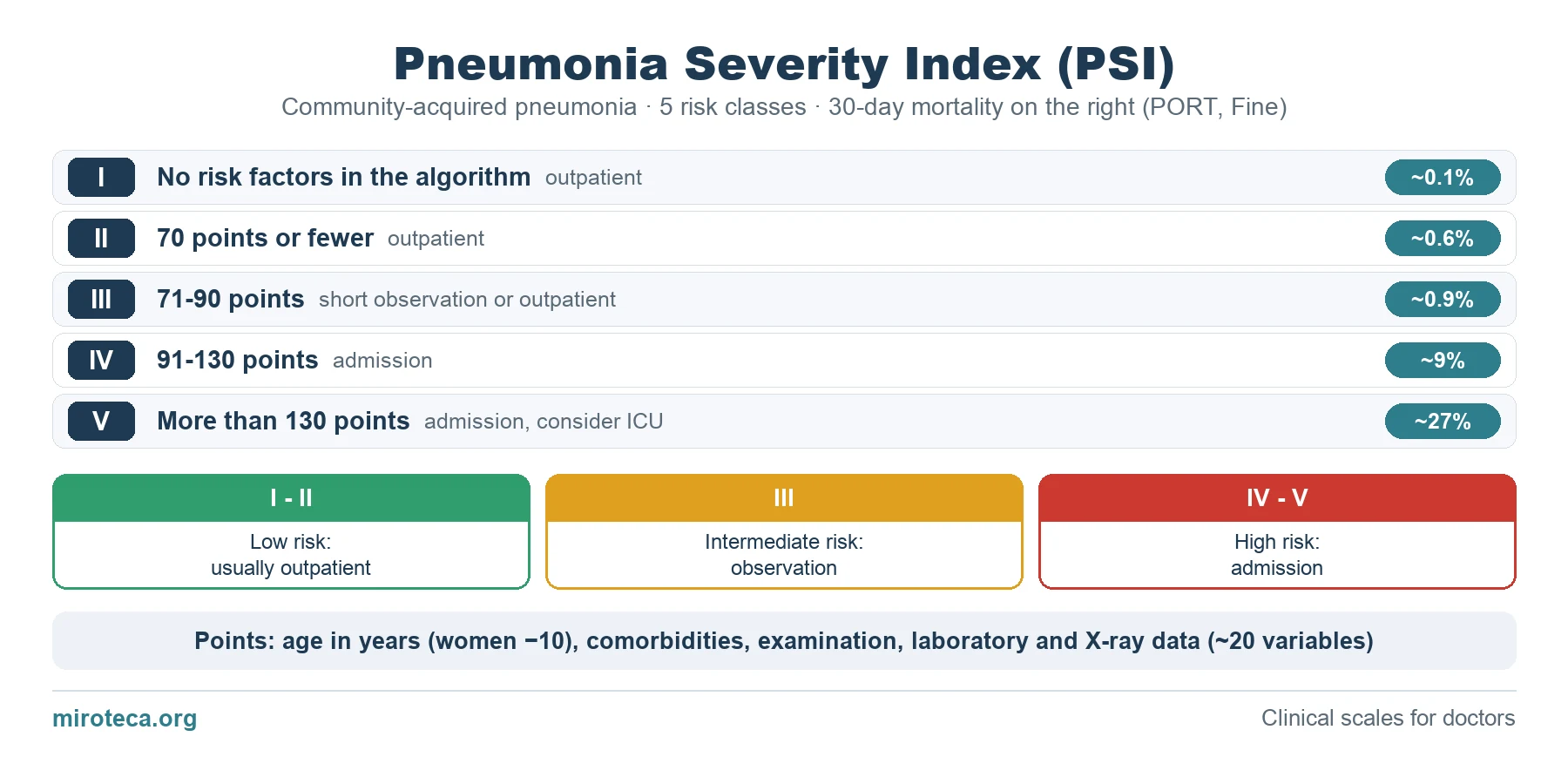
What the diagram shows
The PSI (Pneumonia Severity Index), also called the Fine index or PORT score, sorts community-acquired pneumonia into five classes of mortality risk. It is more complete and precise than CURB-65, though more laborious to calculate.
It adds points from about 20 variables: age (equal to the years, minus 10 for women), comorbidities, examination findings and laboratory and X-ray data. The total gives the risk class and the 30-day mortality shown in the chart.
The detail that settles it
Classes I and II are low risk and usually allow outpatient treatment, class III is intermediate (observation) and classes IV and V are high risk and call for admission, with ICU considered in class V. The PSI is more sensitive for identifying low-risk patients (classes I to III) who are candidates for treatment at home.
Common mistakes
Using it in a hurry in the emergency department: there are about 20 variables. For a quick decision CURB-65 is usually enough, and the PSI refines mostly the confirmation of who is low risk. The two are often combined.
In exam questions
Questions usually ask for the place of treatment: classes I and II outpatient, III observation, IV and V admission. Neither scale replaces clinical judgment (social factors, oral tolerance, oxygen saturation) or assesses the cause; pneumococcus remains the most frequent germ, and empirical treatment is chosen according to severity and risk factors.
Keep practicing
This page is the visual summary. To test yourself with real clinical reasoning, Medicinedle, a Wordle-inspired game, gives you one clinical case a day: guess the diagnosis in six tries, with a new clue after every miss. It is free and available in English.