
What the diagram shows
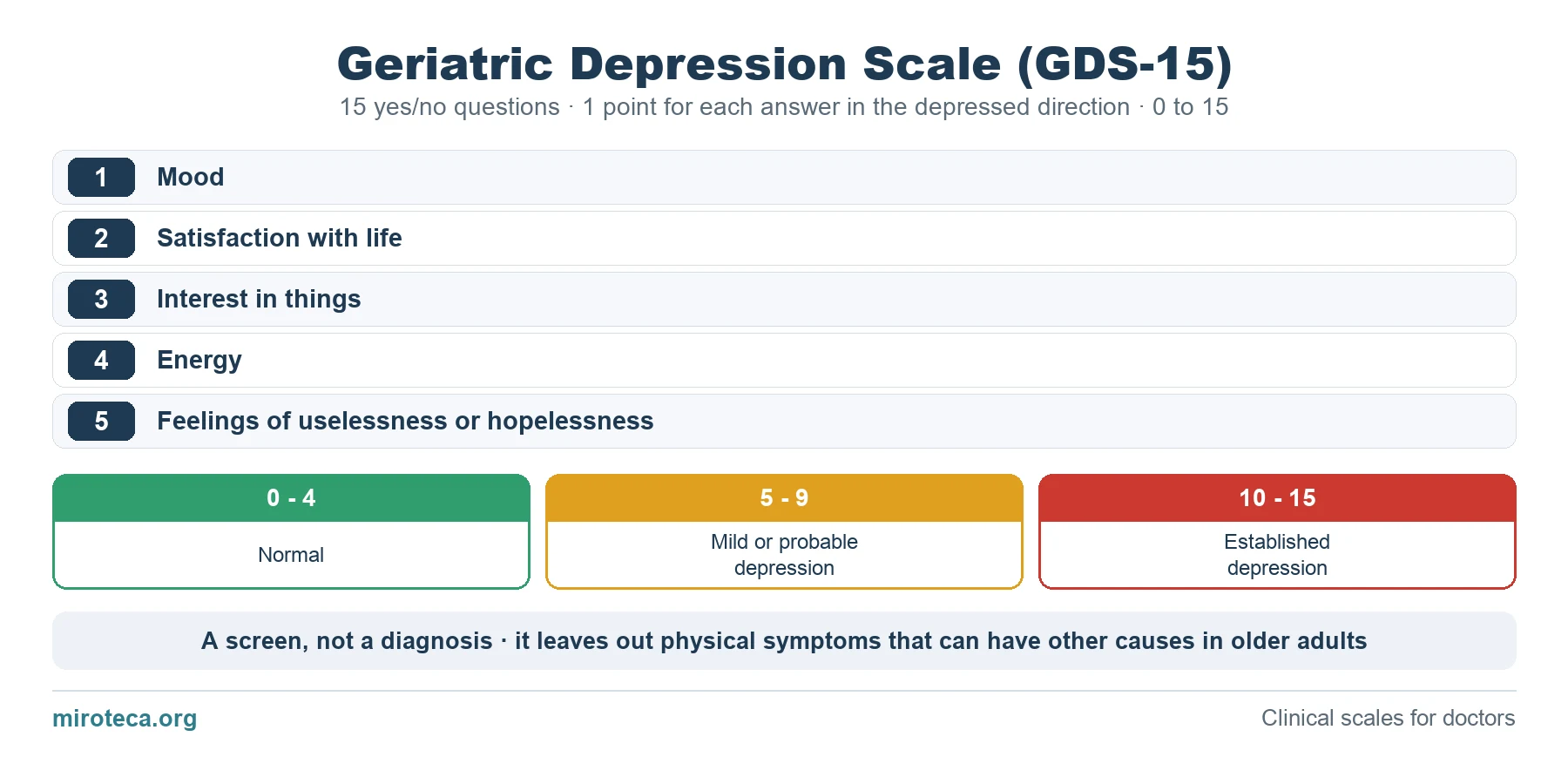
The Yesavage scale (Geriatric Depression Scale, GDS) is a questionnaire designed specifically to detect depression in older people. It avoids physical symptoms, which in older adults may be due to other diseases, and focuses on mood, which makes it more reliable in this population.
The questions are yes/no and cover mood, satisfaction with life, interest in things, energy and feelings of uselessness or hopelessness. The most used version has 15 items, and 1 point is added for each answer that points to low mood, from 0 to 15.
The detail that settles it
The groups are 0 to 4 normal, 5 to 9 mild or probable depression and 10 or more established depression. It is a screen, not a diagnosis: a positive result guides, but the diagnosis is clinical.
Common mistakes
Using general depression scales in older people, loaded with physical symptoms that confuse illness with sadness; the Yesavage avoids that problem. Another mistake is taking the screen as a closed diagnosis.
In exam questions
Questions usually ask why the GDS is preferred in older patients (it avoids insomnia, loss of appetite and tiredness, which may have other causes). A frequent related concept is depressive pseudodementia: a depression in an older person that mimics dementia but improves when mood is treated. It is often grouped with scales such as the Lawton scale and the Katz index.
Keep practicing
This page is the visual summary. To test yourself with real clinical reasoning, Medicinedle, a Wordle-inspired game, gives you one clinical case a day: guess the diagnosis in six tries, with a new clue after every miss. It is free and available in English.