
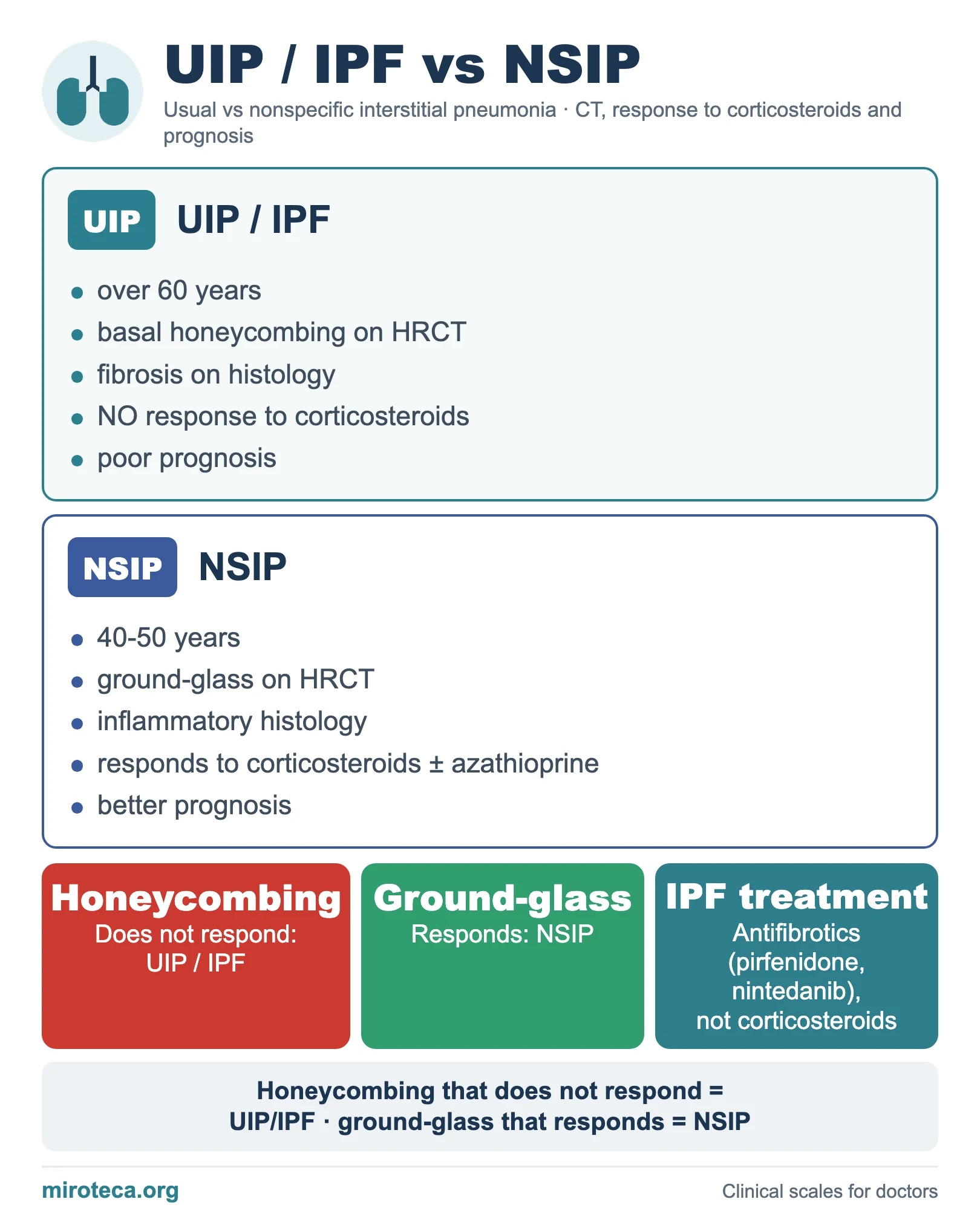
What the chart shows
Two patterns of interstitial pneumonia that are told apart by the image, the response to treatment and the prognosis: usual interstitial pneumonia (UIP, the basis of idiopathic pulmonary fibrosis, IPF) and nonspecific interstitial pneumonia (NSIP).
The detail that settles it
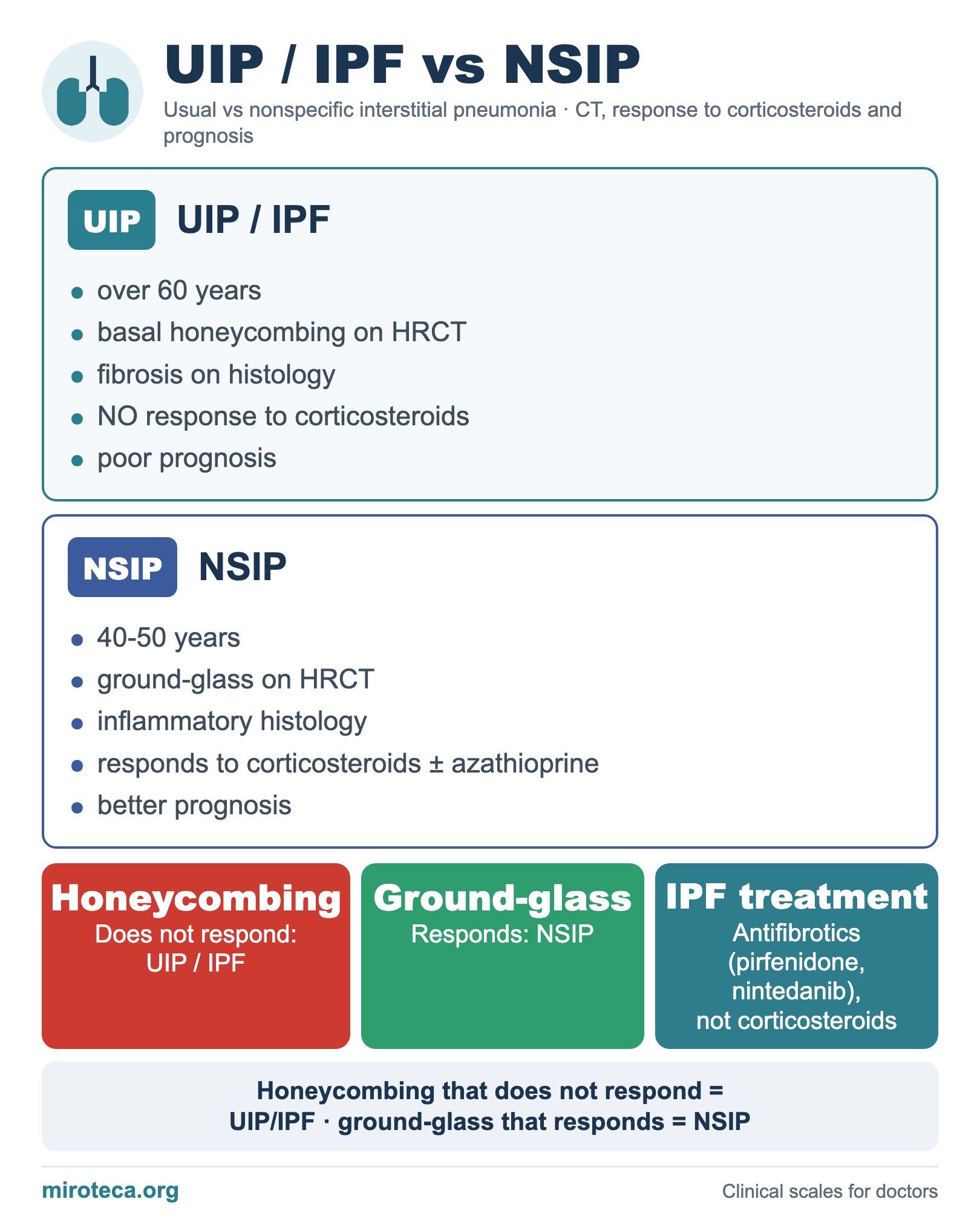
UIP affects people over 60, shows honeycombing with a basal and subpleural predominance, does not respond to corticosteroids and has a poor prognosis. IPF is treated with antifibrotics (pirfenidone, nintedanib), not with corticosteroids. NSIP is younger, shows ground-glass opacities, responds to corticosteroids and has a better prognosis.
Key nuance: NSIP is often associated with connective tissue disease (scleroderma, dermatomyositis), so with an NSIP an underlying autoimmune disease should be looked for.
In exam questions
The questions combine three axes: the CT image, the response to corticosteroids and the prognosis. The summary phrase is "honeycombing that does not respond" (UIP) versus "ground-glass that responds" (NSIP).
Keep practicing
This page is the visual summary. To test yourself with real clinical reasoning, Medicinedle, a Wordle-inspired game, gives you one clinical case a day: guess the diagnosis in six tries, with a new clue after every miss. It is free and available in English.