
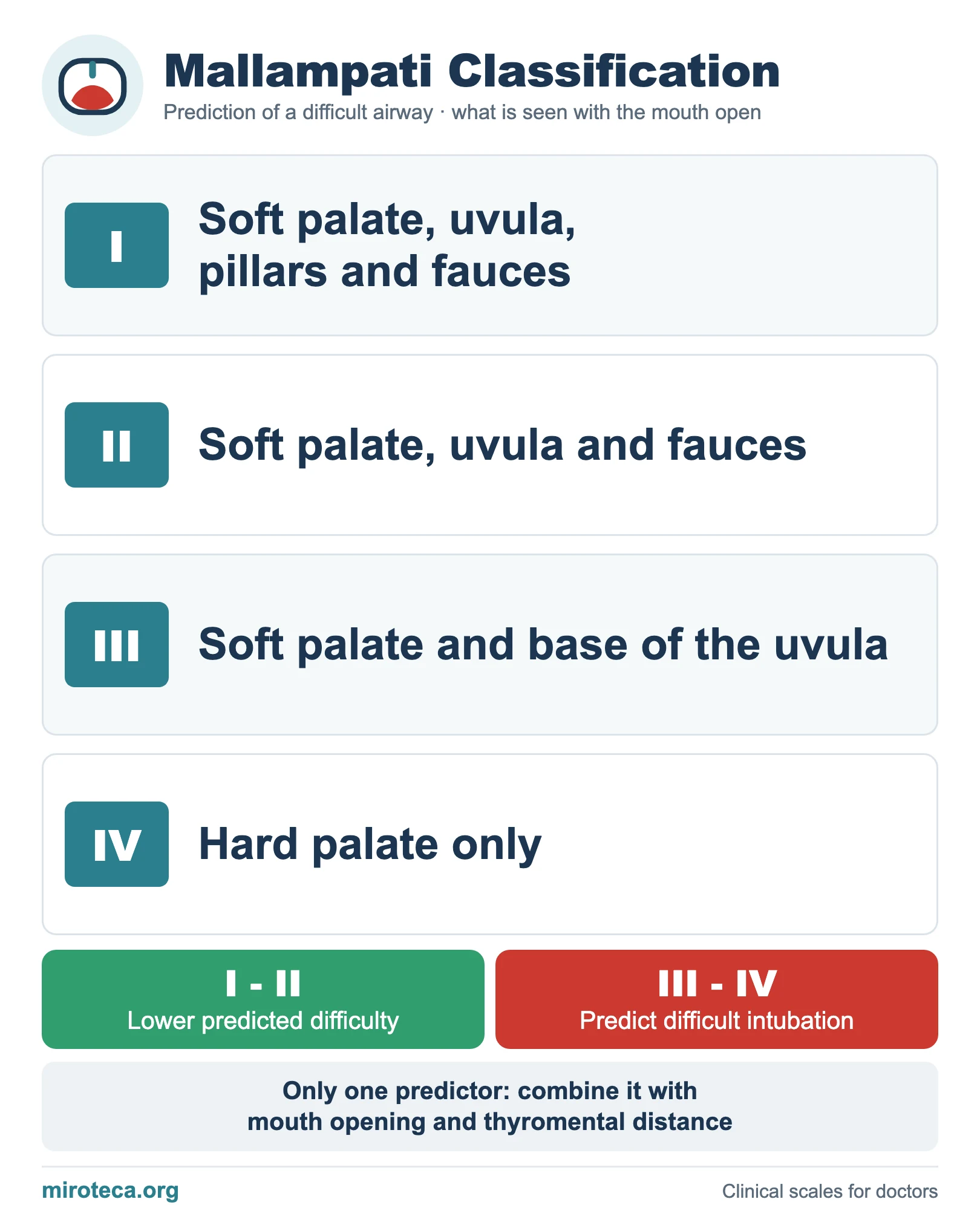
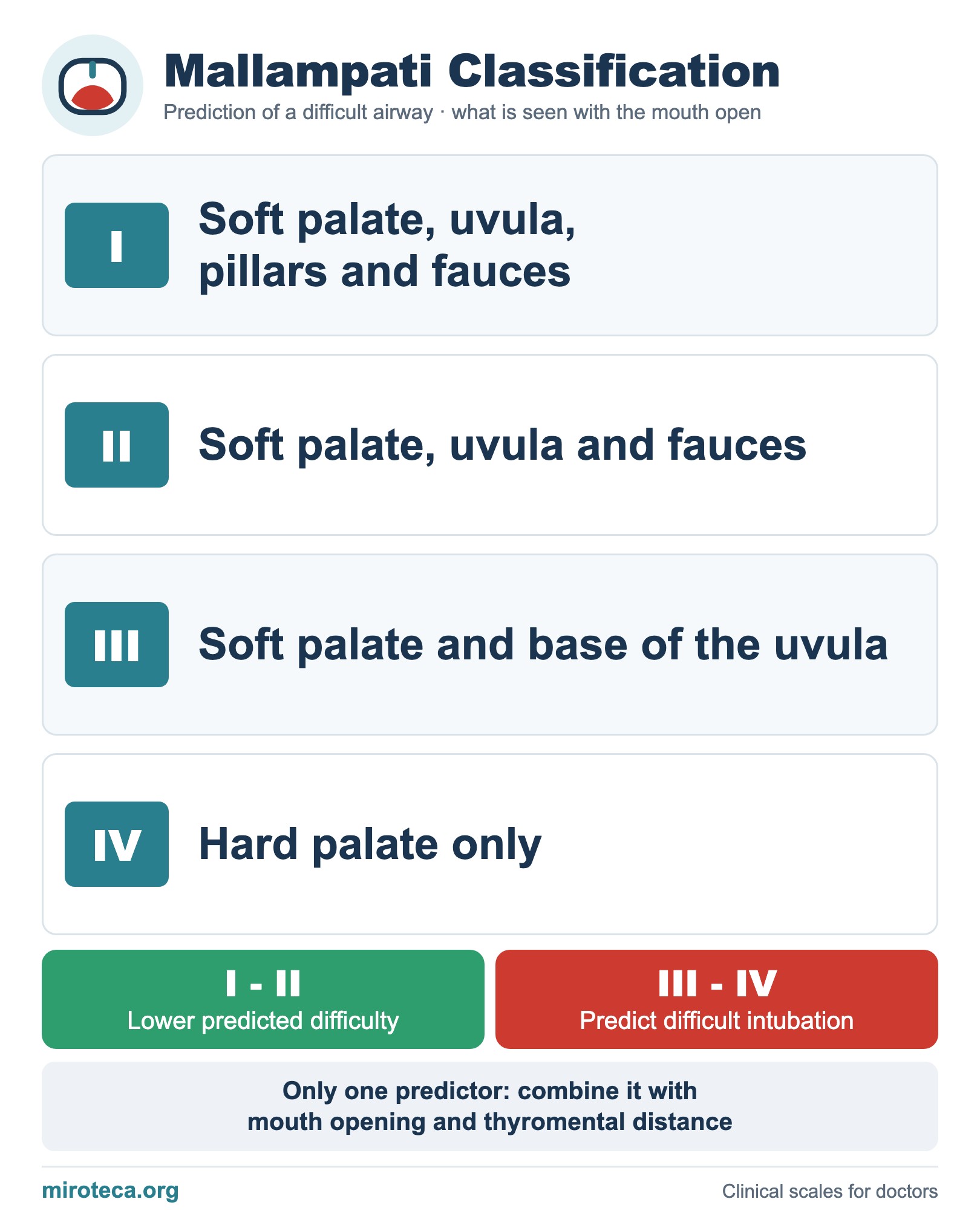
What the diagram shows
The Mallampati classification predicts a difficult airway from what can be seen with the mouth open, before anesthesia. The less of the pharynx that is visible, the higher the class.
The detail that settles it
Classes III and IV predict a difficult intubation. It is done before induction; during laryngoscopy, the view is graded with the Cormack-Lehane classification.
Common mistakes
Using it alone as the only predictor of a difficult airway: it is combined with others, such as mouth opening and thyromental distance.
In exam questions
Questions usually describe the structures visible on examination and ask for the class, or ask which scale is assessed before intubation (Mallampati) and which during it (Cormack-Lehane).
Keep practicing
This page is the visual summary. To test yourself with real clinical reasoning, Medicinedle, a Wordle-inspired game, gives you one clinical case a day: guess the diagnosis in six tries, with a new clue after every miss. It is free and available in English.