
What the diagram shows
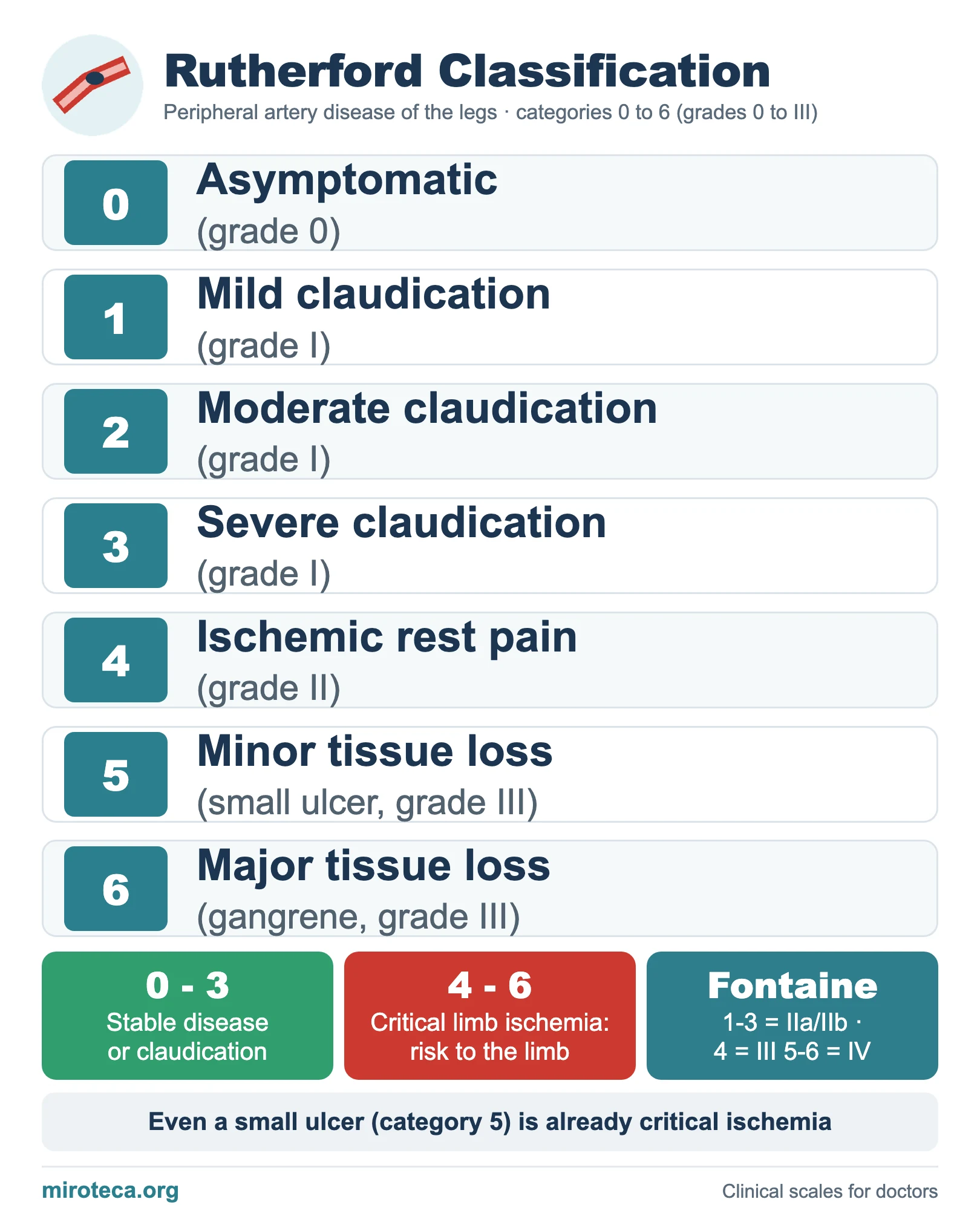
The Rutherford classification grades the severity of peripheral artery disease of the legs, like Fontaine but with more steps. It is used mostly in vascular surgery to describe the situation more precisely.
It rests on symptoms and objective circulation data, from no symptoms to major tissue loss. Grades 0, I, II and III group the categories: grade I includes categories 1 to 3, grade II is category 4 and grade III is categories 5 and 6.
The detail that settles it
Equivalence with Fontaine: categories 1 to 3 correspond to IIa and IIb, category 4 to III and categories 5 and 6 to IV. Categories 4 to 6 are critical limb ischemia, with a risk to the limb. Stable claudication is treated medically, while critical ischemia calls for revascularization, endovascular or surgical, to save the leg.
Common mistakes
Mixing Rutherford categories with Fontaine stages without being clear about the equivalence. Another mistake is underestimating a "small" ulcer: from category 4 onward it is already critical ischemia.
In exam questions
Questions usually give a small ulcer that does not heal on a toe in a patient with poor arterial circulation: category 5, already within critical ischemia. The diagnosis is supported by the ankle-brachial index (below 0.9).
Keep practicing
This page is the visual summary. To test yourself with real clinical reasoning, Medicinedle, a Wordle-inspired game, gives you one clinical case a day: guess the diagnosis in six tries, with a new clue after every miss. It is free and available in English.