
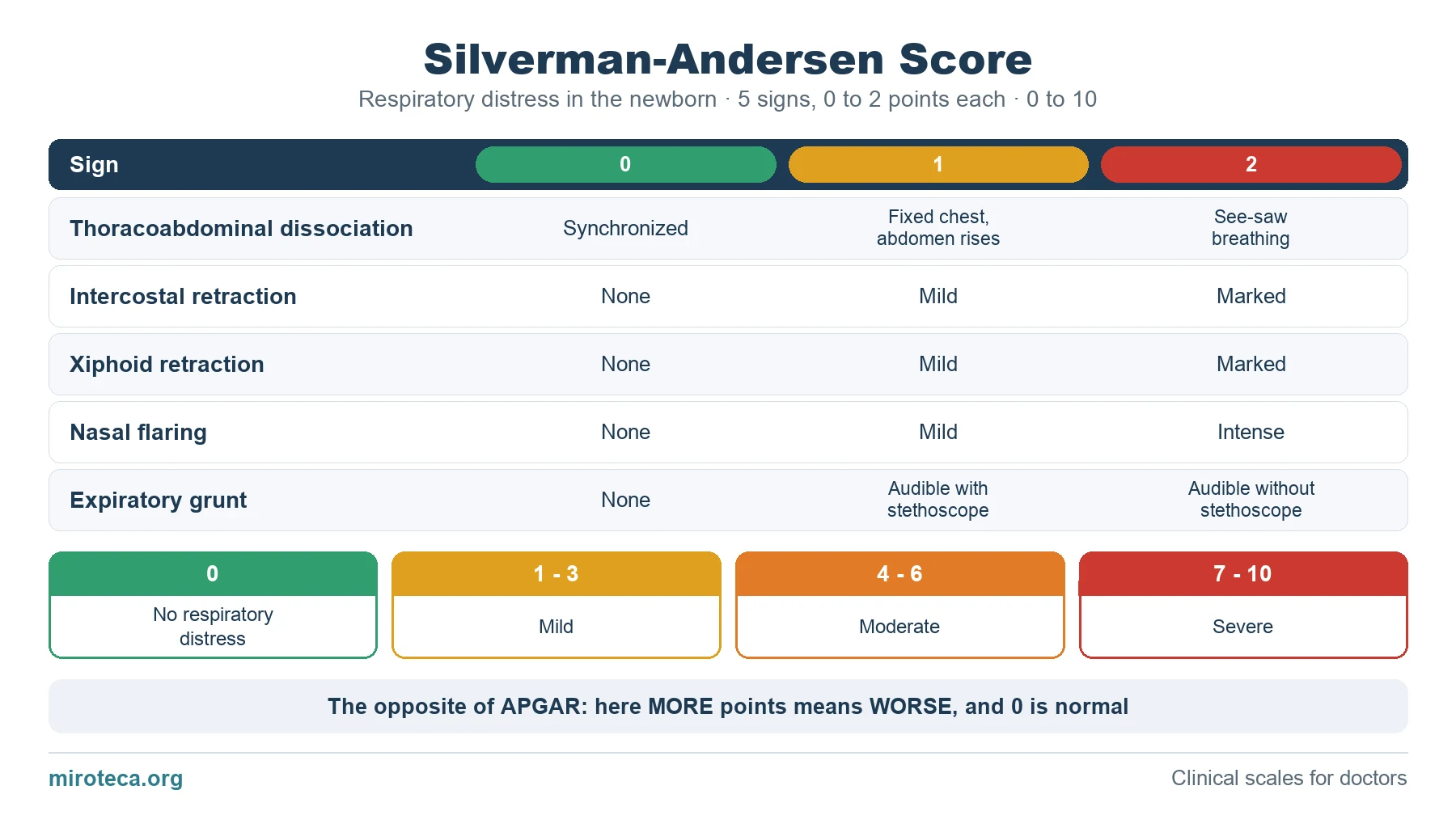
What the diagram shows
The Silverman-Andersen score assesses the degree of respiratory distress of a newborn. It is very useful in the first hours of life to detect and follow neonatal respiratory distress.
It adds five signs of respiratory effort: thoracoabdominal dissociation, intercostal retraction, xiphoid retraction, nasal flaring and expiratory grunt. Each one scores 0, 1 or 2, for a total from 0 to 10.
The detail that settles it
The score works the opposite of APGAR. In the APGAR score more points is better; in Silverman-Andersen more points is worse, and 0 is normal. A newborn with a clearly audible expiratory grunt and marked nasal flaring and retractions adds around 6 to 7 points: a significant respiratory difficulty that needs support.
Common mistakes
The classic error is to read it like the APGAR and believe that more points is better. Another is confusing thoracoabdominal dissociation with intercostal retraction, which are separate items.
In exam questions
The test is useful to quantify and follow neonatal respiratory distress, for example in hyaline membrane disease of the premature infant from surfactant deficiency, or in transient tachypnea of the newborn. A high score points to the need for respiratory support. Sometimes the name is written Silverman-Anderson; the original authors are Silverman and Andersen.
Keep practicing
This page is the visual summary. To test yourself with real clinical reasoning, Medicinedle, a Wordle-inspired game, gives you one clinical case a day: guess the diagnosis in six tries, with a new clue after every miss. It is free and available in English.