
What the diagram shows
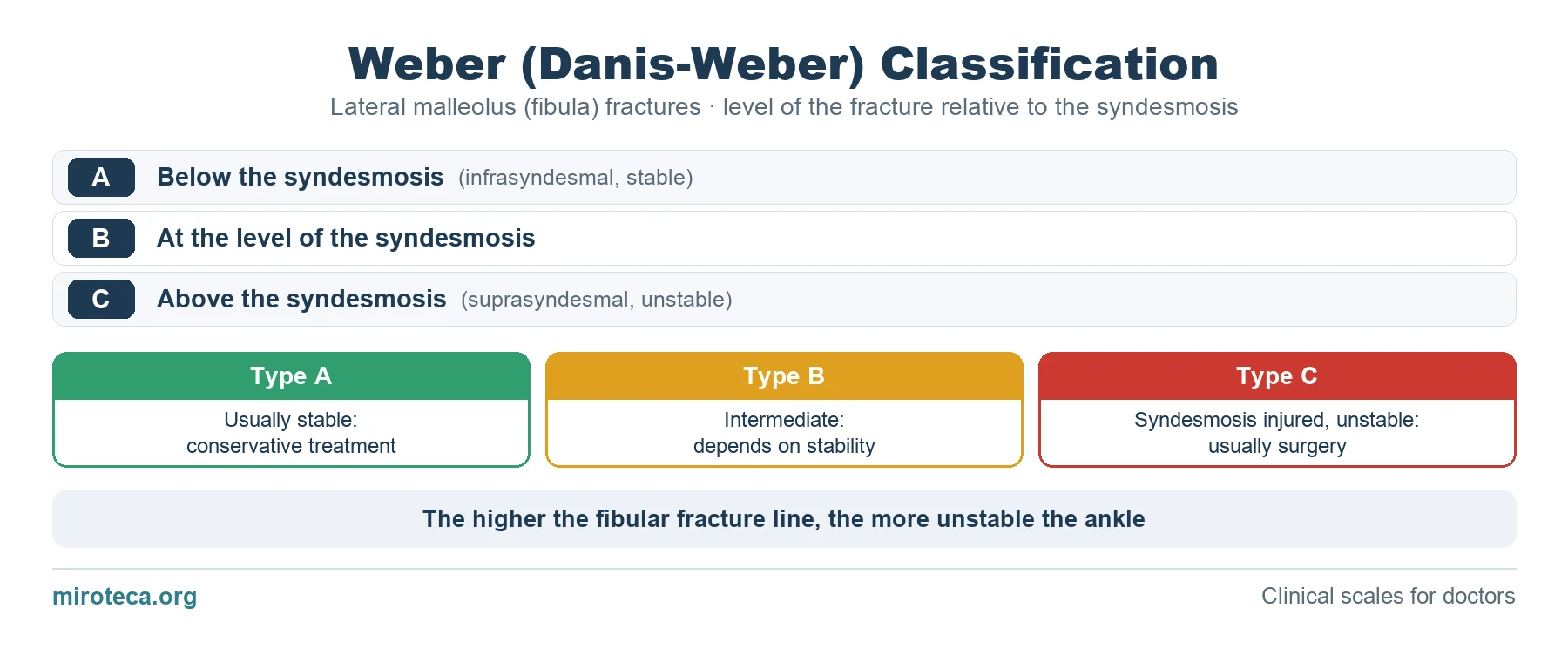
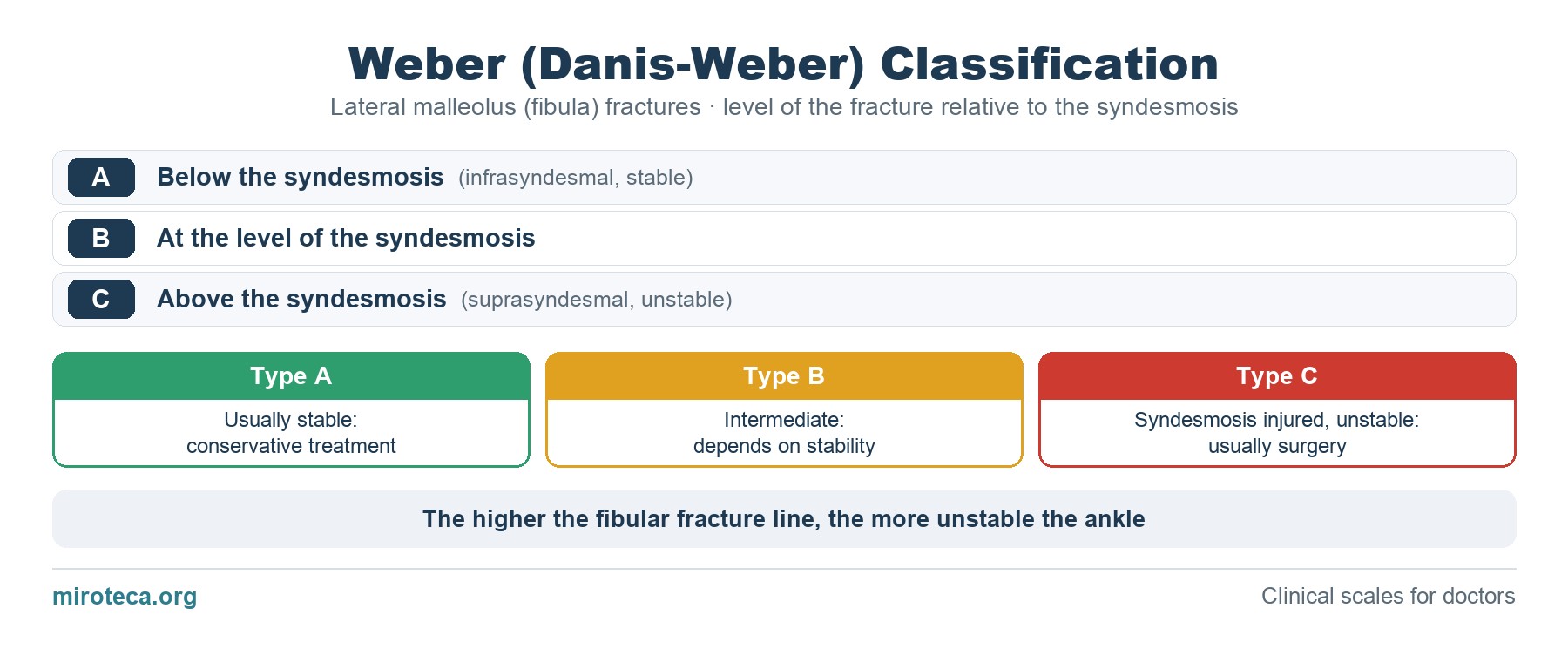
The Weber classification (Danis-Weber) describes fractures of the lateral malleolus (the fibula) by their height relative to the tibiofibular syndesmosis. It predicts stability and the need for surgery.
Three types are used, according to where the fibular fracture line lies: A below the syndesmosis, B at its level and C above it.
The detail that settles it
The practical meaning: type A is usually stable and treated conservatively; type C injures the syndesmosis, is unstable and almost always needs surgery (osteosynthesis, sometimes with a syndesmotic screw); type B is intermediate and depends on stability. The height of the fracture predicts the ligament damage: the more proximal the fibular line, the more of the structures that hold the ankle are torn.
Common mistakes
Assuming that all ankle fractures are stable: Weber C fractures are not.
In exam questions
Questions usually describe an ankle sprain with a fibular fracture whose line is at the level of the syndesmosis, without medial malleolus fracture: Weber B. A fibular fracture above the syndesmosis is Weber C, a candidate for surgery. To decide whether an X-ray is needed in the first place, see the Ottawa ankle rules.
Keep practicing
This page is the visual summary. To test yourself with real clinical reasoning, Medicinedle, a Wordle-inspired game, gives you one clinical case a day: guess the diagnosis in six tries, with a new clue after every miss. It is free and available in English.