
What the diagram shows
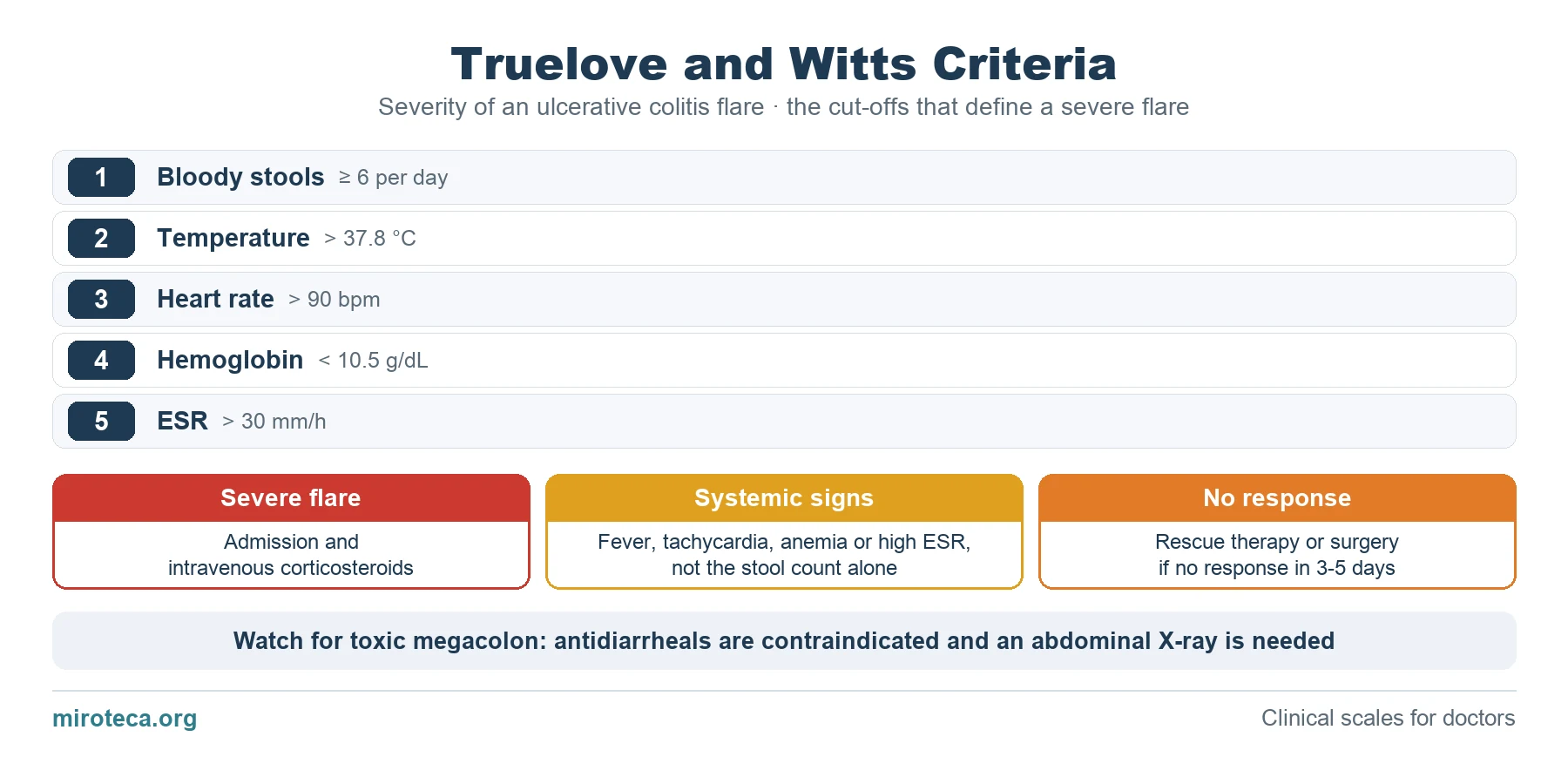
The Truelove and Witts criteria classify the severity of a flare of ulcerative colitis as mild, moderate or severe. Identifying a severe flare is key because it changes management: admission and intravenous corticosteroids.
They look at the number of bloody stools per day, temperature, heart rate, hemoglobin and erythrocyte sedimentation rate (ESR). The chart lists the cut-offs of the severe category.
The detail that settles it
A severe flare is 6 or more bloody stools a day plus systemic signs: fever, tachycardia, anemia or a raised ESR. What defines severity is the systemic repercussion, not the stool count alone. Recognizing a severe flare in time prevents complications such as toxic megacolon.
Common mistakes
Keeping only the number of stools without assessing the systemic signs.
In exam questions
The usual vignette has 6 or more bloody stools a day plus fever, tachycardia, anemia or a high ESR, and the answer is admission with intravenous corticosteroids. A severe flare that does not respond to corticosteroids within 3 to 5 days calls for rescue therapy (cyclosporine or infliximab) and consideration of surgery. The feared complication is toxic megacolon, in which antidiarrheals are contraindicated and an abdominal X-ray is requested. Fecal calprotectin helps monitor inflammatory activity outside the acute flare.
Keep practicing
This page is the visual summary. To test yourself with real clinical reasoning, Medicinedle, a Wordle-inspired game, gives you one clinical case a day: guess the diagnosis in six tries, with a new clue after every miss. It is free and available in English.