
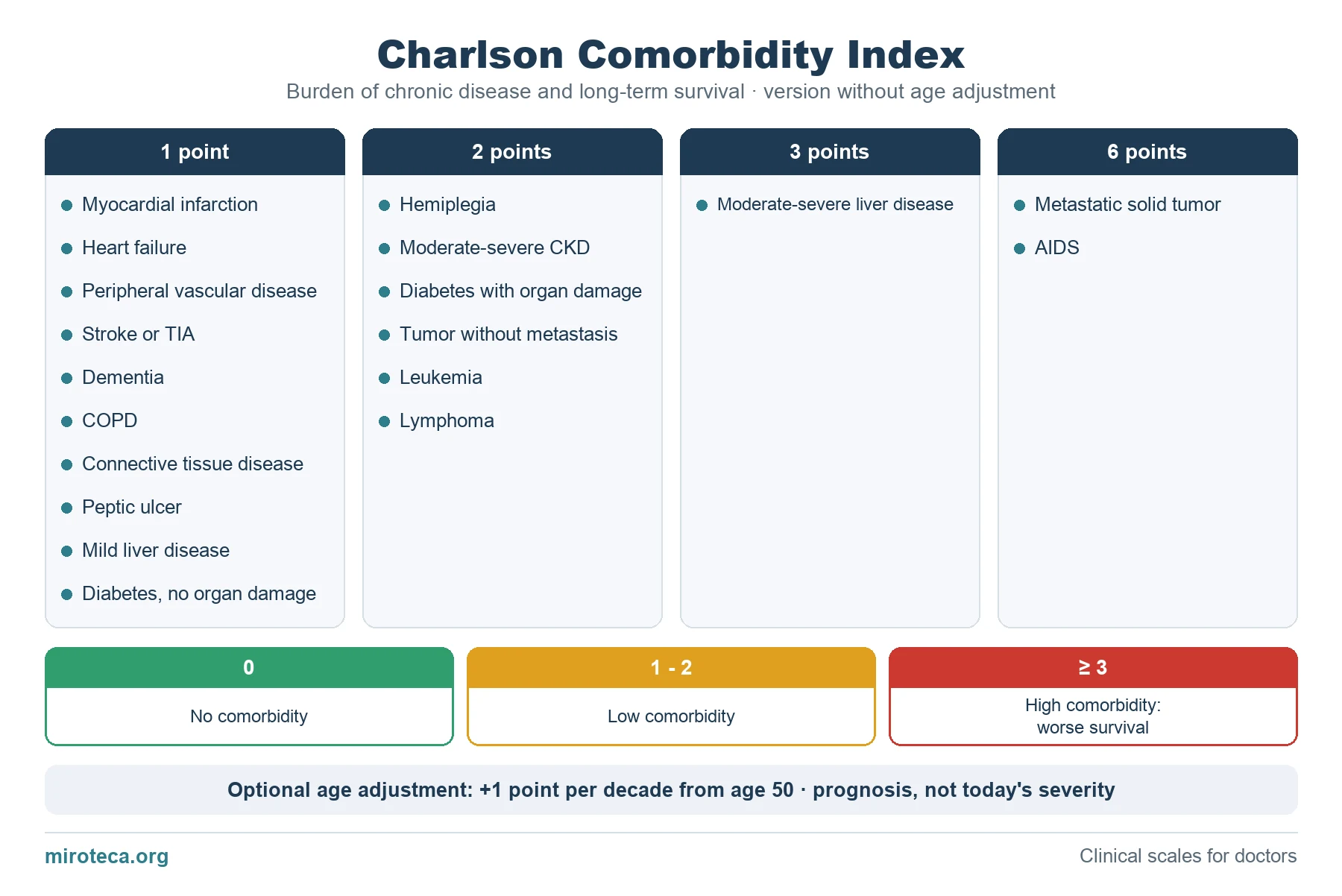
What the diagram shows
The Charlson index sums up in one number how many chronic diseases a patient has and how severe they are, and estimates long-term survival. It is widely used in research and to assess risk before aggressive treatments.
Each condition adds points according to its severity, from 1 point (for example myocardial infarction, COPD or diabetes) up to 6 points (metastatic tumors and AIDS). This chart shows the version without age adjustment; some versions add 1 point for each decade from age 50.
The detail that settles it
A score of 0 means no comorbidity, 1 to 2 low comorbidity and 3 or more high comorbidity, associated with worse survival. A patient with COPD (1), diabetes (1) and a previous infarction (1) adds 3. It is a prognostic tool, not a diagnostic one.
Common mistakes
Thinking it measures how sick the patient is today: it estimates long-term prognosis from chronic diseases. Another error is forgetting that some conditions weigh much more: metastases or AIDS are worth 6 points.
In exam questions
The concept matters more than the numbers: comorbidity, and not only the main disease or the chronological age, shapes prognosis and decisions. A high Charlson can argue against an aggressive treatment such as major surgery or intensive chemotherapy in favor of a conservative or palliative approach. It fits with comprehensive geriatric assessment and with scales such as the Katz index.
Keep practicing
This page is the visual summary. To test yourself with real clinical reasoning, Medicinedle, a Wordle-inspired game, gives you one clinical case a day: guess the diagnosis in six tries, with a new clue after every miss. It is free and available in English.