
What the diagram shows
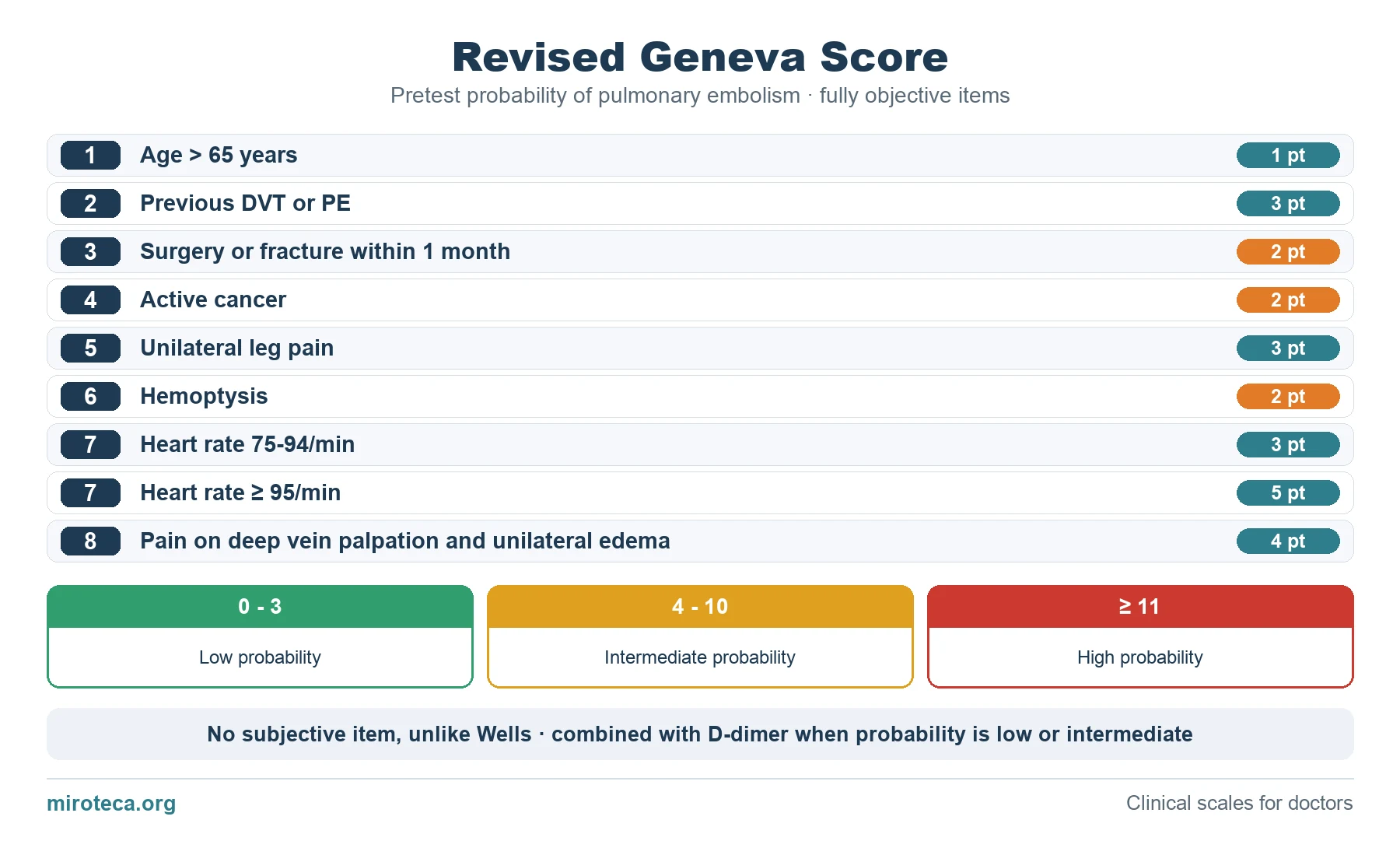
The Revised Geneva score calculates the clinical probability that a patient has a pulmonary embolism (PE). Its great advantage over the Wells score is that it is completely objective: it does not include the subjective judgment of "an alternative diagnosis is less likely".
Points are added for each item present to obtain a low, intermediate or high probability. A 70-year-old patient with active cancer, tachycardia and calf pain is already in the high probability group.
The detail that settles it
The clinical probability, together with the D-dimer, decides whether an imaging test (CT pulmonary angiography) is needed. The score is useful when a reproducible tool free of subjectivity is wanted, and it is always combined with the D-dimer in low and intermediate probability.
Common mistakes
Skipping the D-dimer in low or intermediate probability and ordering the CT directly.
In exam questions
Questions usually ask about the diagnostic algorithm that starts with these scores: if probability is low or intermediate, a D-dimer is ordered; if it is normal, PE is ruled out; if it is raised (or probability is high from the start), CT pulmonary angiography is done. The D-dimer has a high negative predictive value but low specificity (it rises with age, pregnancy, cancer or inflammation), so an age-adjusted cut-off is used. In an unstable patient with suspected massive PE, scales are skipped: imaging or an echocardiogram comes first and thrombolysis is considered.
Keep practicing
This page is the visual summary. To test yourself with real clinical reasoning, Medicinedle, a Wordle-inspired game, gives you one clinical case a day: guess the diagnosis in six tries, with a new clue after every miss. It is free and available in English.