
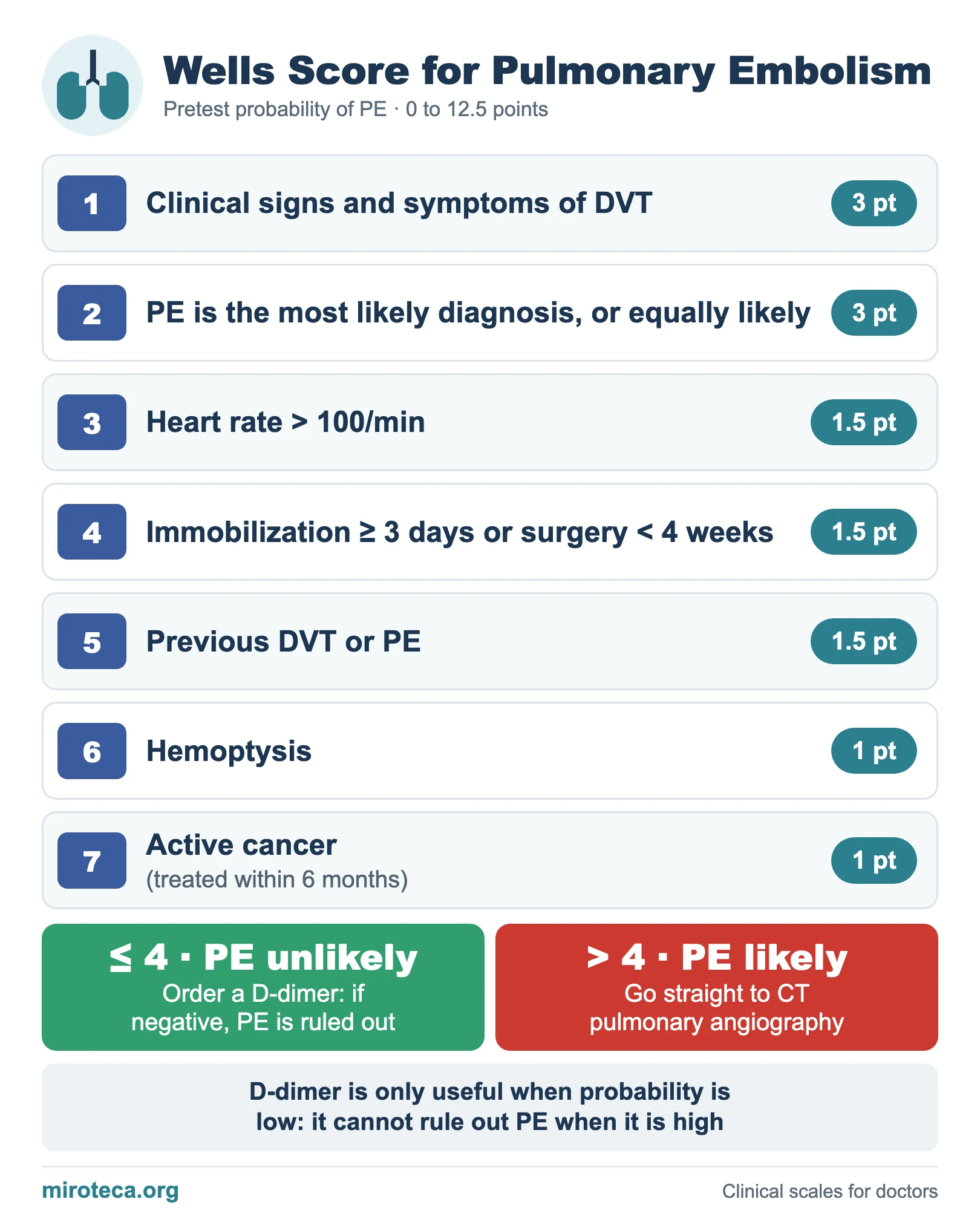
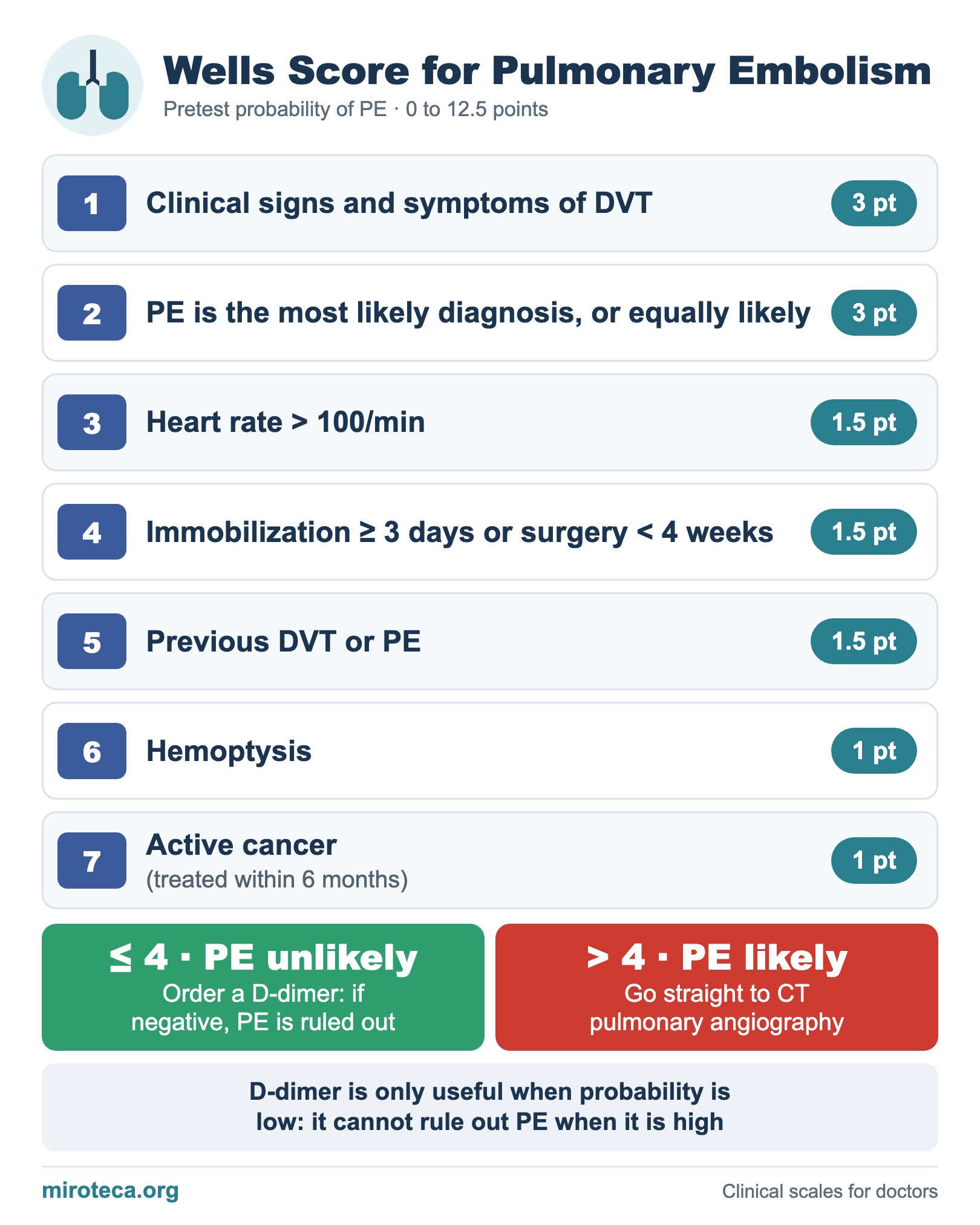
What the diagram shows
The Wells score for PE estimates the clinical probability of pulmonary embolism before ordering tests. It adds seven criteria with different weights, up to 12.5 points.
The dichotomous version splits patients into PE unlikely (4 or less) and PE likely (more than 4). There is also a classic three-level version.
The detail that settles it
The D-dimer is only useful when probability is low: it has a high negative predictive value. With low probability and a negative D-dimer, PE is ruled out without more tests.
With high probability the next step is imaging (CT pulmonary angiography), without relying on the D-dimer.
Common mistakes
The classic error is ordering a D-dimer when probability is high and "ruling out" PE because it comes back low: in that setting the D-dimer is not valid.
Another is mixing it up with the Wells score for DVT, which has different items and points.
In exam questions
Questions usually give a patient with suspected PE and ask for the next step. The answer depends on the pretest probability: D-dimer if unlikely, CT pulmonary angiography if likely.
Keep practicing
This page is the visual summary. To test yourself with real clinical reasoning, Medicinedle, a Wordle-inspired game, gives you one clinical case a day: guess the diagnosis in six tries, with a new clue after every miss. It is free and available in English.