
What the diagram shows
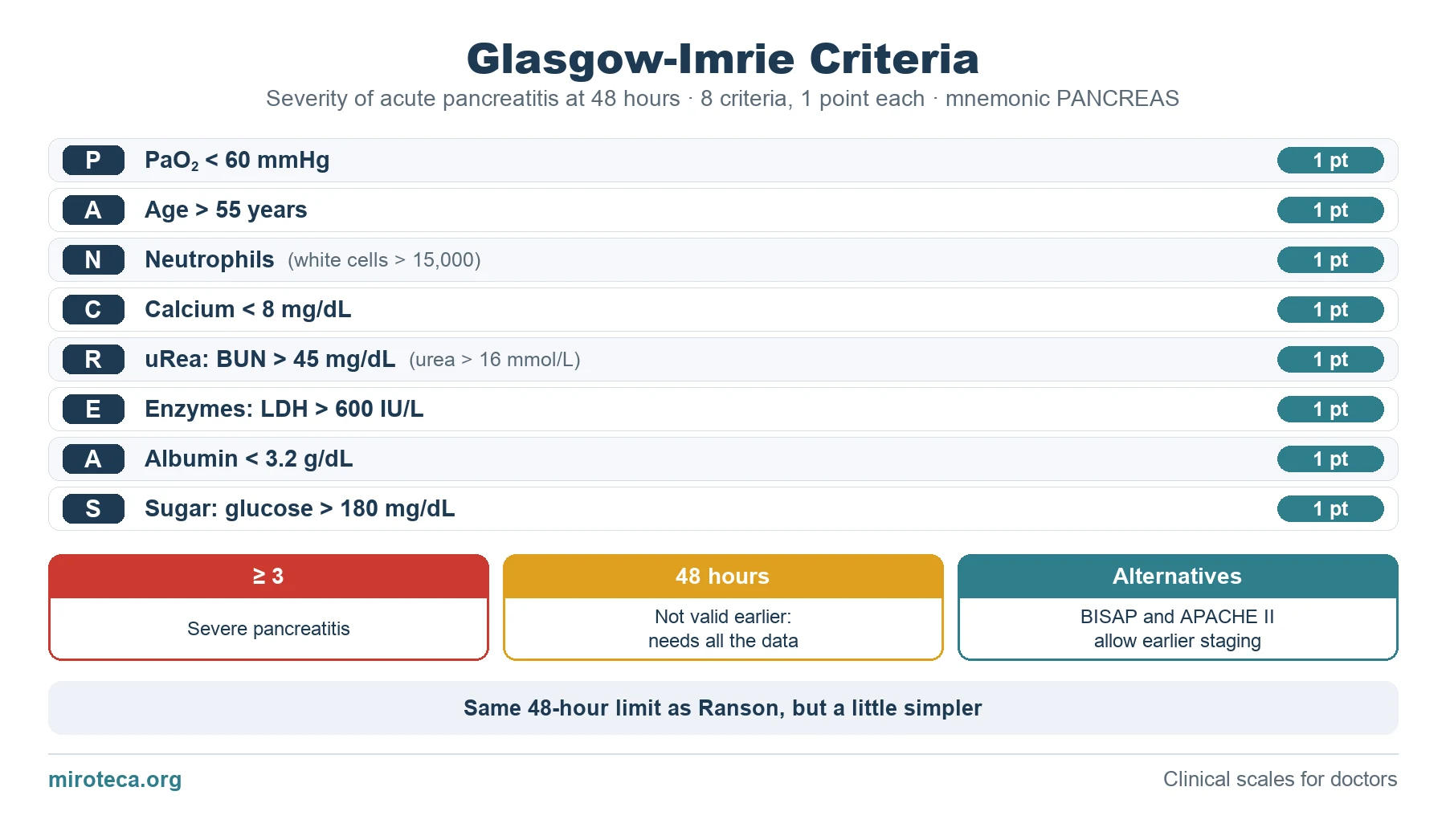
The Glasgow-Imrie criteria estimate the severity of acute pancreatitis 48 hours after admission, using a list of laboratory parameters and age. They are remembered with the mnemonic PANCREAS: PaO₂, Age, Neutrophils, Calcium, uRea, Enzymes, Albumin and Sugar.
One point is added for each criterion, from 0 to 8. The "R" criterion is a urea above 16 mmol/L, which corresponds to a blood urea nitrogen (BUN) above 45 mg/dL; the BUN figure is the one used on this page and in the calculator, with the urea value in mmol/L beside it.
The detail that settles it
A score of 3 or more indicates severe pancreatitis. It is an alternative to the Ranson criteria, also at 48 hours, but somewhat simpler. Like Ranson, it needs 48 hours to be completed, which is a limitation, while the BISAP score and APACHE II allow earlier staging.
Common mistakes
Applying them before 48 hours, when not all the data are available yet.
In exam questions
Questions usually place these criteria among the scales of pancreatitis. Whatever the scale, severity does not change the pillars of treatment: early fluid therapy, analgesia, early enteral nutrition and no prophylactic antibiotics (only when infection is proven). A patient over 55 with leukocytosis, a high LDH and raised glucose at 48 hours already adds several points.
Keep practicing
This page is the visual summary. To test yourself with real clinical reasoning, Medicinedle, a Wordle-inspired game, gives you one clinical case a day: guess the diagnosis in six tries, with a new clue after every miss. It is free and available in English.