
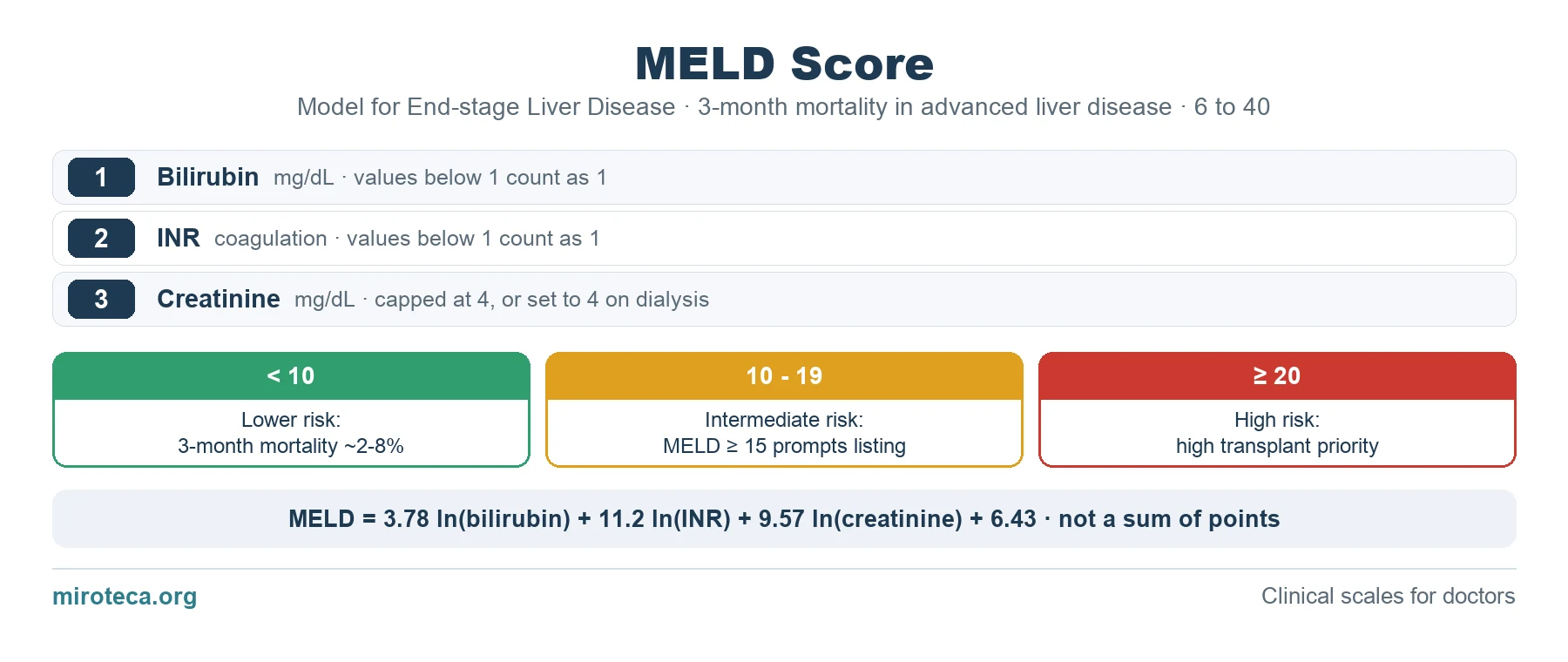
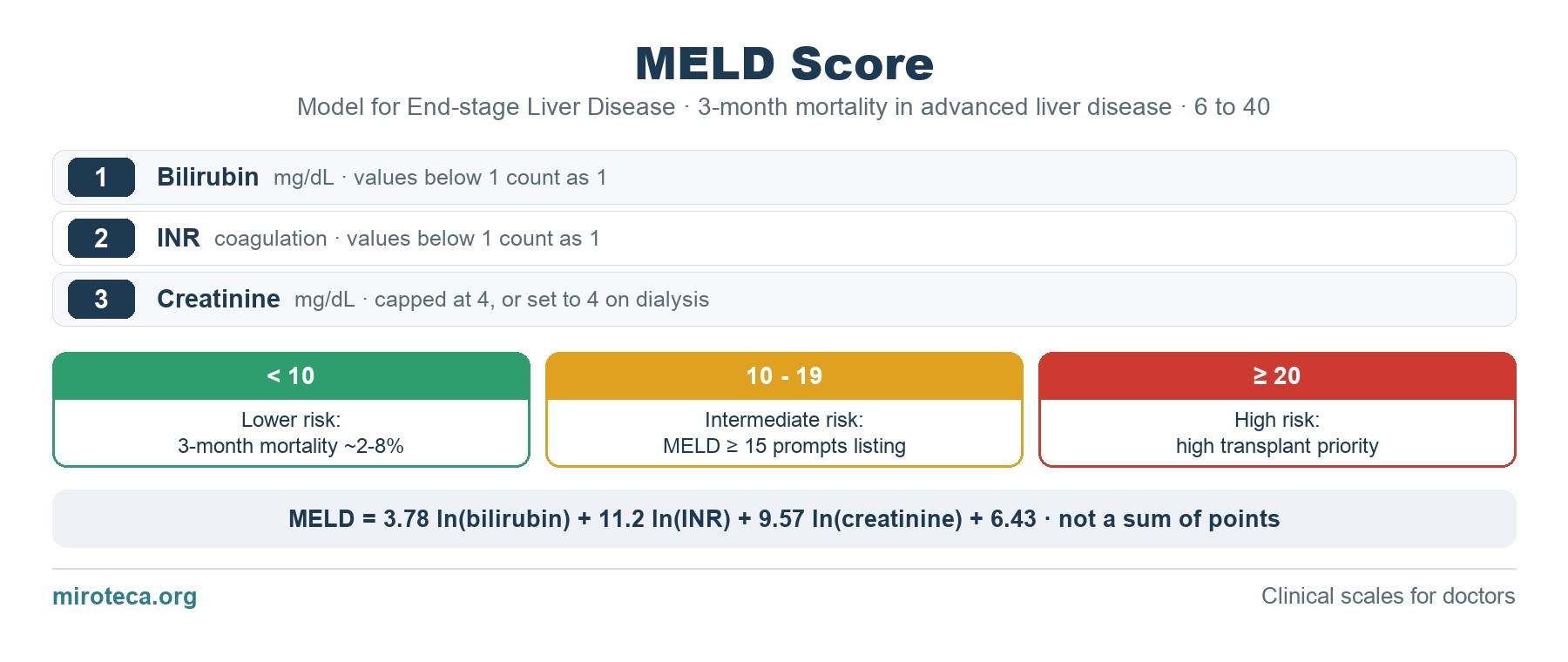
What the diagram shows
The MELD (Model for End-stage Liver Disease) predicts 3-month mortality in advanced liver disease. Its main use is to rank the liver transplant waiting list in an objective way: the higher the MELD, the greater the urgency.
It is calculated from three laboratory values only: bilirubin, INR and creatinine. The chart shows the formula, 3.78 ln(bilirubin) + 11.2 ln(INR) + 9.57 ln(creatinine) + 6.43, so the result is not a sum of points. Values below 1 are rounded up to 1, creatinine is capped at 4 mg/dL (or set to 4 if the patient is on dialysis, two or more sessions in the past week) and the final score is kept between 6 and 40.
The detail that settles it
Unlike the Child-Pugh score, MELD includes no subjective data such as ascites or encephalopathy. That makes it more objective and reproducible, which is why it is the fairer tool for allocating organs. Creatinine carries a lot of weight: a drop in kidney function raises MELD even if the liver has hardly changed.
Versions that add sodium (MELD-Na) refine the prognosis, because hyponatremia also worsens the outlook.
Common mistakes
Thinking that MELD "classifies cirrhosis" like Child-Pugh: what it predicts is short-term mortality. Another frequent slip is forgetting the weight of creatinine, or treating the result as a sum of points.
In exam questions
Questions usually ask why MELD is preferred over Child-Pugh for the transplant list (objective variables) or what its three components are. A patient on the waiting list with high bilirubin, INR and creatinine will have a high MELD and a high priority. A MELD of 15 or more is the usual point at which listing is considered, and below 10 the 3-month mortality is low (about 2 to 8%).
Keep practicing
This page is the visual summary. To test yourself with real clinical reasoning, Medicinedle, a Wordle-inspired game, gives you one clinical case a day: guess the diagnosis in six tries, with a new clue after every miss. It is free and available in English.