
What the diagram shows
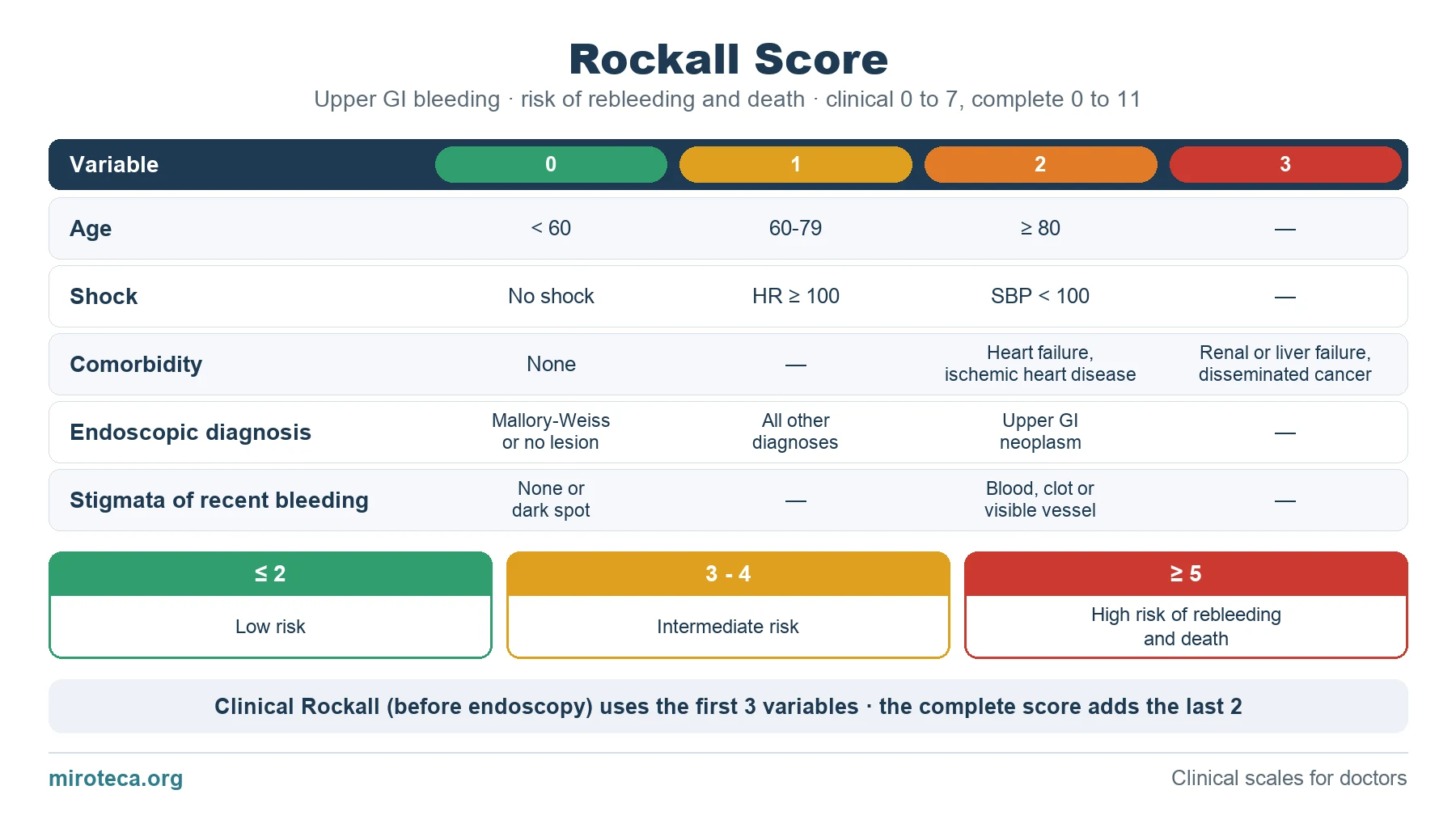
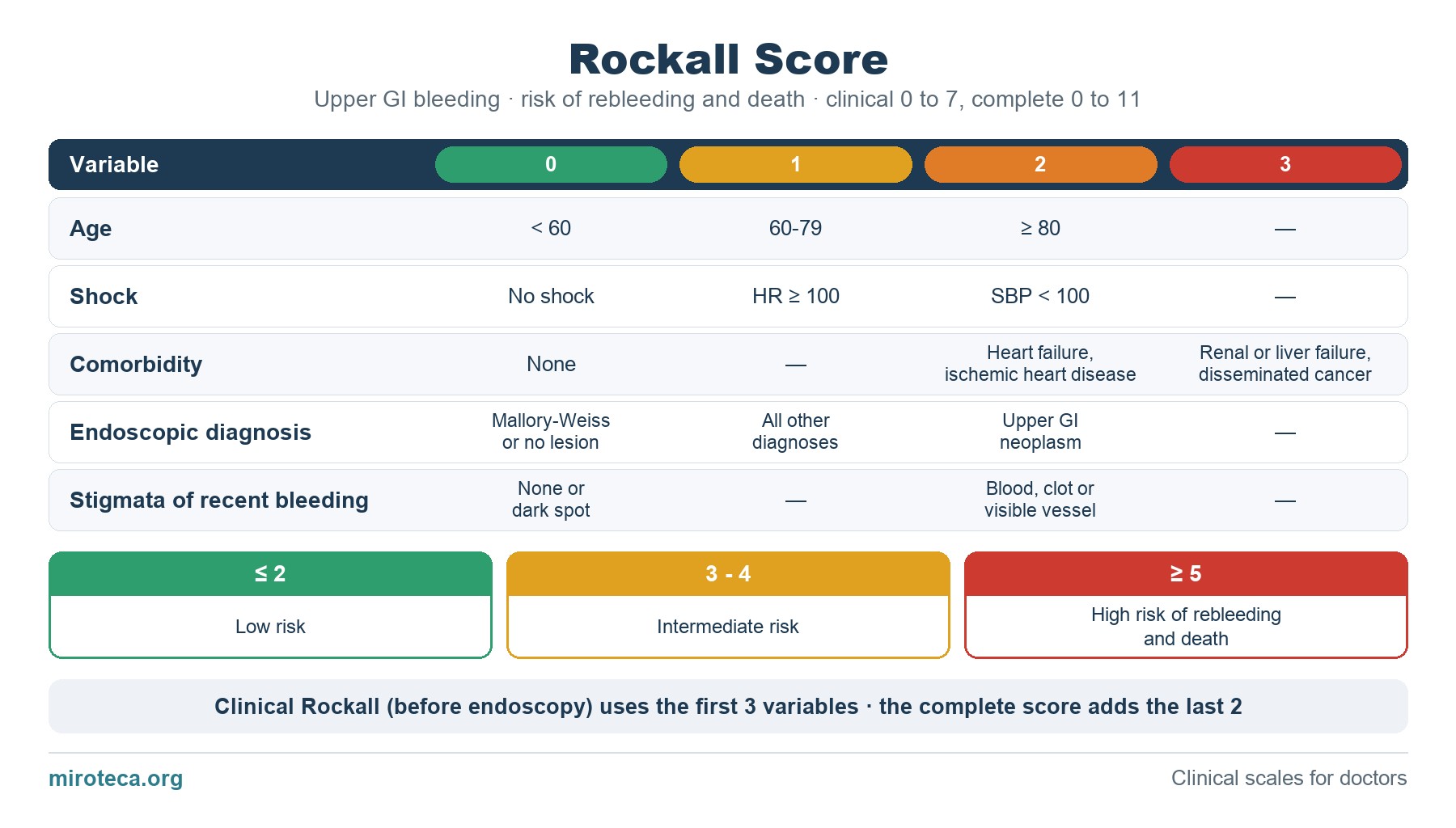
The Rockall score estimates the risk of rebleeding and death in upper gastrointestinal bleeding. It has a clinical part, which can be calculated before endoscopy, and a complete part that adds the endoscopic findings.
The clinical Rockall (0 to 7) uses the first three variables: age, shock (heart rate of 100 or more, or systolic pressure below 100) and comorbidity. The complete Rockall (0 to 11) adds the endoscopic diagnosis and the stigmata of recent bleeding.
The detail that settles it
Low scores (around below 3) mean a low risk of rebleeding and mortality, and the higher the score, the higher the risk. Rockall and the Glasgow-Blatchford score are often used together, since each answers a different question.
Common mistakes
Confusing what each score measures: Rockall estimates the prognosis (rebleeding and death), Blatchford the need for intervention. Another error is mixing the clinical version with the complete one, which needs the endoscopy.
In exam questions
Questions usually place Rockall among the other scores of upper GI bleeding: Glasgow-Blatchford before endoscopy to find very-low-risk patients for outpatient care, Rockall (especially the complete version) for the prognosis once the lesion has been seen, and the Forrest classification for the appearance of the ulcer. The overall management does not change: stabilize, proton pump inhibitor, restrictive transfusion and early endoscopy.
Keep practicing
This page is the visual summary. To test yourself with real clinical reasoning, Medicinedle, a Wordle-inspired game, gives you one clinical case a day: guess the diagnosis in six tries, with a new clue after every miss. It is free and available in English.