
What the chart shows
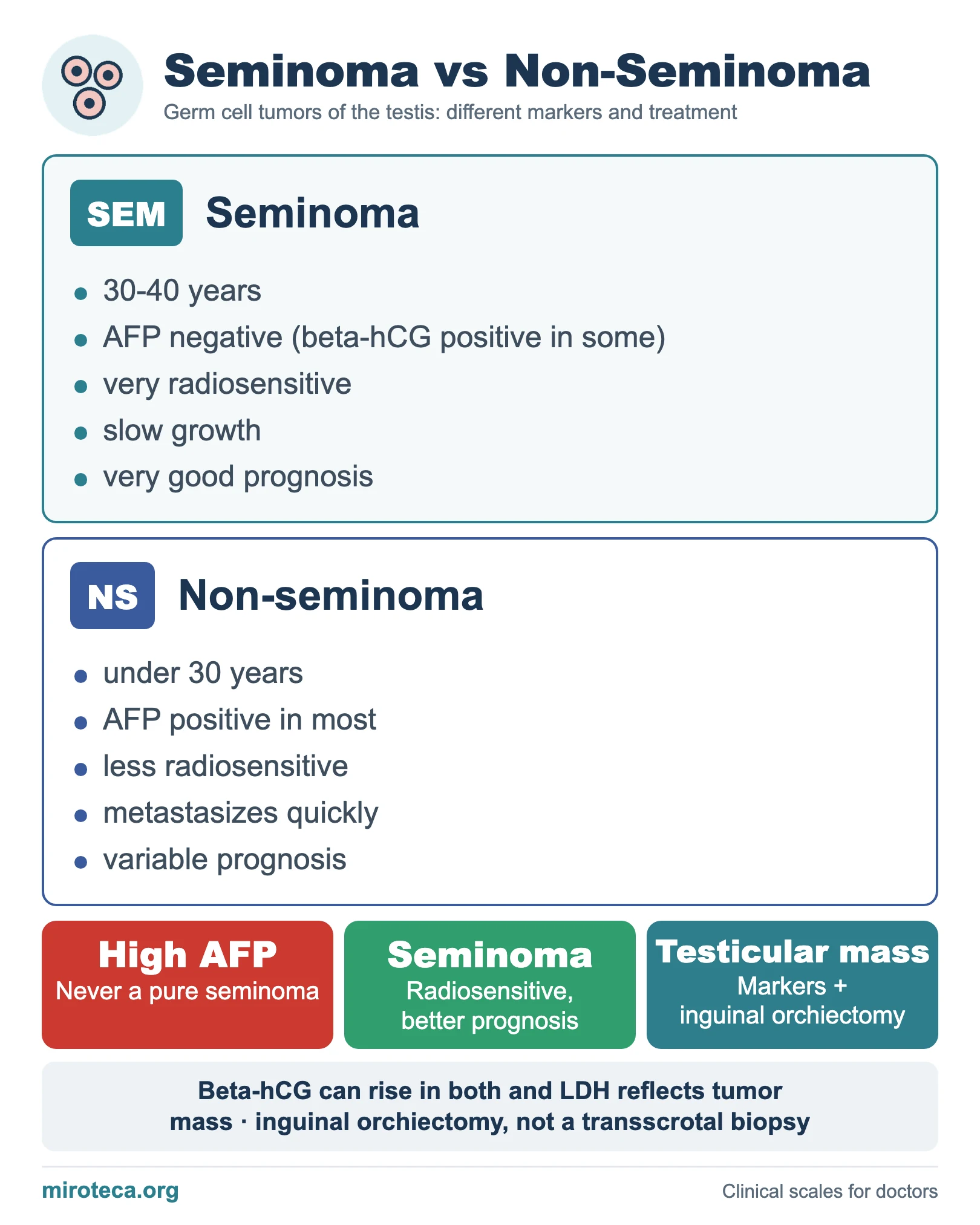
Germ cell tumors of the testis are divided into seminomatous and non-seminomatous, with different markers and treatment. The chart lines up age, markers, radiosensitivity, growth and prognosis.
The detail that settles it
Seminoma is very radiosensitive, grows more slowly and has a better prognosis. The non-seminomatous tumors (embryonal carcinoma, yolk sac tumor, choriocarcinoma, teratoma) are more aggressive. Golden rule: an elevated AFP NEVER corresponds to a pure seminoma (it indicates a non-seminomatous component). Beta-hCG can rise in both and LDH reflects tumor mass.
In exam questions
Short rules: high AFP means it is never a pure seminoma; seminoma is radiosensitive with a better prognosis; for a testicular mass, markers plus inguinal orchiectomy (not a transscrotal biopsy).
Keep practicing
This page is the visual summary. To test yourself with real clinical reasoning, Medicinedle, a Wordle-inspired game, gives you one clinical case a day: guess the diagnosis in six tries, with a new clue after every miss. It is free and available in English.